
Reading the Fantastic Four comics from the start. Except I’m going “bigger picture” this time. I’ve read a lot of Marvel Civil War comics this week, and it’s way too much to summarize in just the trivia section at the end of the post. And quite a lot of it involves Fantastic Four’s peripheral characters. Therefore, let’s get into just how expansive of a narrative Civil War really was.
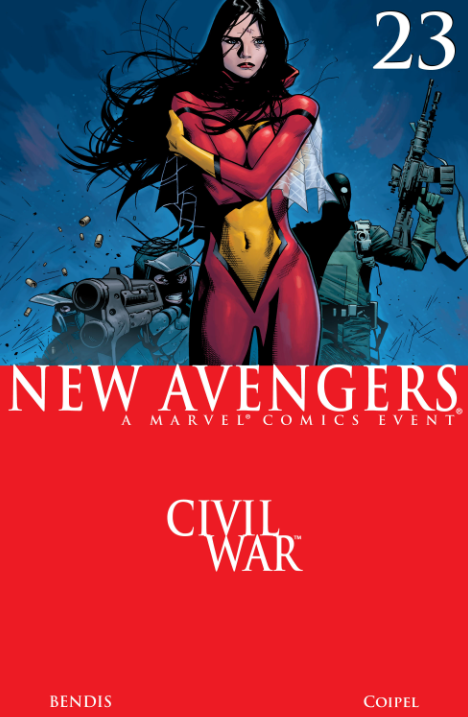
To recap: The New Warriors battled villains in Stamford, Connecticut, resulting in an explosion that killed hundreds. This led to the passing of the superhero registration act, in which all superhumans must register their secret identities with the government. Those who are pro-reg join Iron Man’s side, becoming government agents. Those are anti-reg join Captain America’s side, as fugitives of justice. Spider-Man joined the pro-reg side, and then shocked the world by revealing his secret identity to the public.
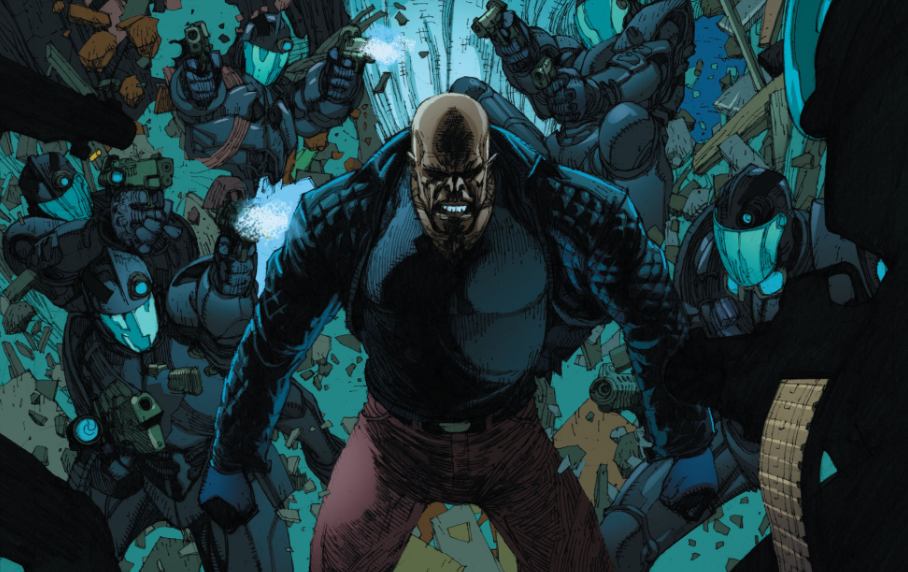
New Avengers #21-24 did a series of solo stories about various members of the team choosing sides. We saw Captain America recruit the Falcon shortly after Cap became a fugitive. Then we got the very dramatic story of Luke Cage (an FF alternate member) standing up to S.H.I.E.L.D. and making the tough choice to leave his wife and baby behind to join Cap’s team.
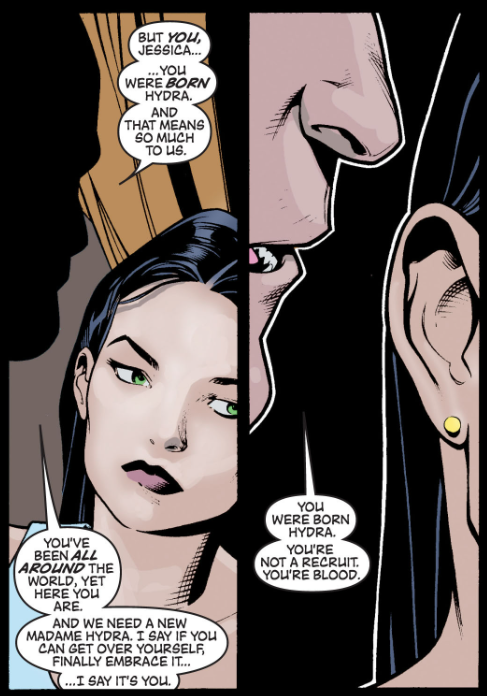
Spider-Woman was caught by S.H.I.E.L.D., and we’re told that she’s the first anti-reg superhero to be arrested. But then Hydra rescues her from S.H.I.E.L.D. in hopes that she’ll be Hydra’s new leader. She refuses, escapes from them, and joins Cap’s team. What makes this interesting is that this isn’t Spider-Woman, but a Skrull secretly plotting an invasion (a Secret Invasion, as it were). Marvel totally knew this at the time, and there a few Skrull-y clues throughout the issue.

The Sentry, anxiety-ridden as usual, fled to the moon once the fighting started in hopes of escaping it all. The Inhumans don’t want him there, though, and they try to fight him. Just when it seems like the all-powerful Sentry will destroy the Inhumans, Crystal (an alternate FF member) approaches him with an invitation from Black Bolt. The Sentry meets with Black Bolt and says he’s not there to fight them. The Inhumans are shocked to learn they all have memories about the Sentry that have been wiped from them, and they refuse to have the Civil War and other superhero crises find their way to Attilan.

Then Crystal reveals that she and the Sentry once had a romantic fling, after she broke up with Johnny but before her relationship with Quicksilver. They share a passionate kiss, but Sentry breaks it off. He says, “I’m married,” only for her to respond, “But only on Earth, right?” Iron Man then shows up to recruit the Sentry, causing more tension between him and the Inhumans. Sentry agrees to join Iron Man’s team. Medusa (an alternate FF member) muses that the superheroes of Earth have no idea what’s in store for them after the Civil War ends.

In She-Hulk #8-9, there’s only two Civil War tie-in issues rather than a whole trade, but a lot happens. Still working as a superhero-themed attorney, She-Hulk is tasked with protecting two former New Warriors, Justice and Rage, who are getting blamed for the Stamford incident that started the Civil War. She-Hulk is pro-reg, having to defend two heroes who are anti-reg. She argues that registration shouldn’t mean making their identities public, just as a blogger threatens to expose their identities online. She-Hulk and even more former New Warriors track down and stop the blogger.
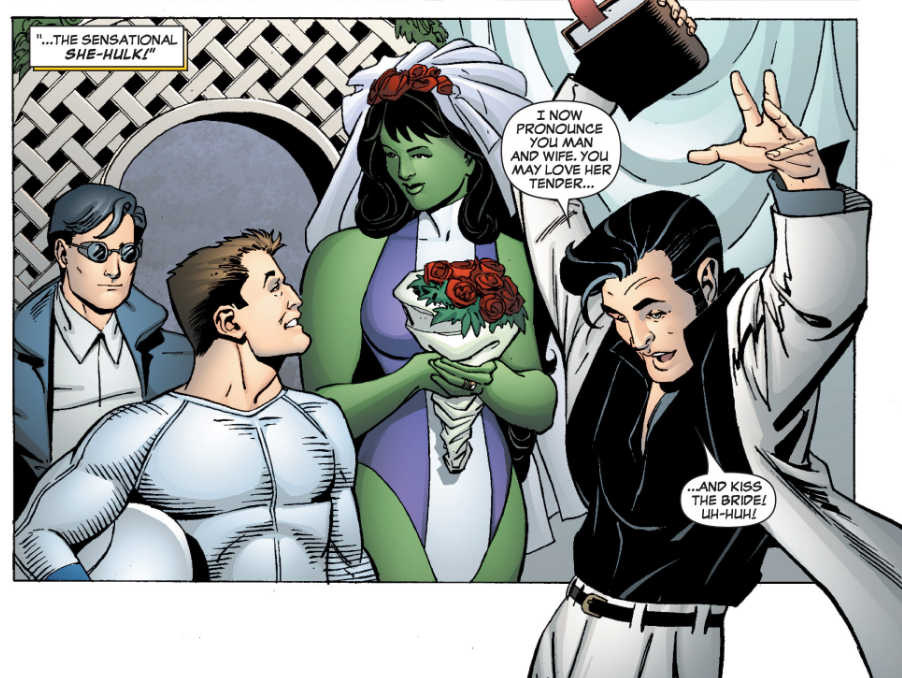
Meanwhile, She-Hulk’s current boyfriend John Jameson, astronaut and test pilot, is approached by Captain America. Cap wants John to convince She-Hulk to switch sides. John instead shows his loyalty to She-Hulk by proposing to her! Amusingly, J. Jonah Jameson learns about the engagement mere minutes after learning about Spider-Man’s secret identity! Poor Jonah’s had a rough day. She-Hulk and John are married in a quickie ceremony in Vegas. After that, the She-Hulk series drifts away from Civil War into more drama about her and John.

While the many mutant characters were side-players in Civil War #8-9, there were nonetheless interesting things happening in the X-books. In X-Factor, the titular team came out as anti-reg, promising sanctuary in NYC’s “Mutant Town” neighborhood (where is this?) for any mutants hoping to escape registration. In Cable and Deadpool #30-32, Deadpool joins the pro-reg side, only for lucrative bounty hunter gigs hunting down other superheroes. This puts him in conflict with his frenemy Cable, who’s on Cap’s team.

Cable teleports them both to the White House (!) where Cable tells the US president that he’s not opposed to registration per se, but to the Fifty States Initiative, which he says will turn the US into a totalitarian police state. He and Deadpool fight in the Oval Office and then on the White House lawn. Cable succeeds in discrediting Deadpool’s bounty hunter gig, which Deadpool suspects was Cable’s plan all along, and the entire world sees the White House trashed in another Civil War superhero fight.
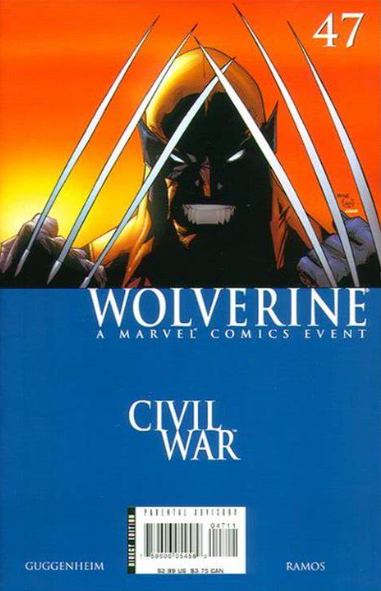
In the Wolverine solo series, issues 42-48, his status as a New Avenger makes him pro-reg, but he doesn’t dwell on that much. Instead, he learns that Nitro is still alive. You’ll remember Nitro is the explosive villain whose nuclear powers were behind the Stamford explosion, after the New Warriors attacked him. Wolverine goes searching for Nitro, eventually learning that Nitro had been given mutant growth hormone (!) at the time, which greatly enhanced his power.

Wolvie then learns the drug came from Damage Control, who’s gone from comedic fourth-wall breaking characters to evil drug profiteers. By giving the drug to mutants, they create more destruction in superhero fights, and that means more profit when Damage Control cleans up after the battle. Wolverine confronts Damage Control’s leader, Roger Declun, and kills him after a huge fight. Brutal! Nitro, meanwhile, is apprehended by Namor and imprisoned by the Atlanteans for the crime of murdering Namorita, who was among the New Warriors at Stamford.
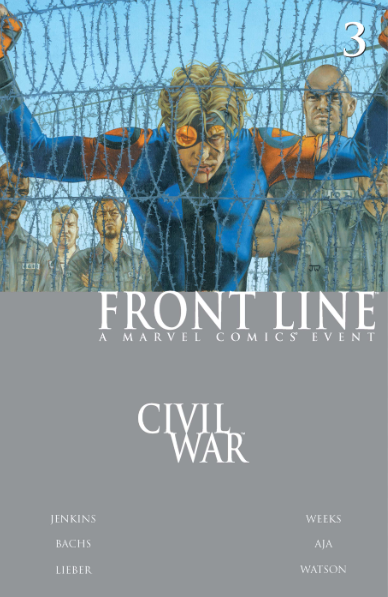
Frontline #2-3, meanwhile, remains essential reading for anyone wanting to follow Civil War. Most of the narrative is about Speedball, the only New Warrior to survive Stamford. He’s arrested and having a tough time. She-Hulk is his attorney, yet she doesn’t mention her defending the other former New Warriors (she keeps a tight lock on lawyer-client confidentiality, it seems). Despite already being arrested and imprisoned, Speedball refuses to register.
Also, in Frontline, we get an extended version of Spider-Man’s press conference, with him fielding humorous questions from reporters. He’s then asked about Norman Osbourne, and he dismissively says Norman is just another criminal, nothing more. This angers Norman, who’s watching on TV. Meanwhile, Iron Man battles B-lister Prodigy. It’s a fight that’d normally be over in seconds, but they duke it out with such ferocity that it wrecks a building and injures several civilians. This shows the severity of the conflict.
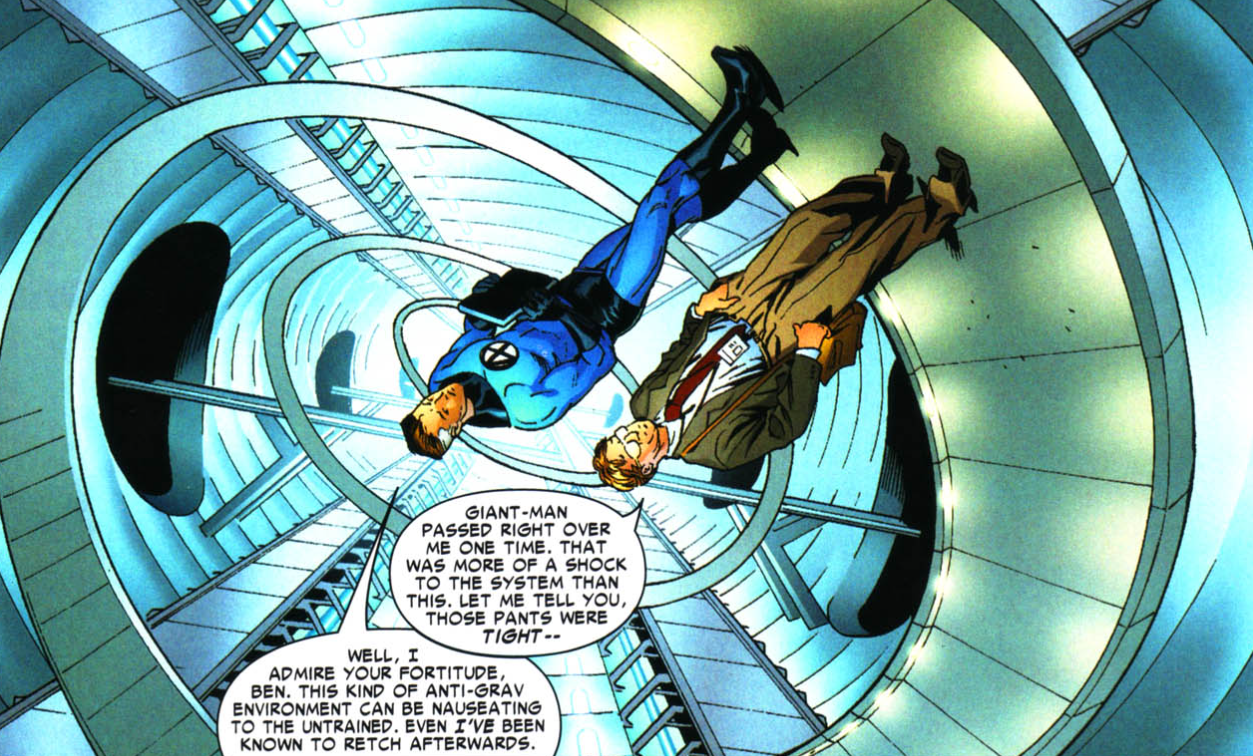
Then we finally circle back to Fantastic Four, where reporter Ben Urich interviews Reed Richards, with more references to a confidential project he and Iron Man are working on. Reed shows Urich the same mathematical projection he showed Sue in Civil War #2, showing that superhero conflicts will continue in extremity unless something is done now. Urich compares this to baseball stats, saying one team might have higher numbers, but another might still dominate a game. He says, “It’s absurd to think you can measure public sentiment, and then pretend numbers don’t lie.”
This leads right into the next issue of Fantastic Four, which we’ll get to next time.
Unstable molecule: Reed and Ben Urich walk down some gravity-warped hallway inside the New Baxter Building, allowing them to walk on the ceiling. I have no idea why this is there, except for Reed to show off to visitors.
Clobberin’ time: One of the Wolverine issues retells the meeting at the Baxter Building from Civil War #1, including the Thing calling Wolverine “Stumpy.” Luke Cage gets in on the act, also calling him “Stumpy.”
Flame on: These issues have occasional references to Johnny being in the coma.
Fantastic fifth wheel: How does Crystal remember her romance with Sentry? An Inhuman telepath named Thyta restores her memory, alone with all the others. This is the only appearance of Thyta. You’d think that if the Inhumans had a telepath, they’d use her more often.
In addition to everything else happening in the She-Hulk issues, there’s also some business about Dr. Strange undoing the spell that protects her secret identity. This was the only way for her to be able to transform from human to She-Hulk and back again without needing special gamma-related gadgets.
Luke Cage’s escape from the S.H.I.E.L.D. agents is broadcast on TV, with a reporter saying the Avengers are now split down the middle.
Four and a half: When Urich asks Reed about baseball, Reed says it’s Franklin’s favorite sport.
Fantastic or frightful? This was a lot to absorb. Overall, the Frontline, Wolverine, and New Avengers issues are quite good. She-Hulk had a huge supporting cast with a lot of subplots at the time, and that might be confusing to readers who hadn’t been with the series from the start. X-Factor was also confusing, with a lot of weirdness about Jamie Madrox’s many duplicates – although perhaps that’s by design. Cable and Deadpool contains a major Civil War incident, but for some reason doesn’t get mentioned as much throughout the event. These comics contain a lot of what was controversial about Civil War, and yet I’m impressed with how this one event so thoroughly took over all of Marvel like it did.
Next: Splitsville.

* * * *
Want more? Check out my new ongoing serial, THE SUBTERKNIGHTS, on Kindle Vella. A man searches for his missing sister in a sprawling city full of far-out tech and secret magic. It’s a sci-fi/fantasy hybrid full of action, romance, mystery, and laughs. The first three chapters are FREE! Click here for a list of all my books and serials.


 macmcentire