
Re-reading Shakespeare’s The Winter’s Tale! In Act 3 Scene 1, and we’re all about the Oracle of Delphi. Who was that, again?
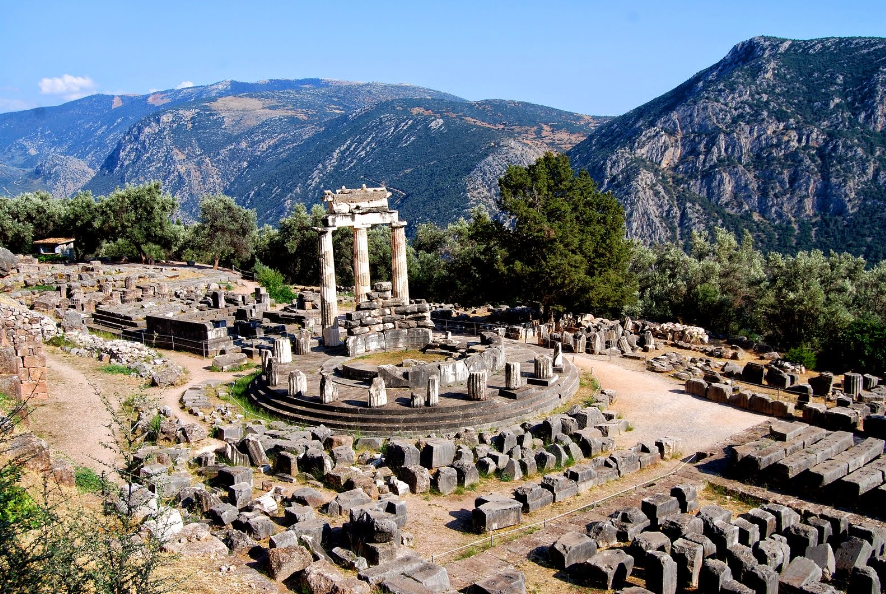
In previous scenes, King Leontes sent two men, Cleomenes and Dion, to visit the Oracle of Delphi and ask about Queen Hermoine’s true intentions. In this scene, the two guys get their moment. They reminisce about their experience of visiting Delphi and seeing the oracle in person. They describe the idyllic island, and the fine dress of the oracle’s attendants, called “grave wearers.” They describe the oracle as having an “ear-deafening” voice, comparing it to the thunder of the gods. Then they say how hopeful they are that this information can help the queen, and they go on their way. Short scene.
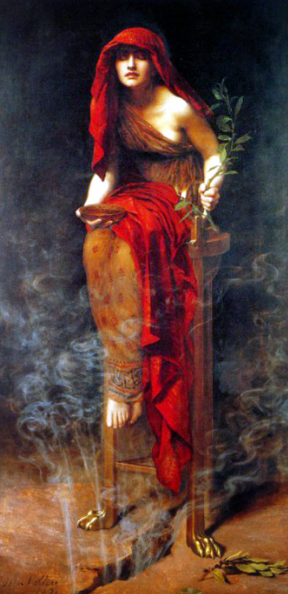
Why are we only hearing about meeting the oracle after the fact and not seeing it played out on stage? This could have been a big, show-offy scene like the “boil and trouble” scene with the witches from the Scottish Play, or the scene with Margery Jourdain and the spirit from Henry VI Part II. Perhaps there was a desire to keep the story moving, as the dramatics between Leontes and Hermoine are more important. Or it could be a question of resources, with space concerns or a limited number of actors. We can only speculate.

Just who is this oracle, anyway? There is so much online about the Oracle of Delphi, also known as Pythia, that it’s overwhelming. I could spend year or more reading all this stuff. Also, the overlap of myth, classic literature, and actual history has a huge overlap, so I’m finding it difficult to sort out what’s real and what isn’t. The gist of it is that visitors, many of whom were powerful and important, traveled to the temple of Apollo in Delphi to ask advice from Pythia, who answered in future-telling prophecy.
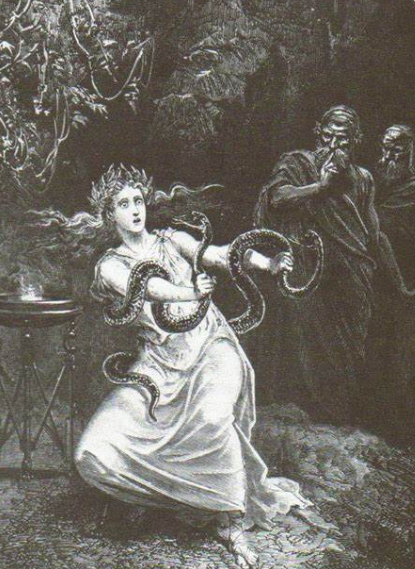
By most accounts, there was more than one oracle over the years, each one taking the name Pythia upon getting the job. Apparently, there are some early stories where Pythia is a male goat-herder (!) wandering about the fields. But for the most part, Pythia is described as a virginal young woman. This version of Pythia is described as sitting on a high chair, sometimes strapped or even chained to the chair, as magical mists or clouds surround them, giving her the gift of prophecy.

If the trope of the ambiguous prophecy did not originate with Pythia, she certainly helped popularize it. One story I’ve seen repeated many times is the Emperor Croesus asking Pythia for guidance. She told him if he marched his armies into Persia, it would be the downfall of a great nation. Croesus attacked Persia, believing victory was his, only for the great nation to be his own.

These are cool stories, but how much of this is real? A common explanation is that these girls were exposed to natural gases on the island of Delphi, such as methane or ethylene, which put them into a hallucinogenic state, after which their visions would be interpreted as prophecy. Others speculate that the girls were given hallucinogenic plants that grow on the island, for similar effect. These stories, however, have been disputed by a huge number of historians and archeologists. The debates are endless.
Who were these girls who served as Pythia? One article I read suggests they were daughters of nearby villagers given to the temple as tribute. But who were her handlers, the ones responsible for interpreting her prophecies? This would seem to be something of an unknown, at least based on my reading over the past week. It just goes to show that the study of history is not complete, and there’s still a lot of unknowns out there just waiting to be discovered.
Next: Trial and error.
* * * *
Want more? Check out my ongoing serial, THE SUBTERKNIGHTS, on Kindle Vella. A man searches for his missing sister in a sprawling city full of far-out tech, strange creatures, and secret magic. It’s a sci-fi/fantasy hybrid full of action, romance, mystery, and laughs. The first ten episodes are FREE! Click here for a list of all my books and serials.



 macmcentire