
Re-reading Shakespeare’s The Winter’s Tale! As the epic act 4 scene 4 continues, Perdita continues to show us what she’s made of.

We just got to know young lovers Perdita and Florizell, and now they’re joined on stage by a whole crowd of other characters. This includes the shepherd, who is Perdita’s adopted father. He gives a fun speech filled with fun wordplay about how his departed wife (Perdita’s adopted mother?) was a great hostess at events like this, and how she should be less of a guest and more a hostess to the others. Among the guests are the king, Polixenes, and former Sicilian lord Camillo, both in disguise. Also here are Mopsa and Dorcas, two shepherdesses.
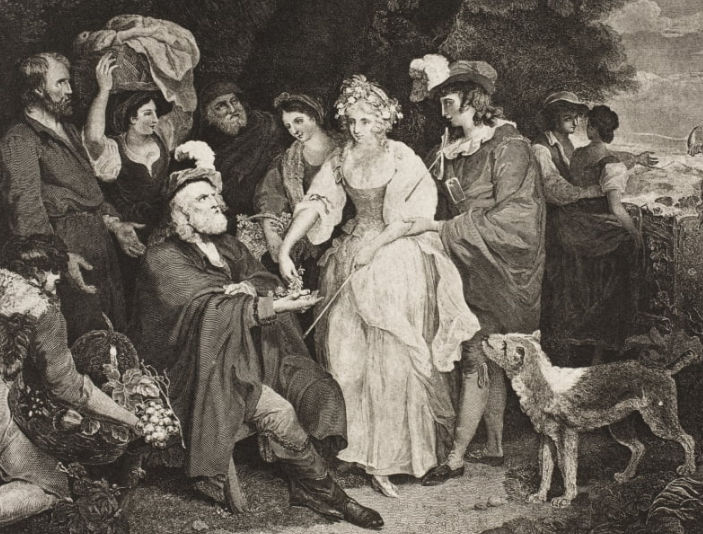
Perdita offers Polixenes and Camillo flowers, specifically rosemary. She says the flowers will keep all winter long (what with this being The Winter’s Tale and all) and that it will bring “grace and remembrance” to them. Of course, this reminds us all of a similar line from Hamlet, when Ophelia, in her madness, hands out flowers to everyone, also saying it is for remembrance. Ophelia’s rosemary is a portent of doom, while Perdita’s is more welcoming. Google informs me that rosemary can also symbolize love and fertility, which follows the play’s winter-becomes-spring imagery.

Perdita and Polixenes then settle down for a lengthy back-and-forth about flowers and gardening, and how growing colorful flowers is a human art. (I see that there are almost 200 references to flowers in Shakespeare’s work. He must’ve been an amateur botanist.)

Polixenes ponders taking a small twig and grafting it onto a larger piece of bark. They two grow together into something even more sophisticated, he says. He uses the word “Marry” in this context, so we know this is about more than horticulture. Then the marriage/fertility talk becomes more text than context as Polixenes encourages her to grow a garden of gillyflowers and that they not be “bastards.”

Perdita has an odd line about not painting her face, so that others are only attracted to her via artificial beauty. She compares this to the authenticity of the flowers she grows in her garden. She next offers him marigold, which she described as opening and closing its pedals in accordance with the sun’s rising and setting, while weeping with morning dew. She says it’s a flower for middle summer, and that he’s “middle aged.” I’m unclear on what middle aged meant in Shakespeare’s day, but that line probably gets a big laugh with today’s audiences.
Polixnes compliments Perdita’s beauty, saying that if he were one of her sheep, he’d get by with gazing instead of grazing. She doesn’t take this, and shoots back that if he did that, he’d become so lean (or thin), that the winds of January would blow right through him.

Okay, why are we putting up with all this talk about flowers? I imagine some of you are hoping the bear would come back at this point. Remember that Polixenes, in his disguise, knows that Perdita is the farm girl his son has fallen for, so this is his way of testing her out, to see what she’s made of. The actor playing Polixenes can really play this up with maximum duplicity, for comedic tension or just plain tension. Perdita, meanwhile, is able to match wits with him without trying, just by being herself.

Next: I’m your Venus, I’m your fire, what’s your desire?
* * * *
Want more? Check out my ongoing serial, THE SUBTERKNIGHTS, on Kindle Vella. A man searches for his missing sister in a sprawling city full of far-out tech, strange creatures, and secret magic. It’s a sci-fi/fantasy hybrid full of action, romance, mystery, and laughs. The first ten episodes are FREE! Click here for a list of all my books and serials.



 macmcentire