
Re-reading Shakespeare’s The Winter’s Tale! The super-long act 4, scene 4 comes to a close with more comedy antics from our favorite comedy character.

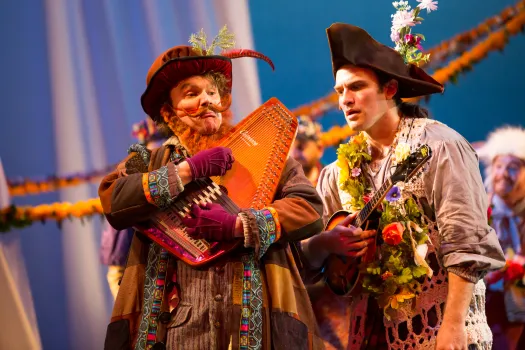
After Perdita and Florizell agree to return to Sicilia with Camillo, they exit. Autolycus (the king of thieves!) takes center stage and reveals he was eavesdropping. He boasts that as a proper thief, he sees and hears everything. He says there could be some “boot” in this conversation, which my books’ footnotes tell me means treasure. He says this is a good time to be unjust, and that he’s not going to tell the king what he’s seen, preferring instead to be a knave. He’s then joined by the shepherd and the shepherd’s son (or “the clown” in some editions). They further discuss what’s happened. It’s interesting that their attitudes toward Perdita have changed. Instead of praising her as the most beautiful girl in the village, they’re calling her a “changeling” and describing her as Florizell’s “clog.”
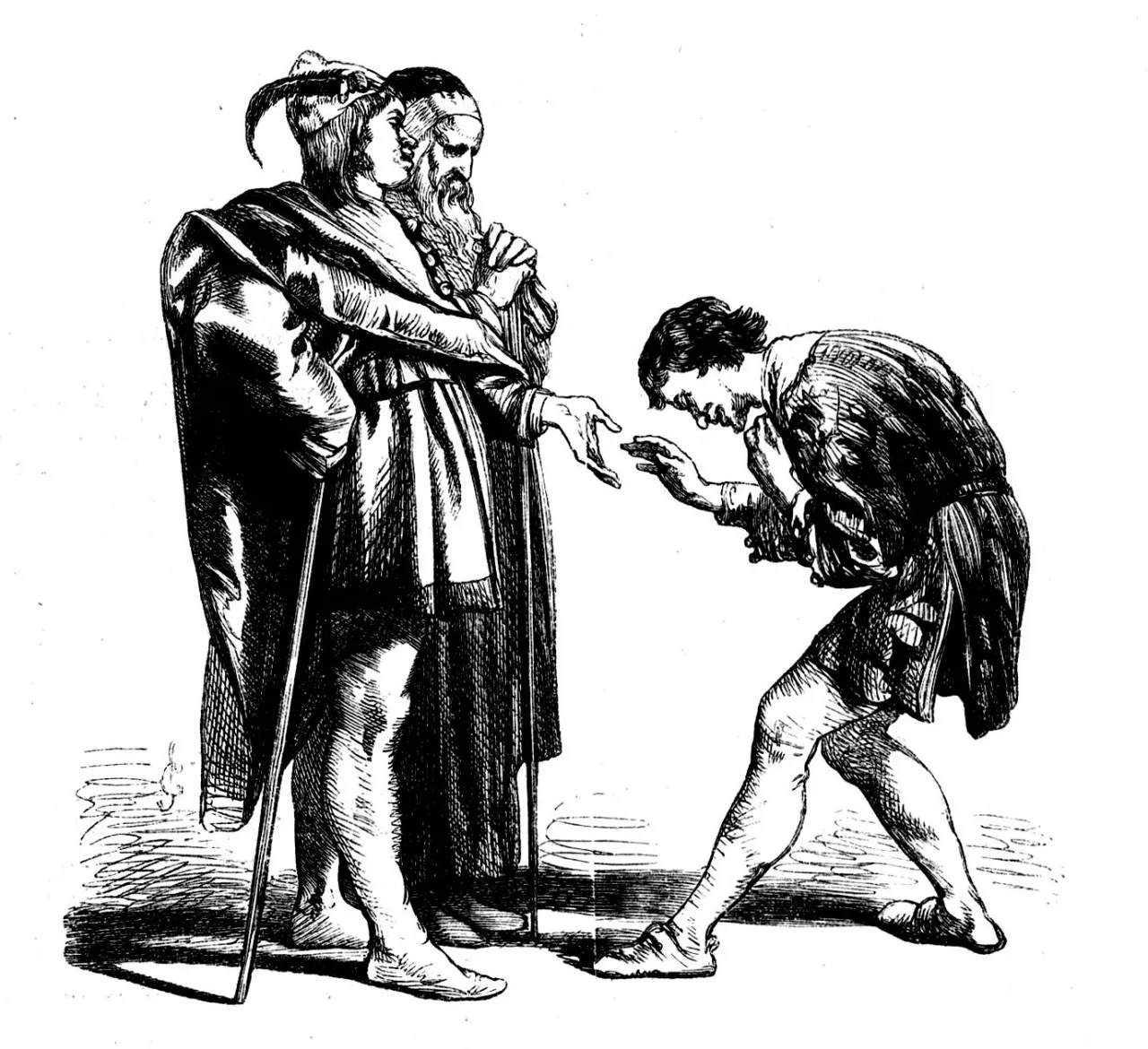
The shepherd is concerned about his social standing with Polixenes the king, because his daughter just ran off with the king’s rejected son. The shepherd’s son it’s time to reveal that Perdita is the shepherd’s adopted daughter, and he encourages the shepherd to gather the secret items he found on the day he found Perdita. This is followed by jokes about the shepherd considering himself as the king’s new brother-in-law.

Autolycus removes his fake beard, revealing himself as the man the shepherd’s son met earlier. Despite an aside about how sometimes even he is honest, he puts on a high-minded way of speaking that is so highbrow it comes off like Dr. Suess-style gibberish. And I mean that in a good way, in how that’s the joke – it’s what Shakespeare intended. The “jokes” are about lying versus truth, and sorting out what it means to be a courtier. The real humor of the scene is not so much in what Autolycus is saying, but in the other two guys’ befuddled reactions to him.

The shepherd produces a “fardel,” which is a bundle of rags like a hobo’s bindle, inside of which contains the letter and gold he found the day he found Perdita. Autolycus plays on the Shepherd’s fears, describing all the tortures that the shepherd might endure. He then has a similar list for the shepherd’s son, more or less confirming that the “clown” is indeed the shepherd’s son and not some random villager. Autolycus’ rants during this part are very funny, reminding me of the Brave Sir Robin song from Monty Python and the Holy Grail.

We learn that Polixenes has already departed for Sicilia in pursuit of Florizell. The shepherd offers Autolycus half of the gold if Autolycus can get them to Polixenes’ ship. They leave, and Autolycus has an aside where he says he intends to get the two of them before the king, for his own benefit as well as everyone else’s. At least I think that’s what he’s saying. This aside is difficult to parse, as he’s such a trickster. Even when speaking openly direct to the audience, he’s still all about plots and schemes. We’ll see how things play out from his perspective as the play heads towards its climax.
Next: The tide turns.
* * * *
Want more? Check out my novel MOM, I’M BULLETPROOF. It’s a comedic/romantic/dramatic superhero epic! https://www.amazon.com/dp/B08XPXBK14.



 macmcentire