Fantastic Friday: No day at the beach

Reading the Fantastic Four comics from the start. After several issues teasing the concept of Dr. Doom’s master, we finally get to meet the guy in issue #566.

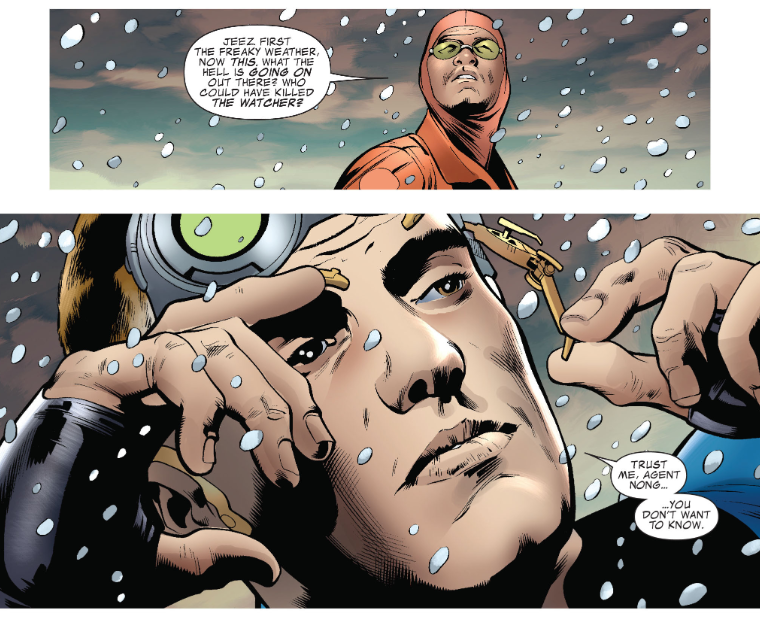
We begin on a beach in Thailand, where Reed asks a local, “Who found the body?” Turn the page and the Watcher is lying dead on the sand, his chest and guts ripped open for some spectacular gore. Reed assures the local authority, Agent Nong, that this is indeed the Watcher. As for who or what killed him, Reed answers, “You don’t want to know.”

Cut to Latveria, where all the people have come out in a massive celebration as Dr. Doom returns to the throne. (The last time we saw Doom in Fantastic Four, he was imprisoned in the Hague. To find out how he got Latveria back, you had to read about the deal he made with Norman Osborn in Dark Reign.) There’s a reference to weather all over the Earth being screwy, and Doom says this is a sign that his master is approaching and will arrive within hours. A little girl attending to Doom asks him what he learned from his master. Doom responds, “Everything.”

In New York, we catch up to Jason, the ex-boyfriend of Ben’s fiancé Debbie Green. He’s written a book about how she dumped him for Ben, although the interviewer calls him out on this, saying Debbie broke up with him six months before she met Ben. Ben himself smashes his way into the studio and threatens Jason. Debbie is also there, and she gets Ben to stop. She reminds him that Jason is not a supervillain, but an ordinary man. She says, “You’re scaring the hell out of me,” and she tells him to go home and “act like a normal person.” This is all captured on live TV.

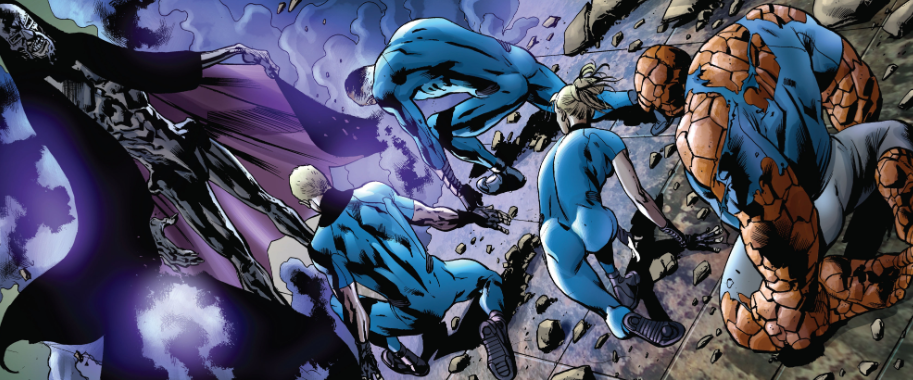
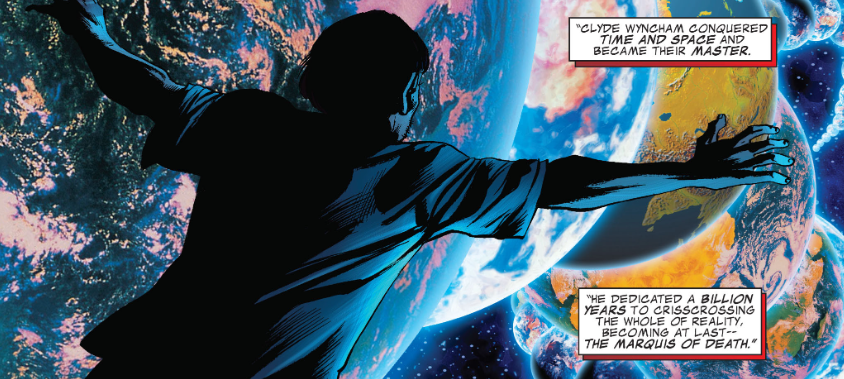
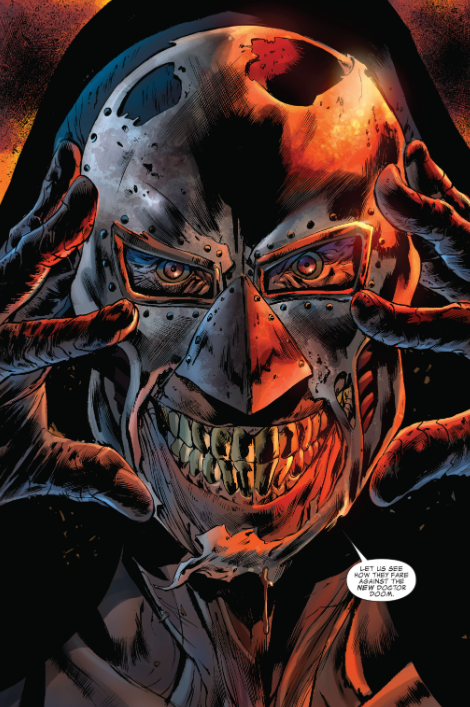
Sue joins Reed at the Baxter Building as he performs an autopsy on the Watcher. He goes back on what he said earlier, in that this is not Uatu, the Earth’s Watcher, but an Uatu from a parallel dimension. Sue concludes that this had to do with Doom’s recent threats that something huge is on its way. They speculate on who Doom’s teacher might have been, and that this dead Watcher might have seen something he shouldn’t have. In Latveria, there’s more celebrating in the streets as Doom’s master is about to arrive. He warns his attainers to shield their eyes, and he welcomes “the Marquis of Death and the new apprentice.” And here they are:

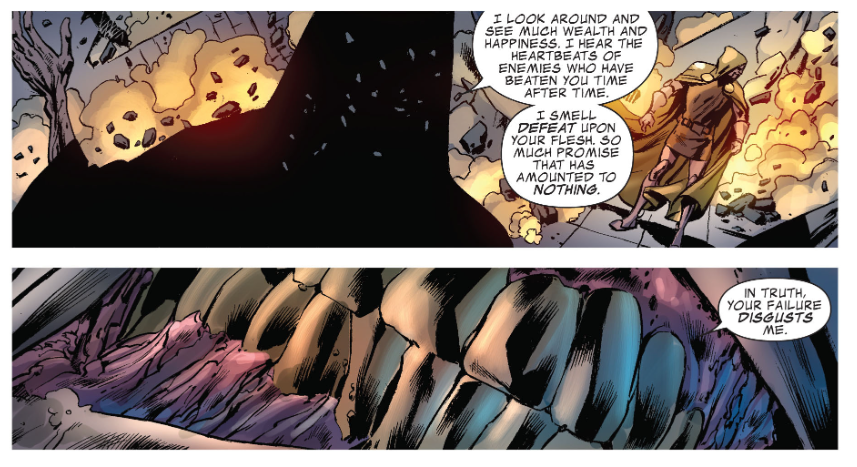
The Marquis tells Doom to ask his question. Doom doesn’t know what question that is, and Marquis says the question is whether he’s happy with Doom’s progress at becoming the greatest villain who ever lived. The Marquis says the answer is “No,” and causes explosions to happen all around. The Marquis says he can hear and smell all the times Doom has been defeated by his enemies. He concludes, “Your foes deserve a new menace, Victor.”

Turn the page, and there’s Dr. Doom being engulfed in flame.

To be continued!

Unstable molecule: Reed examines the dead Watcher while wearing some glowing green goggles. No idea what these are or how they’re helping him.

Fade out: Sue plays the role of co-scientist as Reed autopsies the Watcher. She’s shown carrying a bunch of papers, suggesting she’s been out researching.

Clobberin’ time: How far would Ben have gone in his threats against Jason? The comic would have us believe Ben is so pushed to the edge that he would have hurt or even killed the guy.

Flame on: Johnny appears in only panel of this issue, flying over the ocean. Sue later tells Reed he was in England (why?) and will arrive to help with the Watcher situation in about 90 minutes.

Trivia time: There’s some question as to whether the reporter Alex in this issue is the same reporter named Alex who appeared in Captain Marvel #55. That Alex was a blonde male based in Denver and the one in FF appears to be a blonde female (we only see the back of her head) and is based in New York. Maybe they’re the same character, but it’s unlikely.

This is the only appearance of Agent Nong, and his one-sentence entry in the Marvel Wiki doesn’t state who he works for, whether he’s a local, or with something like S.H.I.E.L.D., or part of Reed’s rarely-seen science staff.  

Fantastic or frightful? Here’s where we start to see some of Mark Millar’s so-called “edgelord” writing come into play. The dead Watcher, complete with his ribcage and guts exposed. Ben being so driven with rage that he threatens to kill an ordinary person. Dr. Doom ordering his goons to shoot any revelers who do not spend at least an hour applauding for him. All this is supposed to be cool and shocking and provocative, but instead it feels like trying too hard. We’ll see where this goes.

Next: Burn, baby, burn.

* * * *

Want more? Check out my ongoing serial, THE SUBTERKNIGHTS, on Kindle Vella. A man searches for his missing sister in a sprawling city full of far-out tech, strange creatures, and secret magic. It’s a sci-fi/fantasy hybrid full of action, romance, mystery, and laughs. The first ten episodes are FREE! Click here for a list of all my books and serials.
Posted in Fantastic Friday | Leave a comment

Reading Shakespeare’s The Winter’s Tale – Act 2 Scene 1

Re-reading Shakespeare’s The Winter’s Tale. We’re in act 2 now, with a trial (of sorts) an arrest, and what may or may not be fantasy magic.

It’s getting wintery.

This scene begins with young prince Mamillus and some ladies of the court fawning over him. Remember the opening of the play, where Mamillus was described as something of a golden child, beloved throughout Sicilia. They play a weird game where he guesses the colors of their eyebrows. I suppose their brows are either covered up, or the ladies are standing behind him. There’s some talk about the ladies’ eyebrows and noses being “blue,” perhaps in reference to the cold of winer. I see that this can be played as either adult women playing a game with a cute child, or if Mamillus is more in his early teens, maybe the girls could be his own age as this could be flirtation.

Two by two, brows of blue.

Hermoine interrupts their game to spend time with her son. She’s described as being in good spirits. So either her romance with Polixenes is genuine, or she’s simply naïve and unaware of what’s about to happen to her. She asks Mamillus to tell her a story, and he says he’ll tell her a story about winter, about sprites and goblins. It’s more fantasy imagery for this high fantasy story. In this mythology, or at least in Mamillus’ imagination, sprites and goblins only come out in winter. We’re not privy to any more of Mamillus’ story, but could this be the actual winter’s tale of the play’s title? One could make that case.

Just as Shakespeare intended.

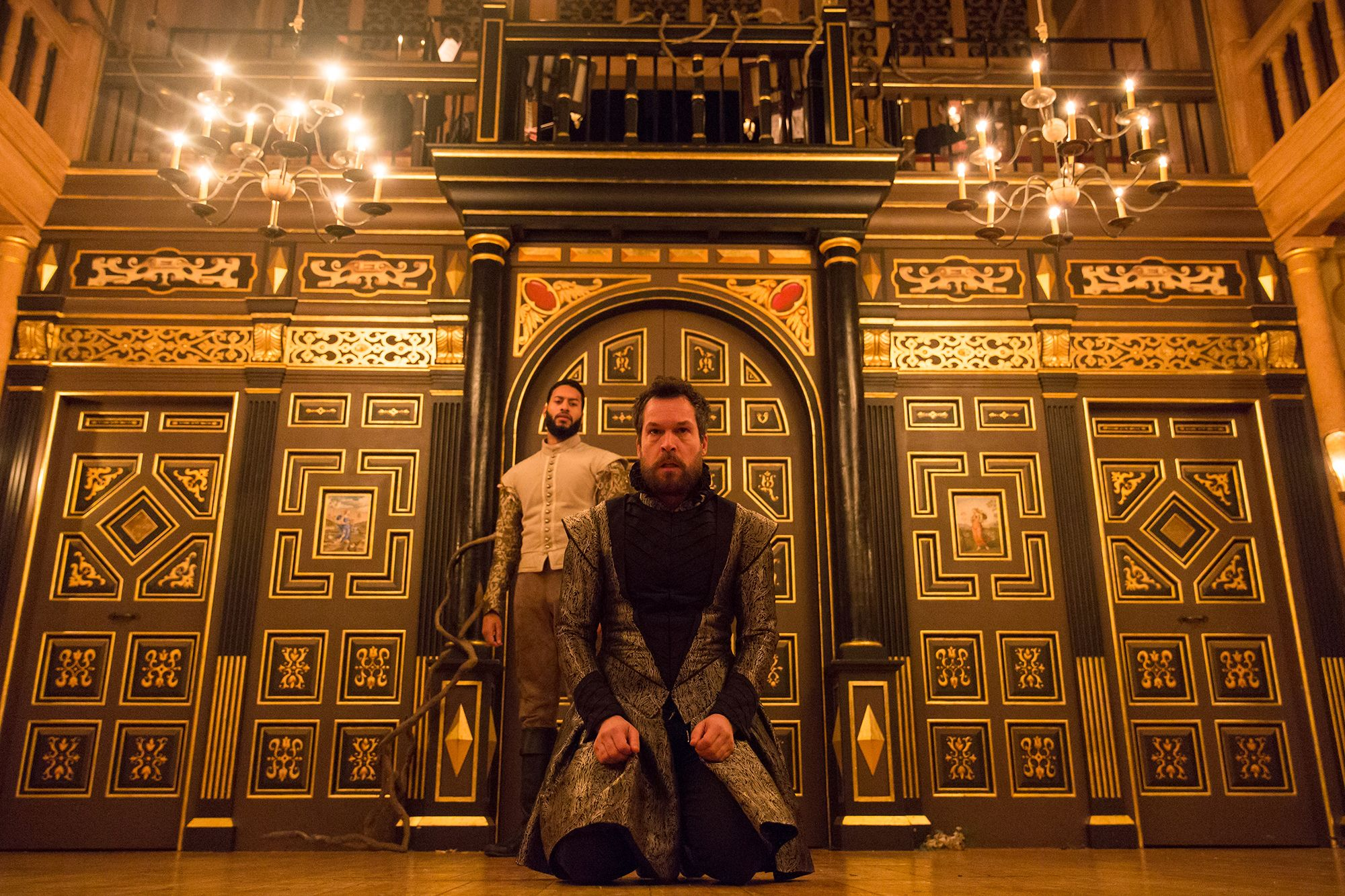
Leontes enters, accompanied by the courtier Antigonus and a bunch of nameless lords. Antigonus is going to hang out on stage and not say anything until the end of this scene, but he’s a very important character, because he’s the one who will… exit, pursued by a bear!!! It’s up to the staging, the costuming, and how the actor presents himself to let the audience know that this character is someone important.  

Don’t be antagonistic, Antigonus.

Leontes reacts to news that Polixenes and Camillo have fled Sicilia. He gives a great speech about drinking from a cup poisoned by a spider, but immune to the poison because he witnessed the spider. This is all to illustrate how certain he is in Hermoine’s cheating on him with Polixenes, despite any evidence. Again, I reminded of Dungeons and Dragons, where players might roll some kind of ability check to determine whether a cup is poisoned before they drink from it.

If you want creepy spiders, D&D has got you covered.

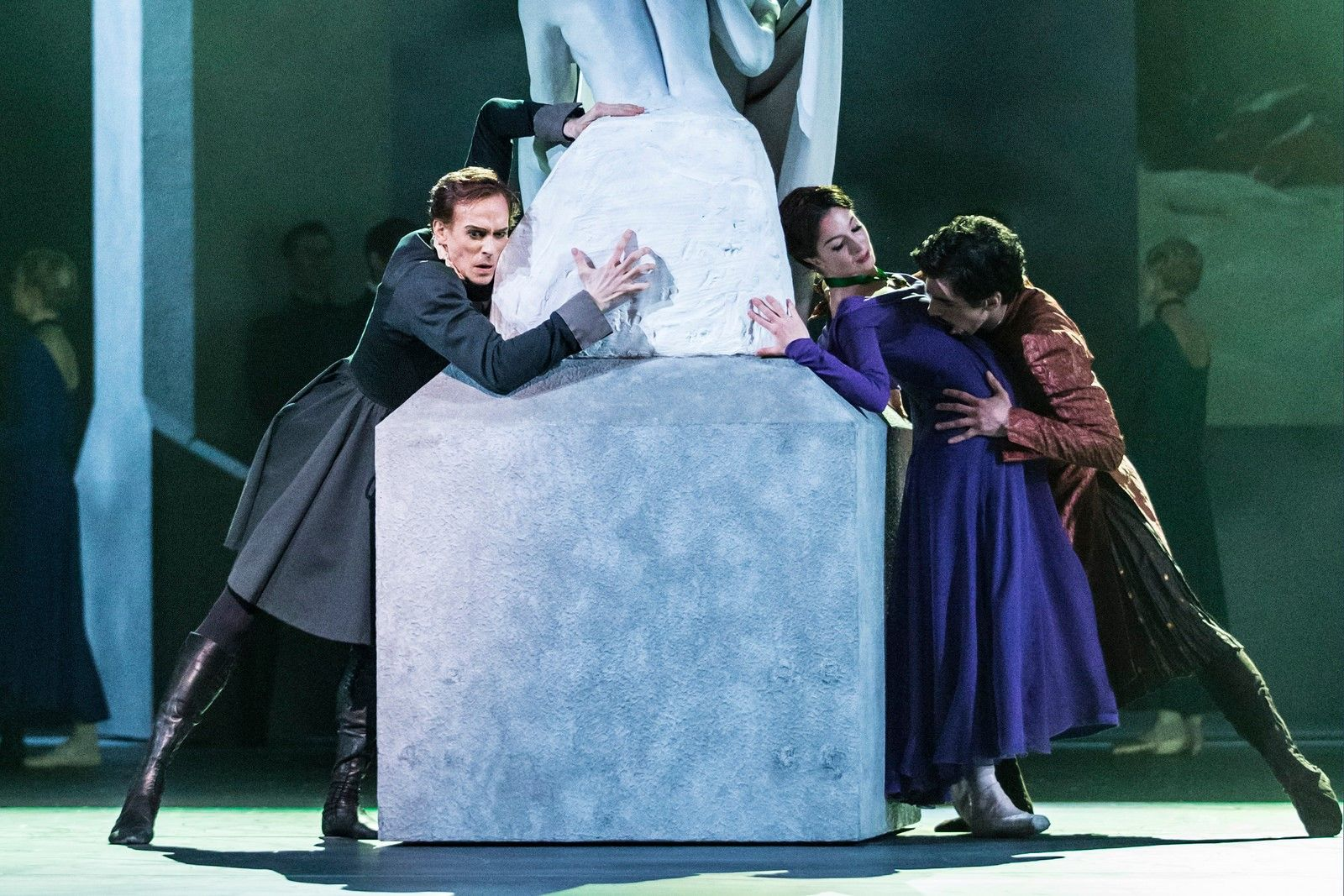
Leontes sends Mamillus and ladies out of the room, leaving Hermoine surrounded by all the men (uh-oh). The scene takes on the feeling of a trial. Leontes accused her of adultery, and she in turn calls him a villain. They go back and forth in their arguments for a bit, until Leontes proclaims “Away with her to prison.” Hermoine speaks to the lords, with more semi-fantasy imagery about an “ill planet” reigning over her, and her belief that “the heavens” will someday be more favorable to her. (Also some foreshadowing here.) She tells the lords that she is not prone to crying as other women are, but her grief is as great as tears. She demands that her serving women go with her.

That’s one ill planet.

Antigonus and one of the lords appeal to Leontes to listen to reason. Antigonus speaks about his love for his wife and children, and how he wouldn’t want them broken apart. Now that we know Antigonus is a good guy, it makes his actions in upcoming scenes make more sense, and it makes his bear-y fate even more sad. Antigonus and the lord continue to argue that Leontes has no evidence of Hermoine’s crime, while Leontes again asserts that he can see what others can’t.

Would you trust this king?

Then Leontes assures Antigonus that he’s sent two of his men, Cleomenes and Dion, ahead to consult with the Oracle of Delphos at Apollo’s temple. Everyone believes the oracle will speak the truth of the matter. This is more fantasy magic in the play (or, perhaps, misguided belief). This is a reference to Pythia, commonly known as the Oracle of Delphi. If you google “Oracle of Delphi” you can see this is A LOT. I’ll get to the further details in a future scene.

The journey to the oracle.

How to portray this on stage to get the idea across? Although Leontes speaks about sending Cleomenes and Dion away in the past tense, it would be easy enough to have them be two of the lords in this scene, and have them go on their way right there. In a filmed version, maybe this dialogue could be moved to a high balcony overlooking the city, and Leontes can point out to figures in the distance as they leave the city on their way to the Oracle. A film could occasionally cut away to shots of Cleomenes and Dion on their journey, like how Kenneth Branaugh’s Hamlet occasionally cuts to Fortinbras’ army on the move throughout the movie, making him an omnipresent force during all of Hamlet’s wishy-washiness.

Fortinbras will have his day.

Next: Be my, be my baby.

* * * *

Want more? Check out my ongoing serial, THE SUBTERKNIGHTS, on Kindle Vella. A man searches for his missing sister in a sprawling city full of far-out tech, strange creatures, and secret magic. It’s a sci-fi/fantasy hybrid full of action, romance, mystery, and laughs. The first ten episodes are FREE! Click here for a list of all my books and serials.

Posted in Uncategorized | Leave a comment

Fantastic Friday: The original Dr. Doom

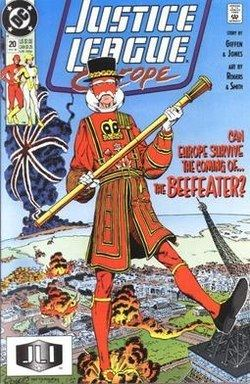
Reading the Fantastic Four comics from the start. Before we get into the storyline about Dr. Doom’s mentor, it’s finally time to look back at the first Dr. Doom. That means this week we’re reading… DC Comics???

Most comic book fans have heard occasional whispers that DC also has a character named Dr. Doom, but just who is this character? He first appeared in Detective Comics #158 in 1950, more than ten years before Marvel introduced its Dr. Doom. I’ll give Stan Lee and Jack Kirby the benefit of the doubt, assuming they were unaware of one old comic book rather than them stealing from DC. Either way, just who is DC’s Dr. Doom?

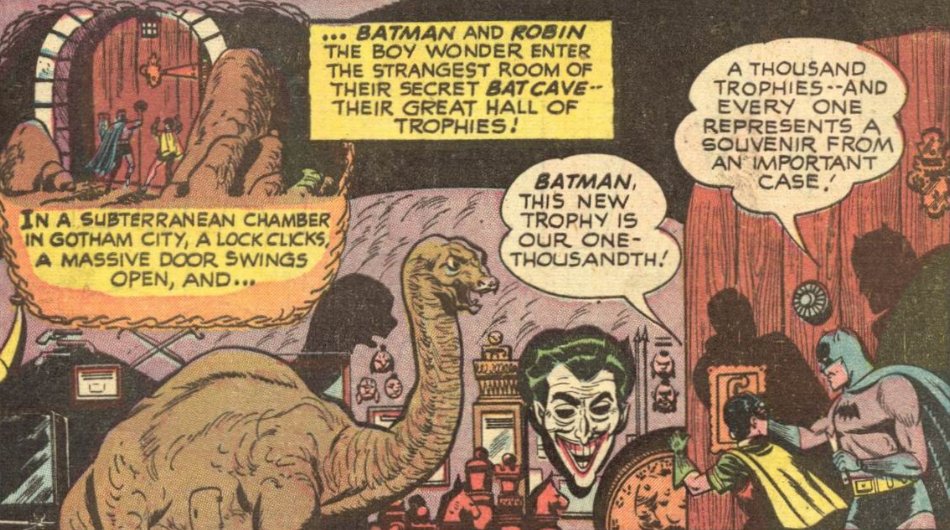
We begin with Batman and Robin entering the Batcave’s trophy room, with various items they’ve collected in their crimefighting adventures. They’re celebrating having collected their one-thousandth trophy, the sound of a musical note trapped in glass, which, if heard, is able to kill a man. They give themselves a little tour of the other trophies, including the giant penny and dinosaur, as well as giant dice, a chessboard, an experimental helicopter, a harpoon gun, and even an empty trophy case that was once instrumental in establishing a man’s innocence. Robin jinxes things by saying that after a thousand trophies, maybe he and Batman can take the night off, but then they get an alert from Commissioner Gordon.

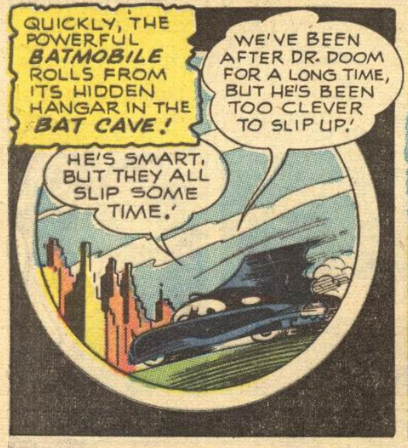
Gordon, via the Batmobile’s radio, tells Batman that a “smuggling-leader” named Dr. Doom was spotted at Gotham City’s Pier 16, where a ship, the Queen Maude, has just arrived. Batman says he’s been pursuing Dr. Doom for a long time, but the villain has been too clever, so that Batman can’t nab him in the act. At the docks, we get our first very tiny glimpse of Dr. Doom:

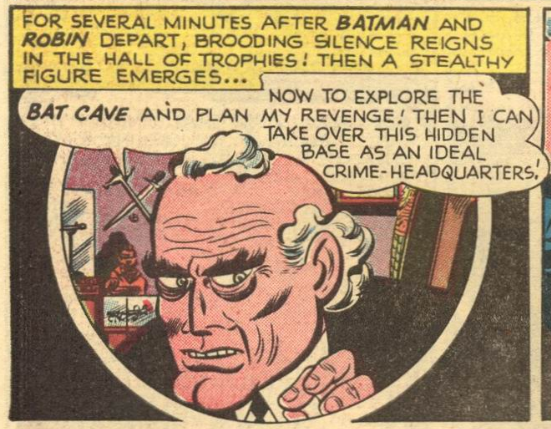
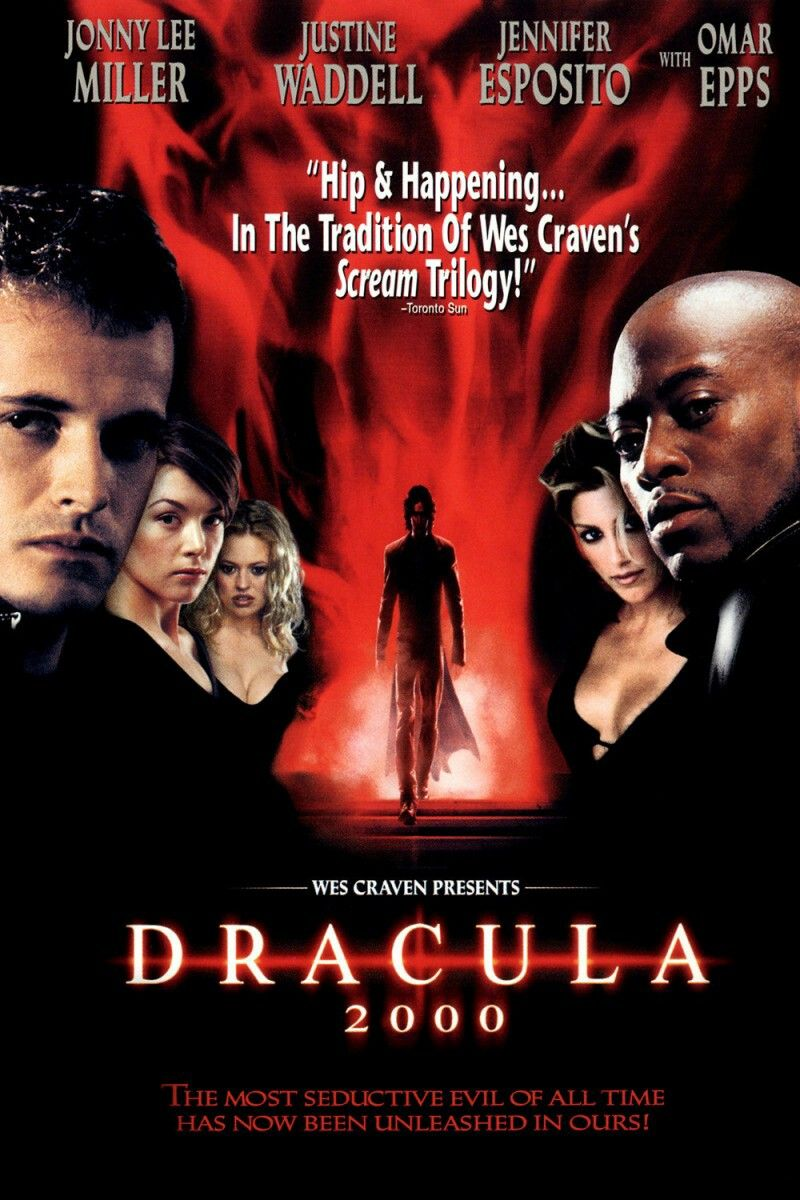
Batman deduces that the Egyptian antiques on the ship are fakes, being used to smuggle jewels illegally into the country. Dr. Doom, with his cigarette in his mouth, dives into the ocean. Turns out his cigarette holder his breathing tube, allowing him to survive the ocean depths. Commissioner Gordon believes Dr. Doom is dead, while Doom instead sneaks back onto the docks and hides inside an empty mummy case. (Not a sarcophagus, only a “mummy case.”) Gordon knows that Batman likes to keep trophies from his cases, so he lets Batman keep the mummy case as trophy number 1,001. The Dynamic Duo place the case inside the Batcave and leave. Then, finally, seven pages into the story, we see Dr. Doom’s face in closeup for the first time:

Doom wants to take over the Batcave and make it his headquarters, except that he’s locked inside the trophy room. He plots to use the other trophies as deathtraps for Batman, and then he short-circuits the Batcave’s alarm to get Batman’s attention. The alarm goes off, so Bruce Wayne and Dick Grayson but their bat-suits back on and return to the Batcave.

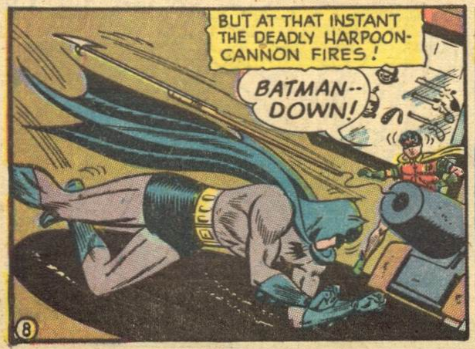
As the heroes investigate, the container holding the giant dice activates, throwing the dice at Batman. Batman ducks out of the way while Robin deduces the dice mechanism had a cut wire. Then the giant penny almost drops on Robin, and the harpoon gun fires at Batman. Fortunately, our heroes are skilled enough to avoid these dangers.

Robin wonders if all their old enemies have returned, but Batman does detective stuff, checking the Batcave’s security cameras. He’s reminded that the mummy case arrived earlier that day. They check the case, only to find it empty. But, Batman finds water inside the case, deducing that Dr. Doom hid inside there after surviving being in the ocean. While they’re figuring things out, Dr. Doom watches them from his hiding place inside the robot dinosaur.

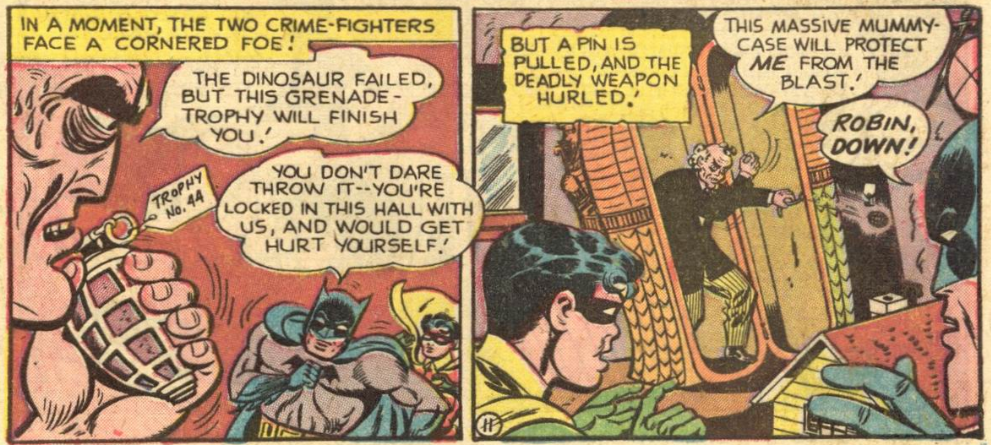
Then the dinosaur attacks, under Doom’s control. It fights Batman and Robin on the giant chessboard, for some classic Silver Age whimsical weirdness. Batman uses the experimental helicopter to fight the dino, cutting the wires that control it. With the dinosaur now useless, Doom escapes it and grabs a grenade, which is trophy #44. He pulls the pin, despite Batman’s warning that it could destroy them all. (Batman didn’t disarm this thing before he put it in the trophy case?) Doom hurls the grenade to the center of the room while he hides safely inside the mummy case.

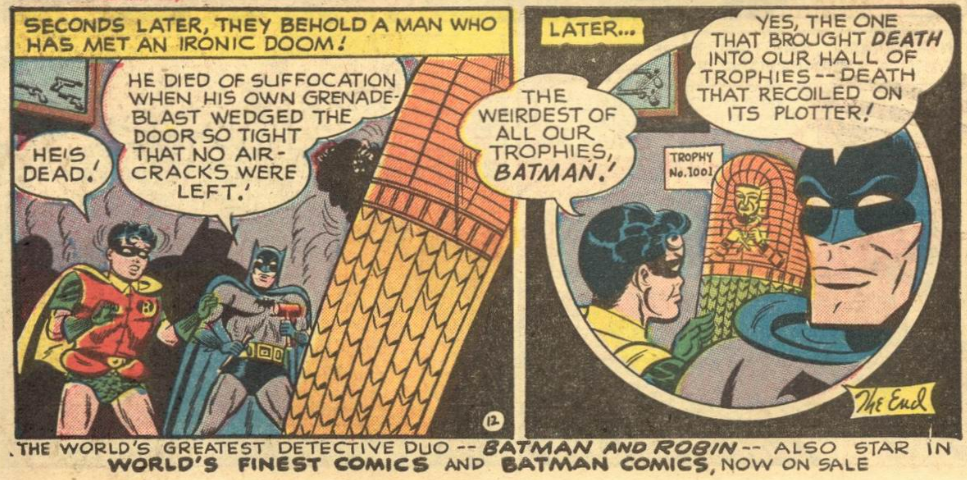
Batman smothers the grenades blast by using another trophy, a small mansion that was once home to a group of miniaturized people. Batman says now that Dr. Doom is inside the mummy case, they know where he is, and they can take him to the police. But then, Batman discovers that the grenade blast sealed the mummy case shut, with no air inside. Batman tries to chisel the mummy case open, but it’s no good. He can’t get it open, and Dr. Doom suffocates to death (!). The mummy case, with Doom’s corpse inside it, is placed inside the Batcave as trophy number 1,001. Batman ends the story on a grim note when he says, “The one that brought death into our hall of trophies – death that recoiled on its plotter!” (And people say these Silver Age comics were all kid-friendly and squeaky-clean.)

That’s it for that story, but this comic book is a 52-page monster. The next story is “Impossible But True,” the adventures of Roy Raymond, a.k.a. the man of 10,000 facts, who is the host of a TV science show. He and his girlfriend Karen investigate a scientist named Dr. Wellington, who claims to be able to combine aircraft and teleportation, only to have someone die aboard a test flight. There are lots of twists and turns before Raymond uncovers the real killer.

In the next story, we have Robotman, star of Doom Patrol, in a solo adventure. Some crooks pose as charity fundraisers, who then take their donations to spend at a fun day at a carnival. Robotman, in his “plastic disguise” as human Paul Dennis, catches onto them. There’s a lot of comedic antics as Robotman and the crooks chase each other around the carnival, before ending with a fight atop a roller coaster and the final confrontation in the house of mirrors.

Then there’s “Dover and Clover,” a comedy story about two identical twins who are bumbling detectives. They accidentally stop a jewel store manager stealing from his own store, but not after they go the zoo and back. This is followed by a text piece called “Winner Take All No. 2” with guidelines for some sort of trivia game readers can play at home. It makes no sense. Then there’s a one-page gag comic, “Little Pete,” where the titular kid refuses to take a swing in his baseball game for fear of breaking a nearby window. The final story is the unfortunately-named “Pow-Wow Smith,” a Western about a Native American tribesman who gets a world-class education and returns to his tribe to confront his childhood rival.

Dark knight: This is a good one for people who say Batman is the “real” character and Bruce Wayne is only an act he puts on. Batman is Batman throughout this entire issue, appearing as Bruce only in one panel.

Boy wonder: Robin keeps saying he wants a night off to relax, only for Dr. Doom’s machinations to keep calling the heroes back to action over and over.

Man of steel: There’s a one-page in-house DC promo in which Superman scolds some kids for being anti-Semitic. He grabs the kids and flies them to Iwo Jima (!) to teach them a valuable lesson about World War II. This is heavy stuff.

Commercial break: Air combat!

Trivia time: This is the only canonical appearance of DC’s Dr. Doom, although DC reprinted this story many, many times over the years, no doubt adding to the popularity of the idea of the Batcave trophies.

What other DC and Marvel characters have the same name? The most well-known is Captain Marvel. Both versions co-existed for decades as the lawyers fought it out. Eventually, Marvel Comics got the name, and DC’s Captain Marvel can only ever be known as Shazam from now on. The two companies both had a character named the Scarecrow, but DC won that one, so Marvel’s Scarecrow is now named the Ragman. I’m sure there are others.

Continuity! As Batman and Robin look through all their trophies, they reference the cases the trophies came from, and each of these corresponds to a previous Batman comic. The DC Wiki has the complete list, so I won’t repeat them all here. What’s missing is the giant Joker playing card, even though it should be here because it was established as part of the Batcave in Detective Comics #114 in 1946. A Joker mask, however, is seen as a trophy in this issue.

How to tell Dover and Clover apart? Dover wears the blue necktie, and Clover wears the red one.

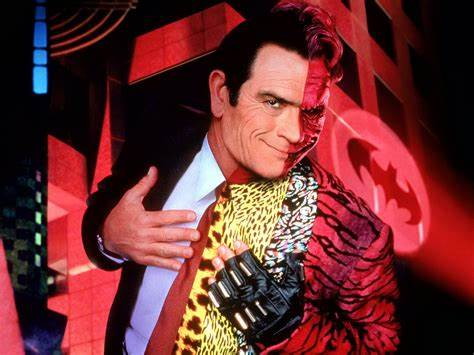
Fantastic or frightful? There are all these stories about censorship in the ‘50s making DC comics child-friendly and bland, but here we see the villain dying horribly in this story, as well as other semi-adult themes in the other stories. (Marvel’s Dr. Doom would have come up with a way to survive.) Other than that, it’s fun to see an entire story set inside the Batcave.

Next: It’s no day at the beach.

* * * *

Want more? Check out my ongoing serial, THE SUBTERKNIGHTS, on Kindle Vella. A man searches for his missing sister in a sprawling city full of far-out tech, strange creatures, and secret magic. It’s a sci-fi/fantasy hybrid full of action, romance, mystery, and laughs. The first ten episodes are FREE! Click here for a list of all my books and serials.
Posted in Fantastic Friday | Leave a comment

Reading Shakespeare’s The Winter’s Tale – Act 1 Scene 2 (part 4)

Re-reading Shakespeare’s The Winter’s Tale. It’s time for a confession and even more conspiratorial stuff at Act 1 concludes. Also, a D&D monster is here.

We’re in the final stretch of the super-long Act 1 Scene 2, when Polixenes returns to the stage. He says one of my favorite lines from the play, “My favor here begins to warp.” Catchy wordplay aside, this means he can tell something is up, and that he’s not as welcome in Sicilia as he was when this scene started. If this were a full-on movie adaptation, I imagine we’d be in a different location now, with visual cues to show that some time has passed.

Warp speed!

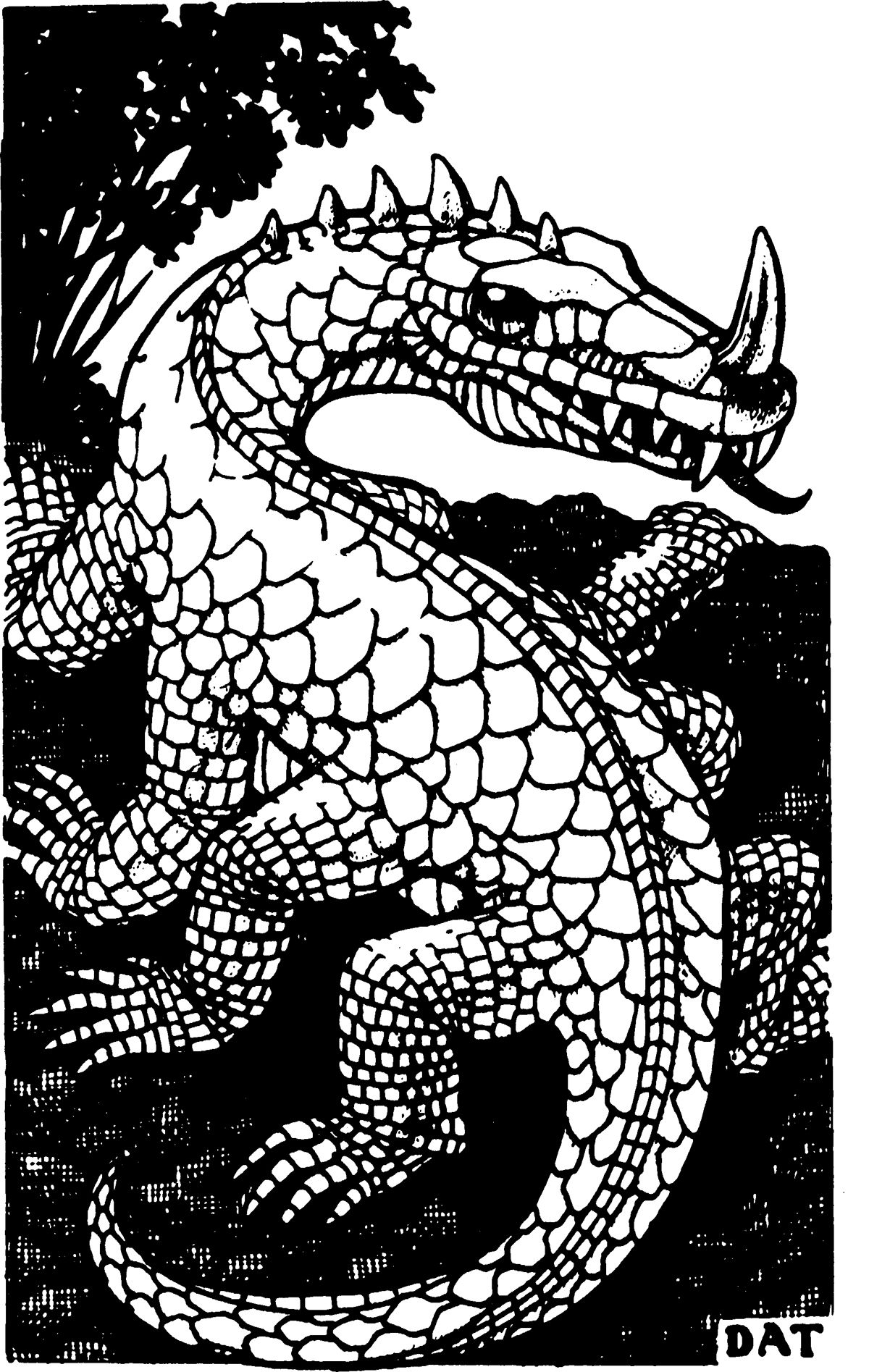
Polixenes speechifies about the changes in Leontes’ behavior, and Camillo blames it on some unknown illness. Because he’s the only one without this illness, Polixenes fears he’s causing it, comparing himself to a basilisk. I’m sure this made all the Dungeons and Dragons fans excited, as this mythological serpent monster is a game favorite. It has the power to petrify anything it looks at it, and therefore its weakness is its own reflection. My old Monster Manual states the basilisk can also see into the astral plane, and its gaze will kill you instantly if your character has also gone astral. That has nothing to do with The Winter’s Tale, I just think it’s neat.

Looks kind of cute.

 Polixenes wises up, knowing Leontes’ change in attitude is no illness. Camillo fesses up that Leontes has “appointed” him to kill Polixenes, for fear that Polixenes touched his wife “forbiddenly.” More fun wordplay. Polixenes compares this betrayal to “the Best,” with the word Best capitalized. This is a reference to the Biblical tale of Judas Iscariot, though I’m unclear as to how audiences can know that.

If you’ve seen this movie, then YOU KNOW.

Camillo says Leontes is unshakable in his belief of Polixenes and Hermoine. Camillo takes charge, coming up with a plan for Polixenes and his people to sneak out of Sicilia during the night, in small groups of twos and threes. A filmed version of this could include a montage of the Bohemians skulking around the city at night.

Fantasy or reality?

Then there’s the question of whether Leontes’ jealousy is based on something real or imagined. It seems to be false on the surface, but could there be something more to it? Polixenes muses about how dangerous the jealousy is, but he uses a female pronoun to describe it, saying “As she’s rare.” He also asks that Hermoine be comforted during this time, in the face of her husband’s suspicions. It’s all open to interpretation of course, I’m just interested in how the presentation of the play would be different if the actors portray Polixenes and Hermoine as genuinely romantic.

Next: The consequences.

* * * *

Want more? Check out my ongoing serial, THE SUBTERKNIGHTS, on Kindle Vella. A man searches for his missing sister in a sprawling city full of far-out tech, strange creatures, and secret magic. It’s a sci-fi/fantasy hybrid full of action, romance, mystery, and laughs. The first ten episodes are FREE! Click here for a list of all my books and serials.
Posted in Uncategorized | Leave a comment

Tim Burton rewatch – Wednesday (2022) episode 5-8

Tim Burton rewatch! I couldn’t just watch the first four episodes of Wednesday without finishing season 1, right? These episodes were produced by Burton, and they were directed by Gandja Monteiro and James Marshall. (Not the same James Marshall who starred in Twin Peaks.)

Here’s what happens: The mystery heats up as Wednesday Addams continues investigating strange goings-on in her new school, Nevermore Academy. The creature menacing the school is a Hyde (as in, “Dr Jekyll and…”) who has a human form. What that human wants may have to do with long-buried secrets from the school’s past.

Origin story: The name Nevermore Academy is obviously a reference to Edgar Allen Poe’s The Raven. The Raven speaks, but the only word it says is “Nevermore,” further haunting the poem’s already haunted narrator. Wednesday’s ancestor Goody Addams is likely a reference to Goody Proctor, a.k.a. Elizabeth Proctor, who was convicted of witchcraft in the Salem Witch Trials of 1692. Her story inspired the creation of Arthur Miller’s classic The Crucible.

Outsider theory: Despite Wednesday’s protestations of how she neither wants nor needs friends, she eventually develops a circle of others who come to her aid by the end. It’s pointed out that she might not want friends, but she’s nonetheless good at colleting them.

Reality breaks through: Gomez and Morticia return for an episode involving a parents’ weekend at the school. Here we see that Morticia and Wednesday’s relationship is strained. Morticia wants what’s best for her daughter, but the two do not see eye-to-eye. This goes a long way in exploring why Wednesday is so distant from others.

Best bits: Tyler: “You’re like a cockroach!” Wednesday: “Flattery will get you nowhere.”

Thoughts on this viewing: As noted last week, the mystery plot in Wednesday isn’t as interesting as just hanging out with these characters. I wonder if that’s why Burton only directed the first half of the series, because he knew that’s where the good stuff was. But there’s a lot to like in this half. Some great performances, some gloomy atmosphere, and a memorable protagonist at its center. Great stuff.

And that’s a wrap on Tim Buron until (if?) this Beetlejuice sequel comes out. What should I do next on this blog? Any suggestions?

* * * *

Want more? Check out my ongoing serial, THE SUBTERKNIGHTS, on Kindle Vella. A man searches for his missing sister in a sprawling city full of far-out tech, strange creatures, and secret magic. It’s a sci-fi/fantasy hybrid full of action, romance, mystery, and laughs. The first ten episodes are FREE! Click here for a list of all my books and serials.

Posted in Uncategorized | Tagged , , , , | Leave a comment

Fantastic Friday: It can’t reign all the time

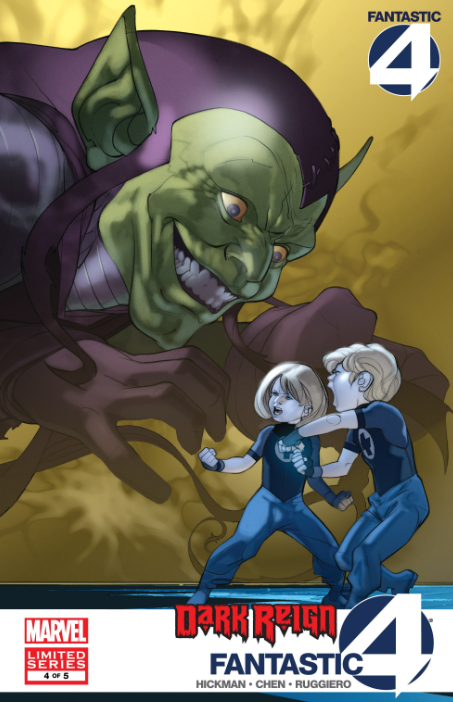
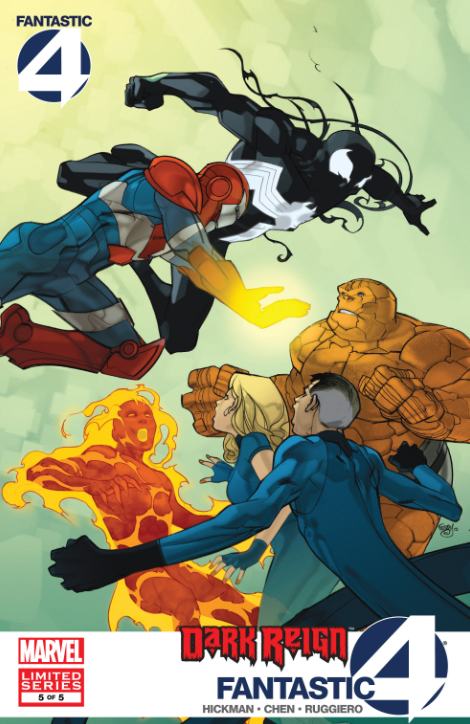
Reading the Fantastic Four comics from the start. The Dark Reign event was all about Norman Osborn throwing his weight around, and that’s what does for our heroes at the end of Dark Reign: Fantastic Four.

Recap: Feeling overwhelmed by all the violence and ugliness of Civil War, and now with Norman Osbourne running the Avengers, the Initiative, and a new version of S.H.I.E.L.D., Reed constructs the Bridge. This is a portal-type machine that allows him to see how these events played out in alternate universes, in the hopes that he can change the world for the better. Meanwhile, agents from H.A.M.M.E.R., Osborn’s new version of S.H.I.E.L.D., attacked the Fantastic Four to arrest them after Osborn declared them suspended from the Fifty States Initiative. When H.A.M.M.E.R. tried cutting power to the building, it made things go haywire, sending Sue, Ben and Johnny on an adventure in other universes.

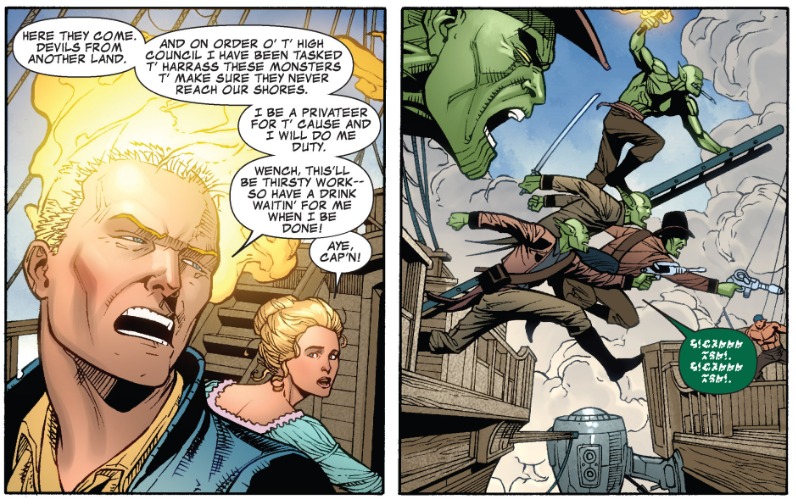
Issue #3 is mostly set in compressed space-time, where Sue, Ben, and Johnny are bouncing around various other realities. We see other versions of them on a pirate ship battling pirate Skrulls on another ship. Then it becomes a Western, with Sue as a super-cool gunslinger. Things shift again, as the cowboy and pirate characters end up in an alternate World War II, Reed, meanwhile, continues to explore other universes where Civil War still happened, but differently. Valeria and Franklin are alone inside the Baxter Building, basically under siege with Osborn’s troops outside.

Issue #4 begins as Osborn shows up at the Baxter Building’s front entrance, demanding to see Reed, while Franklin and Valeria stall him over the intercom. Inside the Bridge, Reed breaks down. He says his mind has processed one billion alternate timelines (!), and he can find no circumstances in which Civil War and Osborn’s reign could have been avoided.

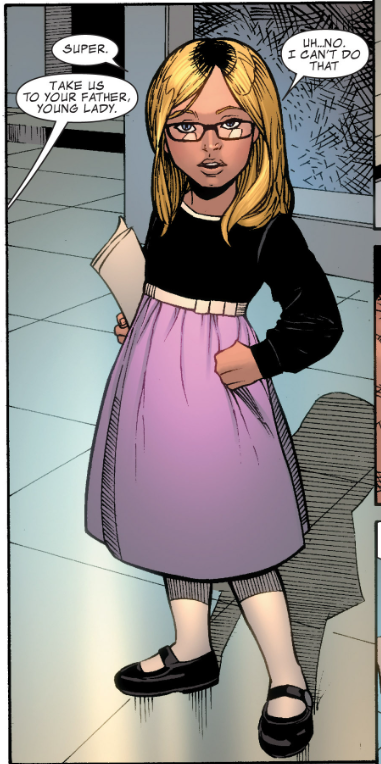
Osborn enters the Baxter Building with the Avengers’ “Spider-Man,” who isn’t Spider-Man at all, but secretly the Mac Gargan version of Venom. There’s some comedy bits where Valeria plays the part of Reed’s secretary. She says the papers they were served say that only one person may meet with Reed, not an entire squad of soldiers. Osborn plays along, and goes off with her alone. Valeria says her parents are away on superhero business, but someone else wants to talk to him. That someone else is Franklin in a Spider-Man mask.

Inside collapsed space-time, where Sue, Ben, and Johnny are lost, they’re not in the WWII from last issue, but on another planet where Reed is in place of the Kree’s Supreme Intelligence. He talks about how all societies will eventually fail, while attacked by Skrulls with Venom symbiotes. The cowboy, pirate, and WWII versions of our heroes join the fight.

Still alone in the bridge, Reed snaps out of his doldrums and says there’s always a solution. He muses on how one single moment is all someone needs to look at things in the right perspective with complete honesty. He says his successes in the other universes were when he acted alone, and not alongside Tony Stark or Hank Pym. He wonders if this is arrogance or the truth.

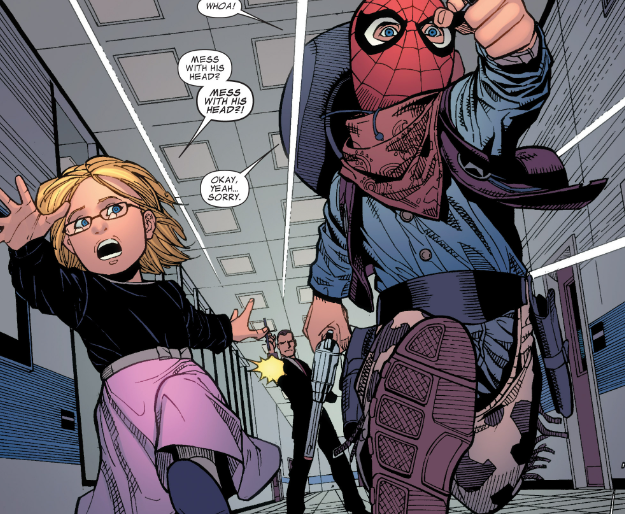
We get a couple of pages of the alternate universe battle against the Skrulls while thinks about hiding his genius behind false humility, and having to do whatever it takes to solve the problems of the world. Reed shuts off the Bridge, which returns Sue, Ben, and Johnny to Earth. Everyone’s glad to be reunited, until Sue asks where the kids are. Turn the page and we see Franklin and Valeria running from Osborn as he shoots at them with a gun (!).

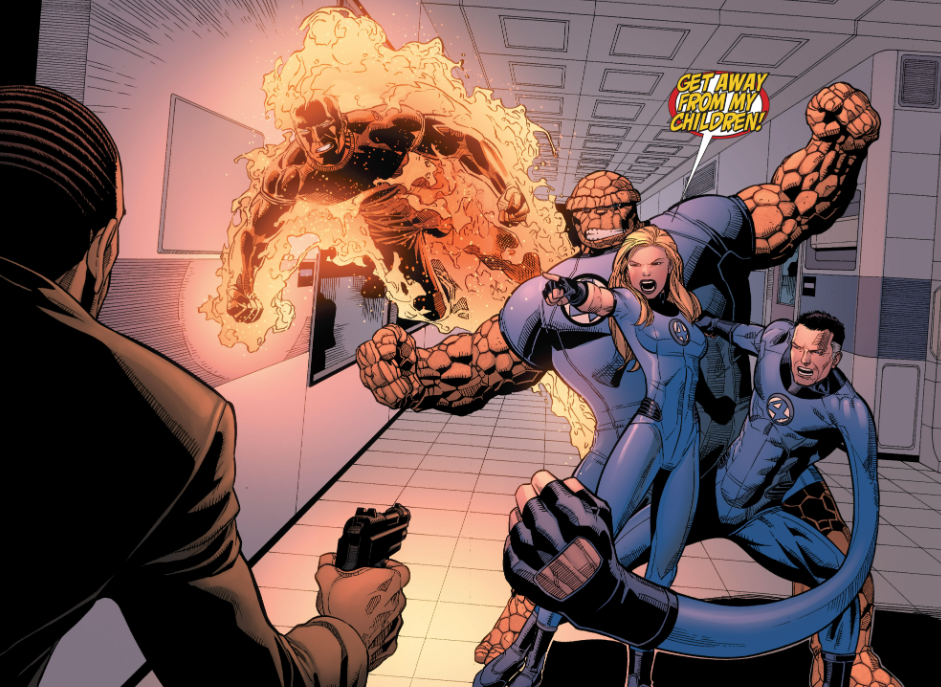
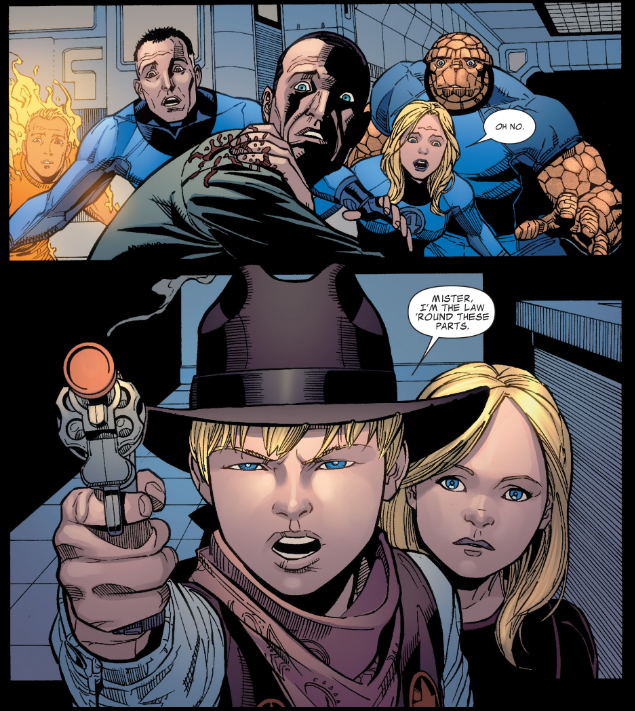
The kids hide inside an office while Osborn monologues about how he has no hesitation about killing kids, saying he’s a believer in “corporal punishment.” (I’m no lawyer, but I find it hard to believe corporal punishment gives someone the right to shoot little kids. Let’s just assume Osborn is exaggerating for dramatic purpose.) Then the FF jump out, ready for a fight, as Sue says, “Get away from my children!”

Issue #5 begins right away with Osborn’s answer to Sue, “Make me.” Sue disarms him with a force field, but that only sends a message for Gargan and the H.A.M.M.E.R. troops to attack. She stops them by surrounding the FF with a force field, and Osborn inside it with them. This would appear to put Osborn at a disadvantage, but he instead withdraws his gun again and aims it at Reed. Except Osborn is shot in the arm by… Franklin! His toy gun now has real bullets, apparently.

Reed stands up to Osborn, telling him to leave. Osborn makes more threats, saying the FF will never stop him, and he’ll come after them when they least expect it. Norman leaves, taking all his goons with him. The whole family is reunited. Johnny asks if Reed found what he was looking for inside the Bridge, and he says it’s hard to say, but he thinks so.

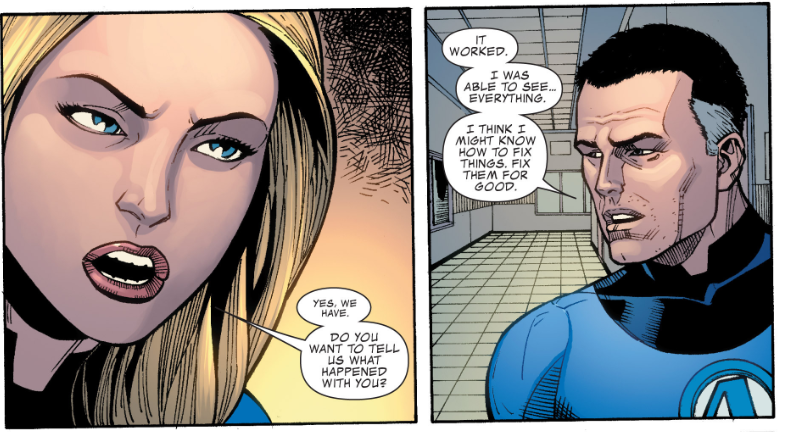
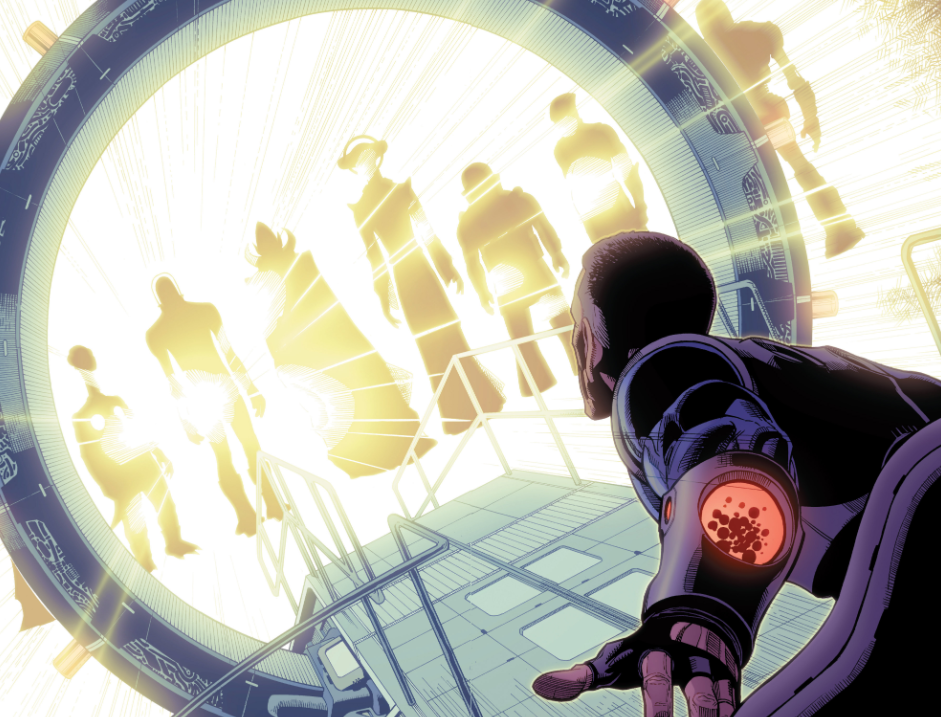
Sue asks for more details, and Reed says he might know how to fix everything. She asks if anything else happened. Then we get a flashback. Just before Reed shut down the Bridge, he asked for one final projection. He asks how many Bridges have been built in by other Reeds in other universes, and the computer tells him there are 141 of them. He then sees a bunch of mysterious figures emerging from the other side of the Bridge.

Back in the present, a shifty-looking Reed tells Sue that nothing else happened. She tells him to destroy the Bridge, because it endangered everyone. He promises to take it apart, piece by piece. Then we see more of the flashback, where the mysterious figures tell Reed they can help fix things in his universe. He asks who they are, and they say, “We’re just like you,” and “We’ll be here waiting when you’re ready.”

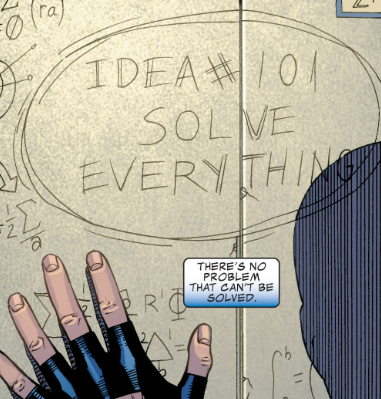
Reed keeps his promise to take the Bridge apart, only to then put it all back together in secret a week later. He says this is his crossing-the-threshold moment, and that everything that’s gone wrong from Civil War onward has been his fault all along. He enters his private thinking room, with his mathematic equations written all over the walls. He thinks, “I know what I have to do to fix it.” We see that he’s written on the wall, “Idea #101, solve everything.” The caption says this is to be continued in Fantastic Four #570, but our heroes must deal with Dr. Doom before that. Speaking of which…

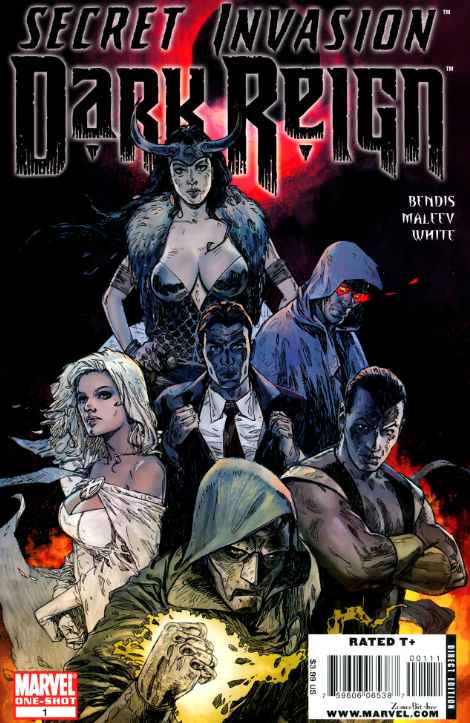
To stay caught up with events in Fantastic Four, we’ve also got to look at what’s been happening in Dark Reign proper. Secret Invasion: Dark Reign #1 takes place immediately after Secret Invasion ended, with Osborn forming his own version of the Illuminati made up of Loki, Namor, Emma Frost, the Hood and our very own Dr. Doom. They’re called the Cabal. With the exception of the Hood, each of these characters are in a down place in their lives. Working with Osborn will put them back on top. Remember that when we last saw Dr. Doom, he was locked up in the Hauge.

Then, in Dark Avengers #1-4, Osborn formed his own team of Avengers, with a few washed-up heroes and a bunch of villains posing as classic Avengers. He even got an Iron Man suit of his own and named himself the Iron Patriot. His team got their first mission when Morgana Le Fey kept time traveling from the Arthurian era (era) to the present over and over to attack Dr. Doom and claim Latveria for her own. Osborn’s Avengers saved the day, and Osborn used his new political powers to restore Dr. Doom to the Latverian throne. And THAT’S where the next issue of Fantastic Four picks up.

Unstable molecule: If you know your Fantastic Four history, you’ve probably already guessed the figures inside the Bridge are the Council of Reeds, a controversial subject we’ll get to sooner rather than later.

Fade out: The Western version of Sue is named “Black Sue,” which is maybe not appropriate. It’s because of her all-black outfit (based on Black Widow, maybe?).  

Clobberin’ time: The Elizabethan version of Ben, called “Chamberlain Grimm,” also joins the alternate FF on their adventures, often hesitant to join the fight until the others encourage him to do so.

Flame on: Even though Franklin saves the day by shooting Osborn, Johnny is the one who is quick to snatch the gun away from Franklin and tell him guns aren’t for kids.

Fantastic fifth wheel: The newly-rebuilt H.E.R.B.I.E. robots are seen in one panel helping Reed dismantle the Bridge. Freakin’ H.E.R.B.I.E. the robot.   

Four and a half: Franklin’s cowboy outfit from the start of miniseries pays off in the final confrontation, as he says a bunch of tough-guy Western lines to stand up to Osborn.

Our gal Val: We were initially told that the FF were going to keep Valeria’s super-genius a secret. But now that Norman Osborn knows, it’s safe to assume everyone knows.

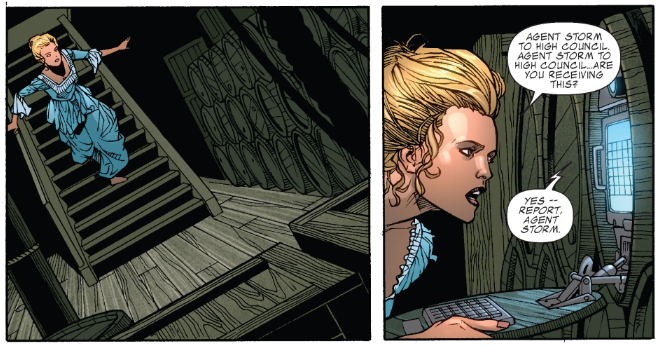
Sue-per spy: The 2019 Invisible Woman miniseries revealed that Sue had a double life as a S.H.I.E.L.D. agent all along. In the pirate universe, that version of Sue was revealed to be “Agent Storm,” secretly reporting to that reality’s version of the Illuminati.

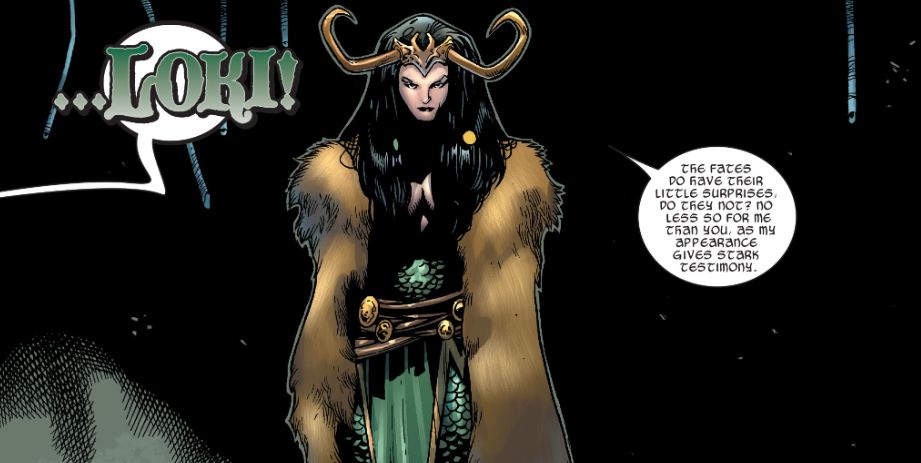
Trivia time: Why is Loki a woman during Dark Reign? It happened just before this, in Thor vol. 3 #5. After Thor came back from the dead following Ragnarok, he went on a quest to find other reborn Asgardians. He found Balder and Loki still alive, held prisoner by a reanimated Destroyer armor. Loki says she (the Marvel Wiki gives her female pronouns during this time) was changed by the Fates upon her rebirth. She promises peace with Thor, only to secretly join the Cabal. Loki remained female for quite some time, even becoming the new Scarlet Witch for a while. She’ll die again in Siege and then be reborn again as Kid Loki in Journey Into Mystery.

Fantastic or frightful? A lot of the alternate timeline stuff in Dark Reign: Fantastic Four has little to do with the plot, and feels like it’s only there for artist Sean Chen to go wild with new designs and big splash pages. The confrontation with Osborn is the big moment, and it’s frightening how he has so much political power that he can shoot at children and get away with it. An enjoyable read, but a slim one.

Next: No day at the beach.

* * * *

Want more? Check out my ongoing serial, THE SUBTERKNIGHTS, on Kindle Vella. A man searches for his missing sister in a sprawling city full of far-out tech, strange creatures, and secret magic. It’s a sci-fi/fantasy hybrid full of action, romance, mystery, and laughs. The first ten episodes are FREE! Click here for a list of all my books and serials.

Posted in Fantastic Friday | Leave a comment

Reading Shakespeare’s The Winter’s Tale – Act 1 Scene 2 (part 3)

Re-reading Shakespeare’s The Winter’s Tale. We’ve seen romance and jealousy, and now as act I scene 2 continues, thoughts turn to murder.

We’ve seen Leontes of Sicilia enraged with jealousy over the perceived flirtations between his wife Hermoine and Polixenes of Bohemia, and wondered whether those flirtations are real or mistaken. Now it’s time for some classic conspiring. After shooing everyone but the courtier Camillo off the stage, Leontes asks Camillo about what people are saying in the kingdom about Polinexes staying longer. Camillo says it’s because of the queen. (Didn’t all this just happen a minute ago, though?)

Maybe Camillo cast a scrying spell.

Leontes starts to praise Camillo, saying he trusts Camillo with secrets like he would a priest, but then he turns on Camillo with more long speeches accusing Camillo of being blind to Hermonie’s infidelity. Camillo tries defending himself, saying he’s only ever been faithful. They go back and forth like this for a while, until Leontes says if his wife’s liver were as infected as her heart, she might not live an hour.

Plotting the plot.

This seems to put an idea in Leontes’ head, as he next tells Camillo he wishes he has a servant loyal enough to “bespice a cup” to give his enemy a “lasting wink.” Camillo says this crime can be done with a “dram” that can act just as deadly as a poison. None of my books have a footnote for “dram,” but the internet tells me it simply means a drink, most often in reference to whiskey. But Camillo is still unconvinced until Leontes makes one more speech about how certain he is.

At least it’s not this dram.

Camillo agrees to go along with the plan, so long as Polixenes is the only target, and the queen’s honor will remain intact. Leontes leaves Camillo alone, and Camillo gets an aside about how thinkable a situation this is. He says there are no examples of people who have killed kings and gotten away with it, and he still would not want to do this even if there were. This feels meta, as if Camillo has already read Shakespeare’s previous tragedies. Because ruin (or “breakneck” as he puts it) is his only option, Camillo decides to forego all his previous protestations of loyalty and forsake his king.

Does this look like a murder weapon to you?

I imagine that a proper movie adaptation of The Winter’s Tale would have this part be its own scene, with Leontes and Camillo meeting in some secret, shadowy location for some proper murder-plotting. You could even have Camillo pour a glass of the poison-like dram and push the camera in close as he does, only then for him to toss the glass on the ground or into a nearby fireplace for dramatic effect. If on stage, there’s still a lot to work with. Once of Leontes’ speeches has him describing the nothingness he feels, with the word “nothing” repeated over and over. Another has a long list of things he’s suspected Hermoine and Polixenes doing, which is descriptive and evocative. A clever actor can make the most of these speeches so that Leontes’ behavior is more than just a bunch of angry rants.

“It was… the nothing!”

The Winter’s Tale is a fantasy play, although the magical elements aren’t as overt as they are in Midsummer Night’s Dream or The Tempest. With that in mind, could Camillo be interpreted as a magical character? As we’ll see, he’s going to move in and out of the story, often changing events and putting characters on different paths. He can’t know the future, because otherwise he’d stop or avoid tragedy to come, but he could be portrayed as having supernatural empathy of what people are feeling and what is occurring outside his physical awareness. Just a thought.

Next: Camillo’s excellent adventure.

* * * *

Want more? Check out my ongoing serial, THE SUBTERKNIGHTS, on Kindle Vella. A man searches for his missing sister in a sprawling city full of far-out tech, strange creatures, and secret magic. It’s a sci-fi/fantasy hybrid full of action, romance, mystery, and laughs. The first ten episodes are FREE! Click here for a list of all my books and serials.

Posted in Uncategorized | Leave a comment

Tim Burton rewatch – Wednesday (2022) episodes 1-4

Tim Burton rewatch! Burton returns to episodic TV for the first time since the ‘80s, directing the first four episodes of Wednesday and producing the entire series.

Here’s what happens: After a piranha-based incident at her old school, Wednesday Addams must relocate to Nevermore Academy, her parents’ supernatural alma mater. Wednesday clashes with her werewolf roommate, a siren bully, and a handsome boy working at the local coffee shop. Wednesday believes herself to be above the usual urban fantasy boarding school drama, but she can’t help but be drawn in by a mystery involving a creature roaming the woods nearby.

Origin story: Charles Addams, a New Jersey native and art school grad, got his start as a designer and layout artist for various 1930s pump magazines. His distinctive cartoons earned him a recurring spot in The New Yorker, giving him and his cartoons worldwide fame. His Addams Family characters originally had no names, but for marketing and the 1964 TV deal, Addams had to name each of them. Wednesday Addams was the first named, as a Wednesday doll was produced in ’63, to promote the upcoming series.

Outsider theory: Nevermore Academy and the surrounding town are made up of “outcasts” and “normies.” But the normies are clearly the second-class ones, with the outcasts running the place. Wednesday might not fit in at Nevermore, more because of her attitude than because of her strangeness. She’s smarter and more capable than everyone else, and has the ability to see through everyone else’s B.S. Thinking to Burton’s previous work, Wednesday has quite a bit in common with Batman.

Reality breaks through: What to make of the opening scene, in which Wednesday dumps piranhas into the school swimming pool, injuring and possibly killing a whole bunch of her fellow teens? A lot of the humor of the Addams Family is the characters talking about ghoulish things they’ve done, leaving the visuals up to the viewers’ imaginations. For us to spend an entire series with Wednesday boasting how she’s the baddest one around, we need this scene at the start to show she’s not all talk. When Wednesday threatens to kill you, she means it.

Best bits: Wednesday: “I act as if I don’t care if people dislike me, but deep down… I secretly enjoy it.”

Thoughts on this viewing: It’s easy to see why Wednesday was such a hit, as it remains fun and engaging today as it did on its big debut weekend. And it’s a big swing back upward for Burton. I’ll admit that the overall mystery plot isn’t all that engaging, but Wednesday succeeds in its big atmospheric moments, such as Wednesday furiously playing the cello, her solving a puzzle in an underground chamber, and especially her bizarre dance that you saw everywhere on social media.

Next: One day more.

* * * *

Want more? Check out my ongoing serial, THE SUBTERKNIGHTS, on Kindle Vella. A man searches for his missing sister in a sprawling city full of far-out tech, strange creatures, and secret magic. It’s a sci-fi/fantasy hybrid full of action, romance, mystery, and laughs. The first ten episodes are FREE! Click here for a list of all my books and serials.
Posted in Uncategorized | Tagged , , , , | Leave a comment

Fantastic Friday: Reign on me

Reading the Fantastic Four comics from the start. We’re in Marvel’s “never-ending crossover” mode as Dark Reign begins the second that Secret Invasion ends. But what does it mean for the FF?

What’s Dark Reign about? At the end of Secret Invasion, Norman Osbourne is the one who saved the day at the end, acting as leader of the Thunderbolts. This was seen on news cameras worldwide, making Osbourne a hero. What’s more, the US President made Osbourne the number one guy, putting him charge of the Avengers, the Thunderbolts, the Fifty States Initiative, and H.A.M.M.E.R., which is Osbourne’s new hardcore replacement for S.H.I.E.L.D. Oh, and he’s started his own version of the Illuminati, made up of villains.

Dark Reign: Fantastic Four #1 tells us it’s been one week since the Skrull invasion, long enough for Osbourne to take control of the superhero community. Reed works in his lab, musing about how these events have him feel like he’s crossed a threshold and had a moment of clarity.

Then we’re reminded that the new Baxter Building was rebuilt from scratch at the end of Secret Invasion (should I start calling it the new new Baxter Building?). Alicia joins Franklin and Valeria on a shopping spree, because the building was restored but the FF’s personal belongings were not. Sue, Ben, and Johnny have some playful bickering while Reed’s reprogrammed Doombots move all the new furniture in.

The others check on Reed in his lab, where he’s tinkering with science instead of putting all the new stuff away. He says he’s invented an observation device that can show them how problems like theirs were solved in other earths. He calls it the Bridge. Sue asks him why he had to build it on moving day, and Reed says he has to know everything has gone so terribly wrong.

Then a bunch of military vehicles pull up in front of the Baxter Building. Norman Osbourne is inside one, giving orders to H.A.M.M.E.R. troops. He says the Fantastic Four are suspended from the Initiative, and today they’re being shut down. “Resistance is expected,” he says.

Inside, Reed prepares for a journey. Apparently, he must enter the Bridge in order to glimpse the other worlds. He says he’ll only be gone for a moment from the others’ point of view. Reed says some of his choices led to the world being messed up and his family almost dying. Reed disappears into the Bridge just as the H.A.M.M.E.R. soldiers bust through the building’s lobby. Sue, Ben, and Johnny enter an elevator, with Sue saying she wants this over in two minutes.

The soldiers reach the building’s generator and cut the power, making Reed notice something is amiss while inside the Bridge. Alicia and the kids show up outside, seeing energy waves coming from the top of the building. The power outage stops the elevator, so Sue has Ben tear open the door. On the other side is another world, filled with dinosaurs and what look like superhumans. Inside the Bridge, Reed gets the energy fields stabilized. He says, “Okay… here we go. Let’s have a look at everything.”

Issue #2 begins with Franklin distracting the H.A.M.M.E.R. troops with toy guns while genius Valeria builds a real weapon out of Reed’s science gear. This scares off the soldiers, who now say they’re not there to attack the FF, but to serve notice that the FF’s operations are to be shut down. There’s a few shots of Sue, Ben, and Johnny fighting the dinosaurs and other characters, and then we’re back to the kids. The power is still out, so Valeria gets to work on fixing it.

Inside the Bridge, we see Reed mapping out other universes where recent Marvel events went differently. Valeria gets the power back on, after which the dinosaur world seems to fade away as the caption states, “Variable space-time compressing…” Reed determines that only 418 alternate versions of the superhero registration act resulted in a peaceful solution. He tells the Bridge computer to feed those directly into his brain (!). He deduces that every nonviolent solution to Civil War resulted when Iron Man’s involvement was little to none.

Inside the compressed space-time, we see an Elizabethan England type of setting, with Sue sitting on a throne, surrounded by old-timey versions of other Marvel heroes. She learns there’s a peasant rebellion in the works, led by “a man with an iron heart and a silver tongue.” Outside the castle, we see Elizabethan Tony Stark talk about fighting for fairness and equality. He initially brags about being nonviolent and enlightened, only to draw a sword and says he will fight if dialogue fails. He leads his team of old-timey superheroes in chanting, “Republic! Republic! Republic!”

Reed continues to study other what-ifs of how Civil War could have been prevented. He finally concludes that the deciding factor is him acting alone, without Tony Stark or Hank Pym. No one else was there to interpret his ideas except for him. Reed tells the computer to show him more, after which the Elizabethan reality disappears into collapsed space-time, and Reed, Sue, and Johnny end up in yet another reality, where Johnny is a pirate captain, leading pirate Sue and pirate Ben are attacking another ship. But wait, the Elizabethan timeline’s Ben is also here, demanding to know what’s going on.

To be continued!

Unstable molecule: We’re in Dark Reign and Secret Invasion just happened, but Civil War is what’s on Reed’s mind, showing just how massive of a shadow that event cast over the Marvel Universe.

Fade out: With Reed inside the Bridge, Sue immediately takes the leadership role when the Baxter Building is attacked. Reed and Johnny know to take her orders.

Clobberin’ time: The Elizabethan version of Ben is “Chamberlain Grimm,” who wears a monocle. When the peasants revolt, he says, “M’Lady, ‘tis the clobbering hour.”

Flame on: Johnny bemoans the fact that he lost his list of girls’ phone numbers in the old Baxter Building.

Fantastic fifth wheel: Reed has multiple H.E.R.B.I.E. robots assisting him in the lab, after we’d been told he dismantled H.E.R.B.I.E. to use his tech in the repurposed Doombots. I guess there’s no rule that Reed can’t build more H.E.R.B.I.E.s. Freaking H.E.R.B.I.E. the robot.

In the other universes, we see brief glimpses of FF alternate members Luke Cage, She-Hulk, and Storm.

Four and a half: Franklin spends these issues dressed in a cowboy costume he bought on the family’s shopping spree. My guess is he’s acting up in dealing with his little sister being revealed as a super-genius.

Our gal Val: Valeria reveals her “weapon” she invented on the spot to scare away the H.A.M.M.E.R. guys is really a communication device powerful enough to contact an orbiting space station.

Trivia time: The Marvel Wiki alleges that the dinosaur timeline is the same prehistoric Earth seen way back in Eternals #1. Sure, why not?

Fantastic or frightful? By this point in the characters’ histories, jumping from alt-universe to alt-universe is as much of a commonality as fighting Dr. Doom. Except this time, they’re doing it in the context of Civil War and Dark Reign. It’s an exciting start to the miniseries that really has you hungry for what’s next. But it’s getting close to midnight on Thursday, and I’ve got to get this posted.

Next: It can’t Reign all the time.

* * * *

Want more? Check out my ongoing serial, THE SUBTERKNIGHTS, on Kindle Vella. A man searches for his missing sister in a sprawling city full of far-out tech, strange creatures, and secret magic. It’s a sci-fi/fantasy hybrid full of action, romance, mystery, and laughs. The first ten episodes are FREE! Click here for a list of all my books and serials.

Posted in Fantastic Friday | Leave a comment

Reading Shakespeare’s The Winter’s Tale – Act 1 Scene 2 (part 2)

Let’s read Shakespeare’s The Winter’s Tale. We’re still in Act I scene 2 as tensions are building and the plot kicks off.

I bought this version back in 1998, and I still have it. It has more footnotes than the 2024 one.

After exploding with jealous rage in an aside to the audience, Leontes then seems to make a sharp turn by heaping loving praise on his son Mamillius. Remember that this is the same kid that the two characters in the opening scene also heaped praise on. It’s all the “praising the beauty of youth” poetry that was everywhere in the Elizabethan era (era), except this is Shakespeare, so there’s something of a double meaning to it. Leontes’ extoling his son’s innocence is also him casting a light on his belief that his wife Hermoine is not so innocent.

So theatrical.

Leontes’ speech to Mamillius also contains some turns of phrase that go beyond being open to interpretation and into being unknowable. He thoughts seem to wander from praising his son to pondering his own situation. He says women are not to be trusted as “o’erdyed blacks.” My Pelican Classics edition claims this is a racial reference, which makes me uncomfortable, while my Folger edition says this is in reference to clothing dyed black to become funeral wear. In this context, Leontes is saying Hermoine is like someone who is dressed for a funeral but who is only pretending to mourn. Or he’s saying that the dying process has weakened the fabric, so Hermoine is similarly weak. (A production could easily have Hermoine wearing black in this scene to further this point.) My older 1998 Folger edition splits the difference by listing all these interpretations as possibilities.

But the Men in Black were NOT o’erdyed.

All my books and most of my online sources point to Leontes’ line “Affection, thy intention stabs the center” as something both hugely significant but also somehow impossible to interpret. On the surface, he’s saying that emotion, and the reasons behind the emotion, can cut through to the truth. Is this his own emotions showing him the truth? Once again, the 1998 Folger cuts through the noise and states that no matter how you read the line, it reveals Leontes getting more and more unhinged.

Aiming for the center.

This same speech is bookended with Leontes referencing his brows, meaning his forehead. He describes his brow has horned, while Mamillius has a perfectly smooth brow. Part of this is the always-wacky “cuckold” joke of Shakespeare’s time, where humiliated husbands were shown to have horns or antlers as a form of mockery. But in the context of The Winter’s Tale, Leontes uses it as an age thing. He says Mamillius has no horns because he’s so young and innocent, and that Leontes has horns himself despite his wife believing his brow is smooth like an egg. Just imagine a version of this play were this is literal, and these characters are actual horned demons in some sort of fantasy hellscape. Somebody Mike Mignola on the phone.

Hellboy’s brow has its own backstory.

Then there’s more cordiality – either genuine or false, depending on how you play it – between Leontes and Polixenes. They continue to praise Mamillius as well as Polixenes’ own unnamed son. (This son is Florizell, whom we’ll meet later in the play as a romantic lead.) Leontes does not reveal his jealousy to Hermoine and Polixenes, and instead encourages them to take a walk together in the garden.

Why is he turning his back to us?

Then Leontes has another fiery speech about his jealousy, this time using the metaphor of one man fishing in another man’s pond (a serious crime, apparently). What’s interesting is that neither of the speeches in this section are labeled as asides, and it seems like he’s saying all this stuff to innocent little Mamillius. The easy way to do this is have Leontes make these speeches while the other characters do background business. A more interesting way is to have Mamillius take in his father’s words and maybe be a little less innocent by the time he leaves the scene.

This is a lot for a short section, but it’s important to chew over as this very, very long scene continues. Because coming up next, Leontes makes a plan.

Next: Along came Camillo.

* * * *

Want more? Check out my ongoing serial, THE SUBTERKNIGHTS, on Kindle Vella. A man searches for his missing sister in a sprawling city full of far-out tech, strange creatures, and secret magic. It’s a sci-fi/fantasy hybrid full of action, romance, mystery, and laughs. The first ten episodes are FREE! Click here for a list of all my books and serials.

Posted in Shakespeare's The Winter's Tale | Leave a comment