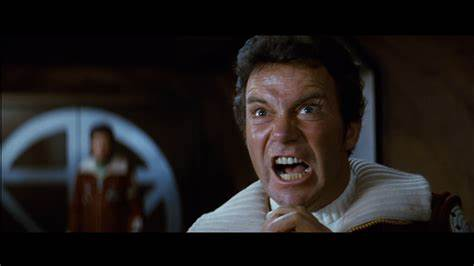
Rewatching the Star Trek movies! Here’s The Final Frontier (1989) in all its broken glory. Shatner directs! Script disagreements galore! Paramount slashed the budget! Sybok! Row your boat! God needs a starship! The fan dance! This one has it all.
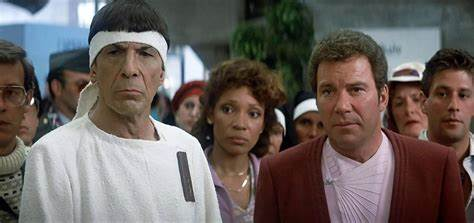
Here’s what happens: Kirk, Spock, and Bones are called in from vacation to the still-being-built Enterprise A following a hostage situation on a hostile desert planet. But the kidnapping is a ruse by Sybok, a Vulcan who’s very in touch with his emotional side. Sybok’s plan is to seize control of the Enterprise and take into the center of the galaxy on a search to find… God. Also, Sybok is Spock’s never-before-mentioned long-lost brother!
Captains courageous: Sybok has this telepathic power to take away everyone’s pain. Kirk refuses, asserting that he accepts his flaws and past mistakes, asserting “I need my pain!” In Trek, our innate humanity is what wins out over alien weirdness. Therefore, Kirk’s refusal to undergo Sybok’s treatment is what allows him to see through the B.S. at the movie’s climax and famously ask, “Why does God need a starship?”
Ol’ pointy ears: Spock’s whole life-death-rebirth journey across these films has been about accepting his emotional/human side in contrast with his hardline Vulcan/logical side. Now he’s put up against Sybok, who all the emotional side. Spock refuses to kill Sybok when Kirk orders him to, but then Spock sides with Kirk against Sybok throughout the rest of the film. Sybok departs the plot abruptly, leaving his and Spock’s issues forever unresolved.
Welcome aboard: Many fans over the years have been disappointed by how Star Trek V introduces a never-before-heard-of brother for Spock. But Trek continuity – including the original series’ “Journey to Babel,” the animated series’ “Yesteryear,” TNG’s “Sarek,” the 1994 novel “Sarek” by A.C. Crispin, and SNW’s “The Serene Squall” – is wildly inconsistent when describing or depicting Spock’s birth and childhood. Spock’s true origins, therefore, are unknowable.
Continuity café: In the TNG episode “Disaster,” a little girl says her favorite nursery rhyme is “The Laughing Vulcan and His Dog.” Writer Ronald D. Moore has said in multiple interviews that this was not a reference to Sybok, though it sure seems to be. The fan speculation and debates continue.
What you leave behind: At its best, Star Trek V has some real visual splendor and a fun, “Gee whiz, let’s go on an adventure!” feel to it. But then, the story is unfocused. The searching-for-God business isn’t well thought out. Sybok’s power to mesmerize people by taking away their pain is one gimmick too many. I don’t know. For as much as we all love Trek, there’s no denying the franchise has a camp element to it, so why not lean into the camp once in a while?
Reading the Fantastic Four comics from the start. Time to start breezing through the rest of Jonathan Hickman’s run multiple issues at a time, with FF #8-11. Fantastic Four’s “lost years” in the 1970s is where things got all confusing and impenetrable, and now we’re back there.
Picking up where we left off two long issues ago, there are four lost civilizations recently discovered that are causing tensions around the globe, and there are four evil alternate universe versions of Reed also running around creating trouble. After Johnny’s death (he’s not really dead) the Fantastic Four have rebranded as the Future Foundation, with Spider-Man and a bunch of young geniuses as new members.
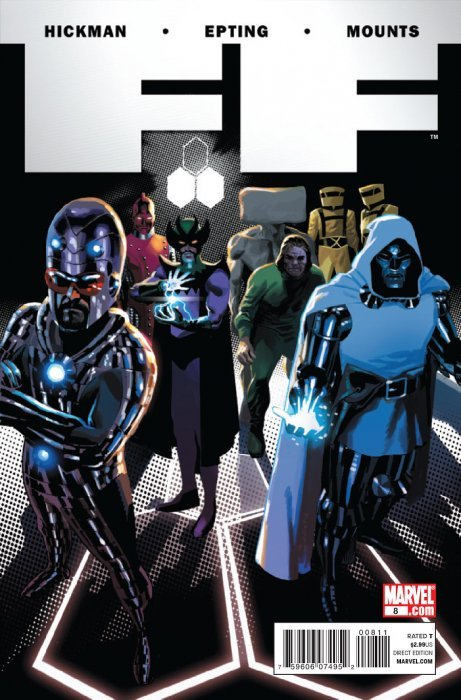
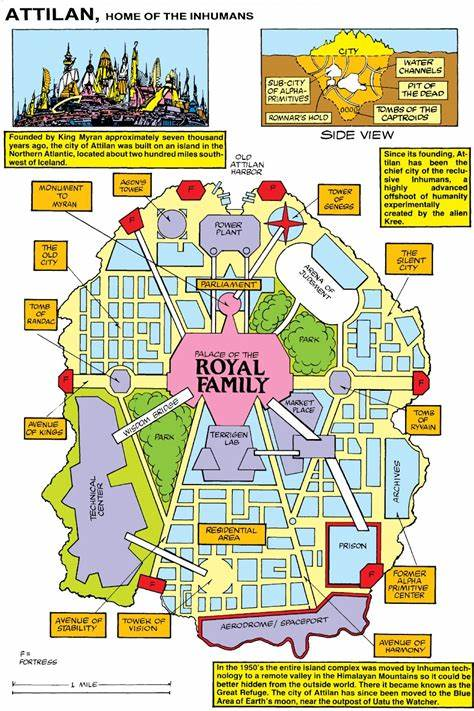
Issue #8 begins with Black Bolt, his new five wives (!) and the floating city of Attilan attacking the High Evolutionary’s city. At the new Baxter Building, Sue confronts Nathaniel Richards about everything that’s happened, namely a bunch of the FF’s enemies being brought in as consultants – Diablo, the Mad Thinker, the Wizard, a bunch of A.I.M. scientists, and the High Evolutionary himself. With his time travel-y knowledge of the future, Nathaniel insists it must be done, and that he’s preparing for war.
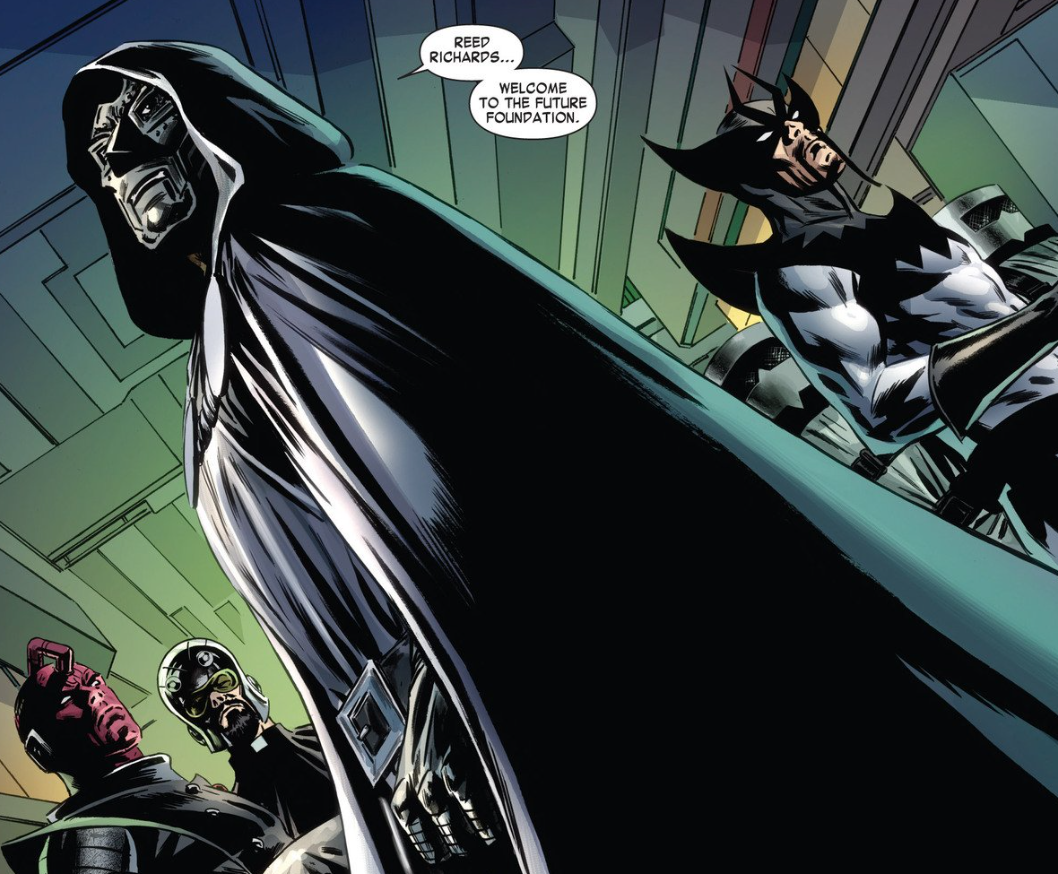
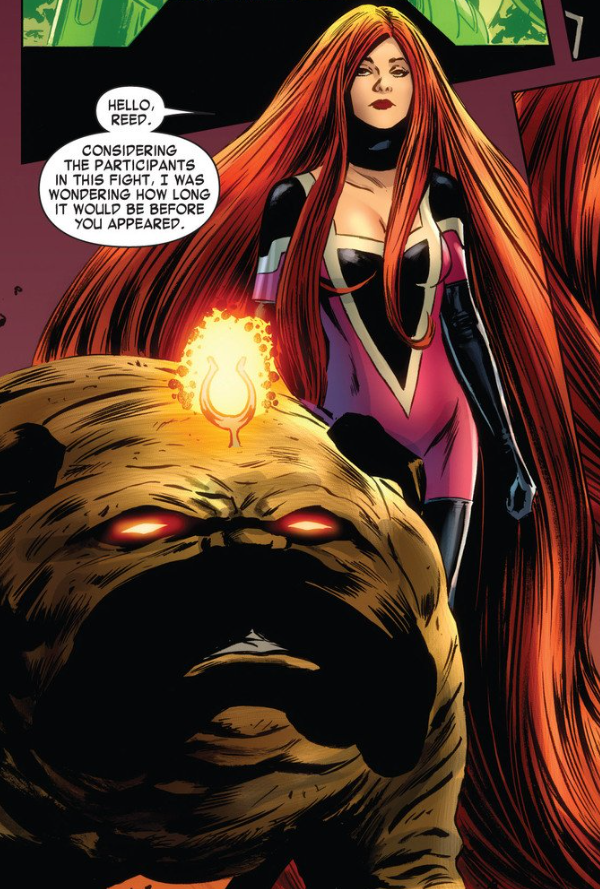
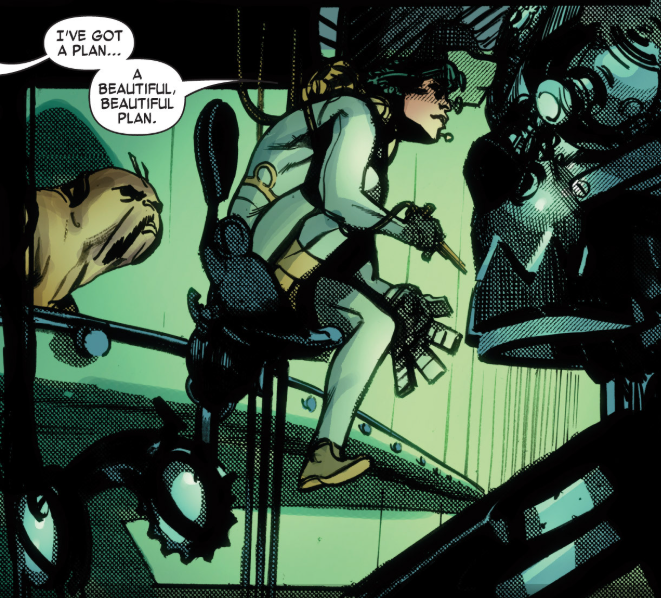
Valeria and Bentley-23 scheme to escape the Baxter Building even though Valeria is grounded for bringing the four evil Reeds to Earth. Reed, Nathaniel, Spider-Man and all the villains infiltrate the High Evolutionary city while the Inhumans attack. Medusa and Lockjaw appear, teleporting Reed away from the scene, saying Black Bolt demands Reed’s presence. Dr. Doom, whom you’ll remember is now technically a member of the Future Foundation, confronts one of the evil Reeds. But before he can get information, Doom is attacked and betrayed by Diablo and the Wizard.
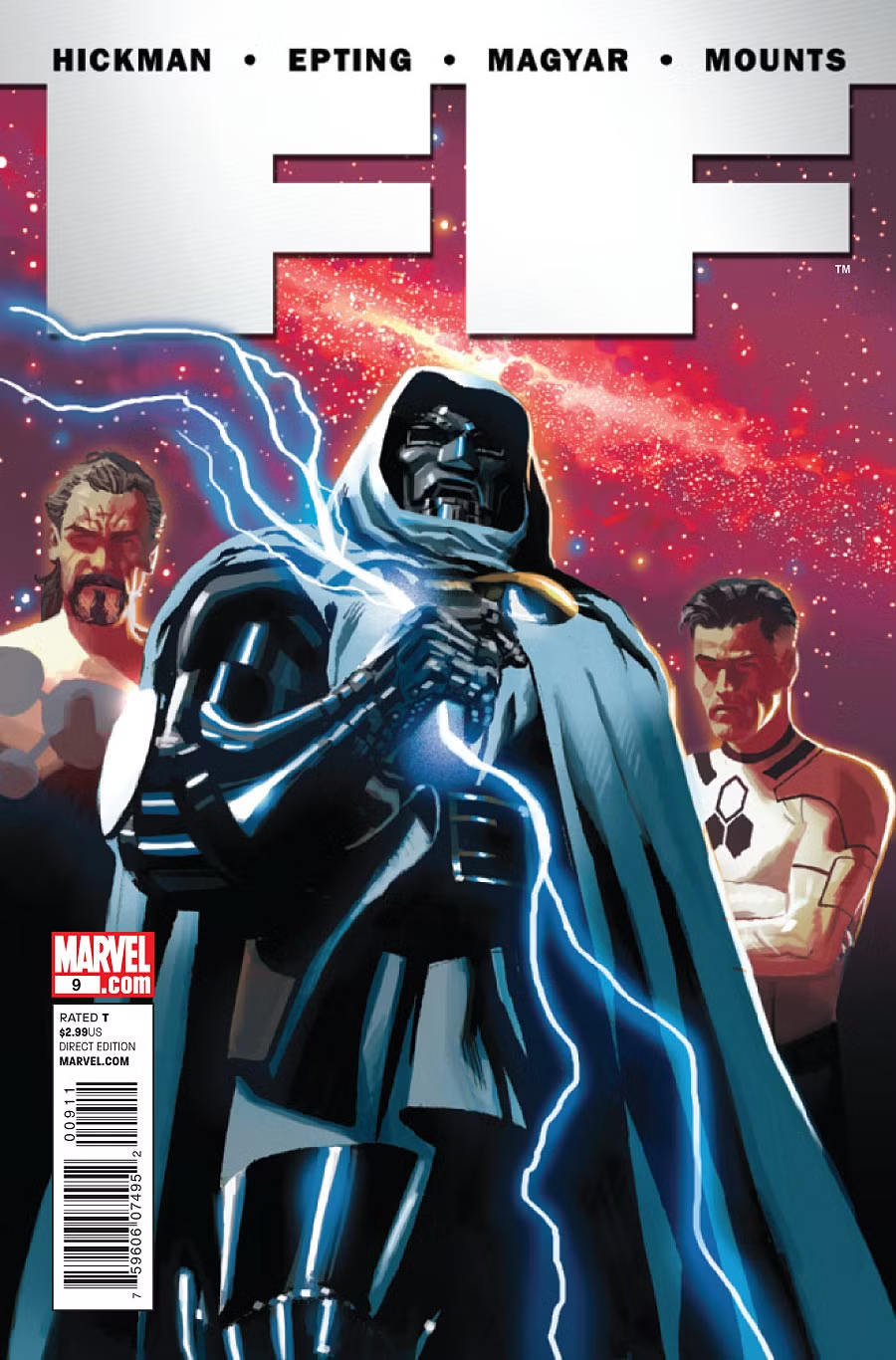
Issue #9 begins with Doom easily recovering from the attack and fighting back. Reed, Spidey, and Nathaniel meet with Black Bolt, who tells them to stand aside while he deals with the evil Reeds. The evil Reeds debate whether to shut down the evolutionary engine that powers the city while the Mole Man escapes. Then Maximus, Black Bolt’s evil brother, joins the fight in a huge battle mech. This turns the tide of the fight. The Inhumans win, capturing two of the evil Reeds.
There’s tension between Dr. Doom and the Inhumans. Doom refuses to join the others in Attilan after seeing a third evil Reed watching from a distance. This Reed has his universe’s version of the Infinity Gauntlet, which he uses to defeat and then enslave Doom. The fourth Reed escapes, but Black Bolt and Medusa insist he will be caught. To get Reed, Spidey, and Nathaniel back home, Medusa offers them Eldrac, a powerful teleporting door, which she says will take them wherever they need to go, which may or may not include time travel.
Issue #10 begins among the Kree, where Ronan the Accuser plans to attack the Inhumans and take Kree leadership back from the Inhumans. (Because there’s not enough characters and storylines happening at once, here’s another.) Ronan is married to Crystal at this time, remember, and she chooses to stay by his side rather than return to her family.
Eldrac returns Reed to the new Baxter Building where he catches up with Sue. Natheniel is teleported to Latveria, to meet with the evil Infinity Gauntlet Reed and the enslaved Dr. Doom. There are references to the “great game” from a few issues back, and Nathaniel says he’s there to help Doom, not the evil Reed. Then we catch up to Ben, still in mourning over Johnny. He’s been staying at Avengers Mansion. Spider-Man appears there courtesy of Eldrac. He tells Ben it’s time to come home. Ronan, Crystal, and the Kree arrive outside Attlian, ready for battle. Then Ben returns to the Baxter Building, bringing the Avengers along with him.
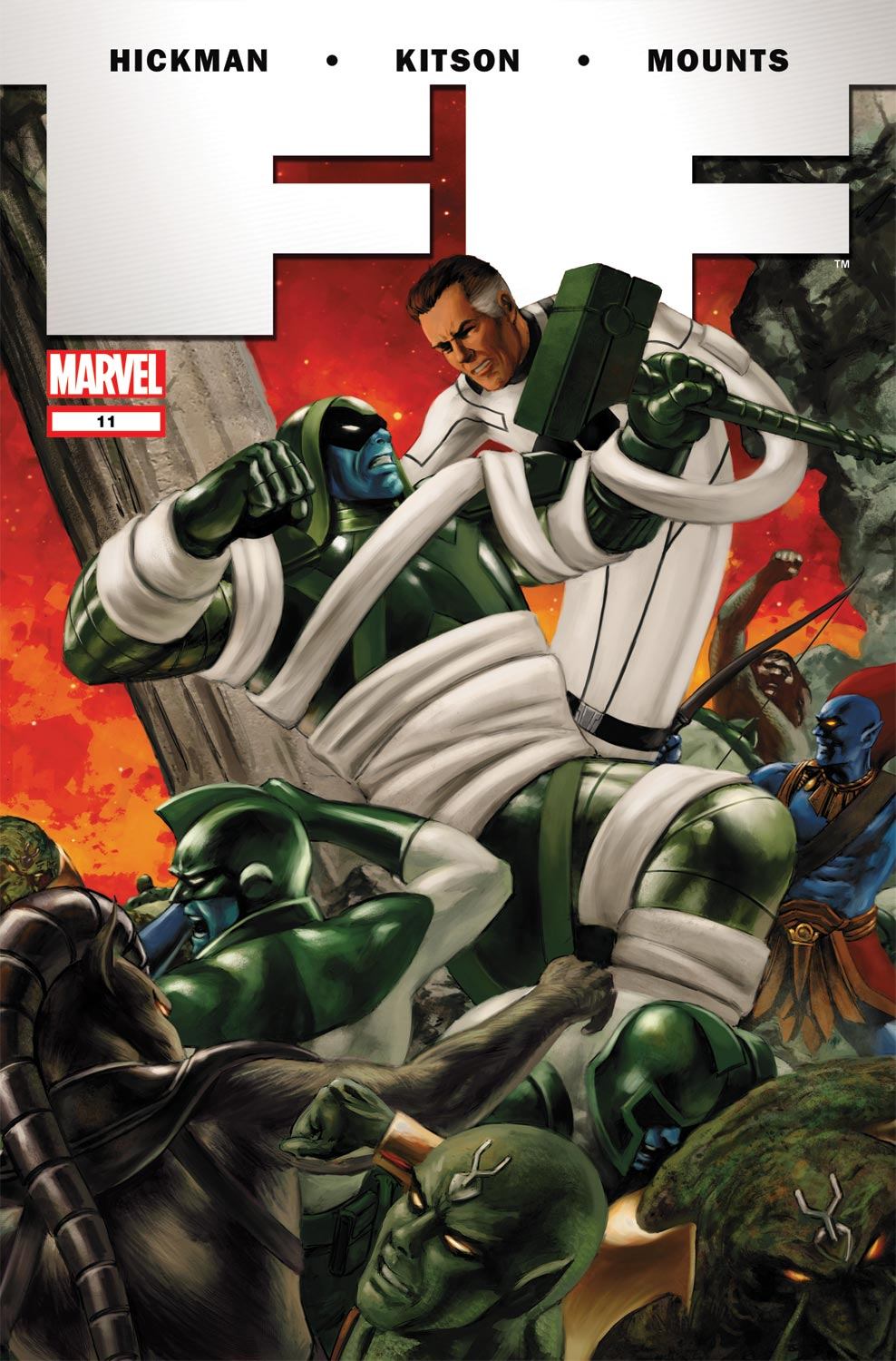
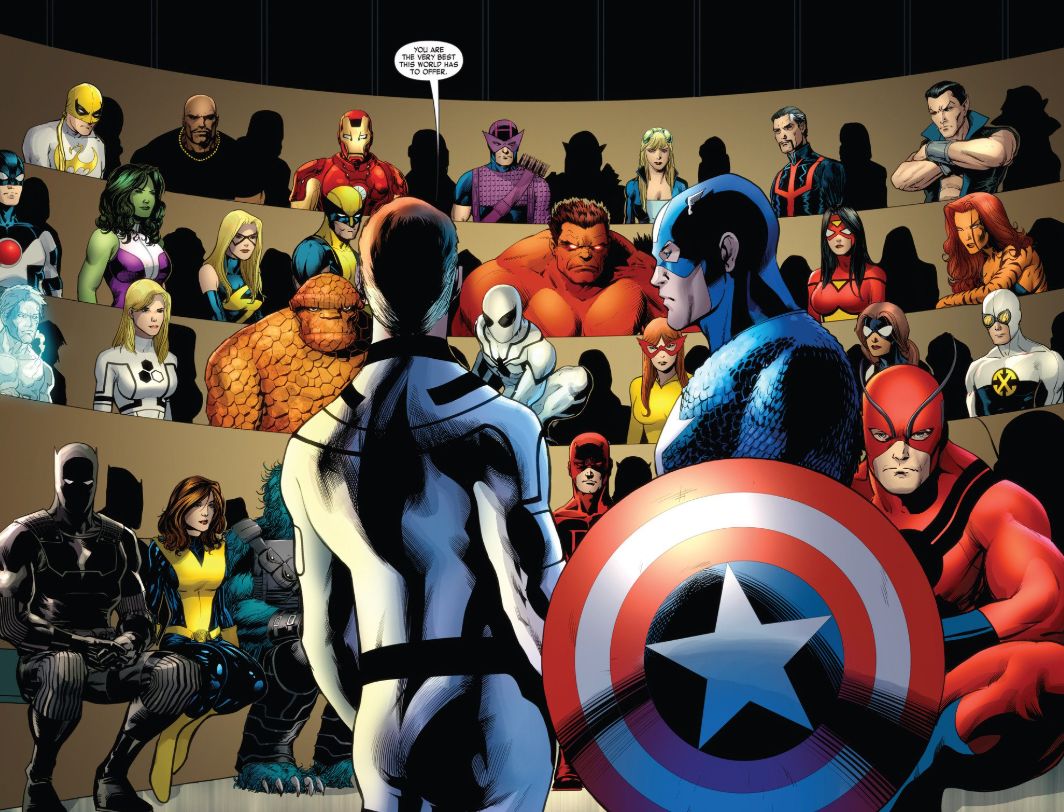
Issue #11 begins with the Future Foundation kids building a giant teleporter inside the Baxter Building in case of emergency. The Kree move on Attilan, attacking a prison and locating the two evil Reeds captured during the battle. Then we’re reunited with Anti-Priest and the Cult of the Negative Zone. They contact Annihilus with a new plan to reopen the Negative Zone portal by putting amplifiers in place around New York, surrounding the Baxter Building. That’s where Reed addresses the Avengers, apologizing for his past actions and hoping that they can succeed where the group of villain consultants did not. Reed and Captain America form a plan to deal with the Inhumans.
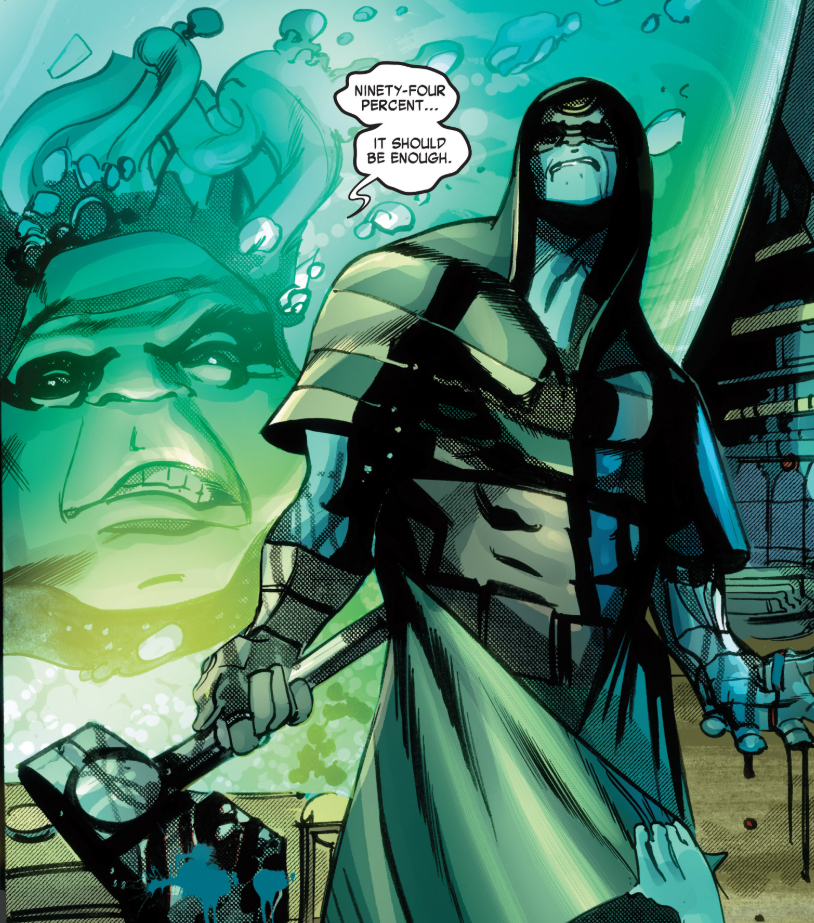
Ronan confronts the two evil Reeds. He does his thing, accusing them of crimes of arrogance. His hammer weapon opens up, revealing a Kree biological entity of some kind. It merges with the two Reeds, transforming into the Kree Supreme Intelligence, now alive once again. But now he has knowledge of the multiverse he didn’t before. He asks, “Where are my armies?” Then, as the FF and the Avengers gather on the Baxter Building’s roof, a Kree fleet appears in the sky over New York.
To be continued!
Unstable molecule: This is the usual character arc for Reed. He gets lost in his own head with all the big science stuff, and then comes around to realizing what’s important. Hence his acknowledging that working with the villains was a bad idea and calling in the Avengers instead.
Fade out: Sue sits out the battle because she’s still recovering from injuries from previous issues. We see her working in the Baxter Building’s garden to relax. Have we ever seen this garden room before?
Clobberin’ time: Ben enjoys “Jarvis burgers” while at Avengers mansion. He later jokes that he maintained his task of doing the dishes even when in mourning.
Fantastic fifth wheel: Alternate FF members among the Avengers are She-Hulk, Luke Cage, Namor (who officially joined the team during the Onslaught crossover), and Tigra (who was a member of the short-lived “Fantastic Seven” team in the ’70s).
Crystal has fully entered her villain era (era), as she’s all-in on the Kree conquests. Medusa is on hand throughout, speaking on behalf of Black Bolt. She seems perfectly okay with her husband having a bunch of other wives.
We get another look at the face of H.E.R.B.I.E. the robot as the Baxter Building’s computer. This time, it’s identified as “H.E.R.B.I.E. Home System.” Freakin’ H.E.R.B.I.E. the robot.
Four and a half: Franklin jokingly (or not?) gives himself the codename “Hyperstorm” while on lookout for the Future Foundation kids. Does he not remember that Hyperstorm was the deadliest threat in the FF history? Or could this be foreshadowing big things to come for Frankllin?
Our gal Val: Valeria “escapes” being grounded, only to have lunch with Bently-23 in the room with the Bridge, the teleporter that brought the four evil Reeds to Earth. Bently likes the bridge for its villain potential, while Valeria finds comfort there, saying it’s the safest room in the building.
Foundational: The Future Foundation kids’ plan is to create a teleporter powerful enough to zap multiple floors of the Baxter Building away to safety in case of emergency. The three Moloid kids discuss developing a sense of humor. Leech chooses “Kid Incredible” as his codename. We’ll see how long that lasts.
Trivia time: The Marvel Wiki insists that the Avengers team in this issue is a combination of multiple teams, the Avengers, the New Avengers, Avengers Academy, the Young Allies, and… the X-Men.
The Wiki also offers partial information on how the Supreme Intelligence comes back to life. Ronan’s hammer, the Universal Weapon, contained the Supremor Seed, the last remains of the Supreme Intelligence. The engine at the heart of the High Evolutionary’s city is what merged the seed with the two evil Reeds, bringing the Supreme Intelligence back to life. It’s as easy as that!
Fantastic or frightful? Comics are often criticized as being unforgiving for new readers, with hundreds of characters and plotlines all running at once. These issues are exactly that. Yes, there’s a big battle with a lot of action, but all the twists and turns, and the constant changes in location, and all the shifting alliances, it’s just too much. The handful of character moments we get are nicely done, and I really wish there was more of a balance between those all this plot, plot, and more plot.
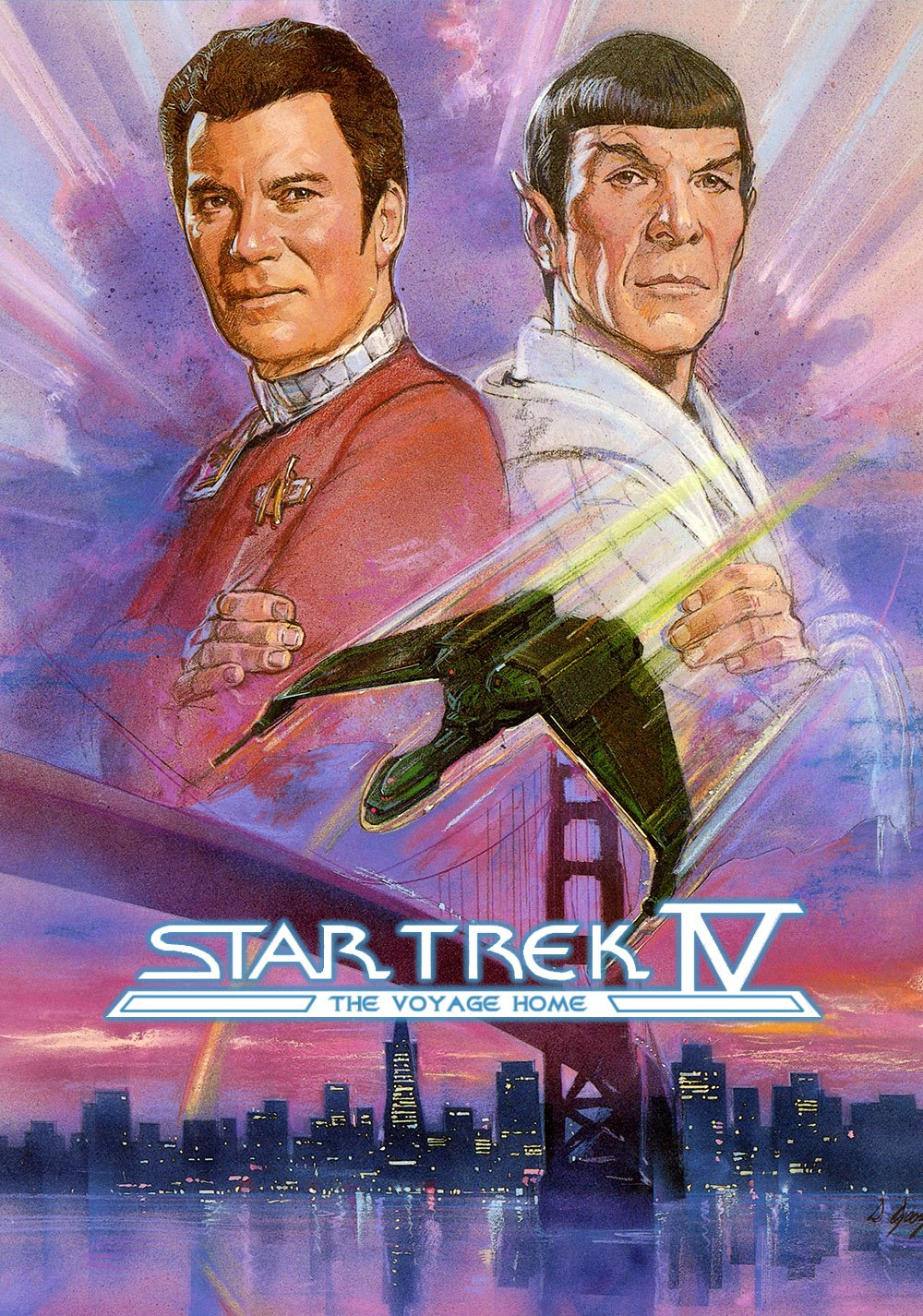
Rewatching the Star Trek movies! After the life and death seriousness of the previous movie, it’s time for the franchise to let its hair down and have some fun in Star Trek IV: The Voyage Home.
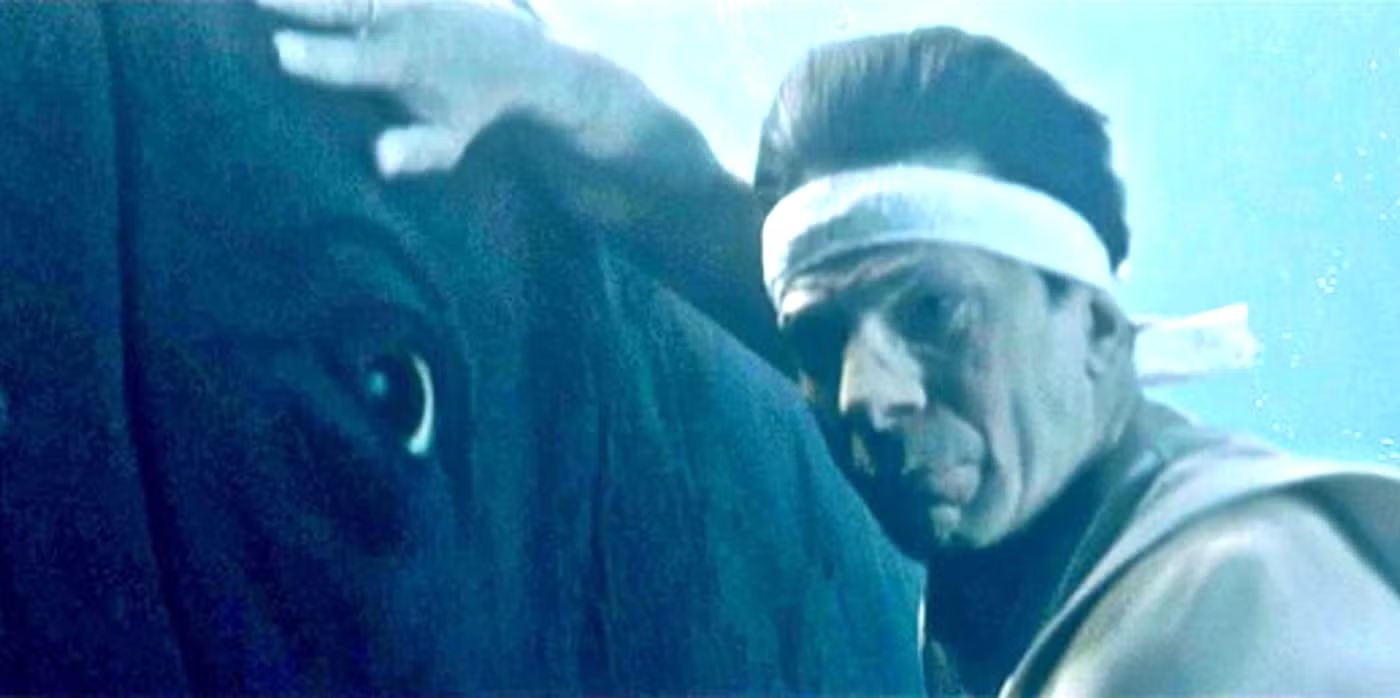
Here’s what happens: Kirk and company return to Earth to face trial for stealing and then blowing up the Enterprise in the previous movie. Except a giant alien probe has made it to Earth first, threatening the entire planet if it doesn’t get an answer. Spock and Uhura are quick to deduce that humpback whales are the key to answering the probe’s call and saving the Earth. But all the humpbacks are extinct, so prepare for time warp…
Captains Courageous: In the previous movie, Kirk risked everything on a leap of faith to bring back Spock. This time, it’s another leap of faith. McCoy goes on quite a rant about how much of a longshot Kirk’s time travel plan is, but Kirk insists it’s the only way.
Ol’ pointy ears: We spent two movies with Spock having accepted his human half, which felt like genuine character development for him. But now he’s rebooted (so to speak) back to hard logic mode. It makes for some fun humor, but what is the character arc here? Spock is so single-minded at first that he can’t answer “How do you feel?” Later, when the mission is in trouble, Kirk calls Spock out his non-emotions, reminding Spock that he’s half-human and asking if he feels anything about that. This comes to a head during the trip back to the present (future?) where Spock must do the illogical thing and make a guess on how to get home. His humanity and imperfections are what save the day.
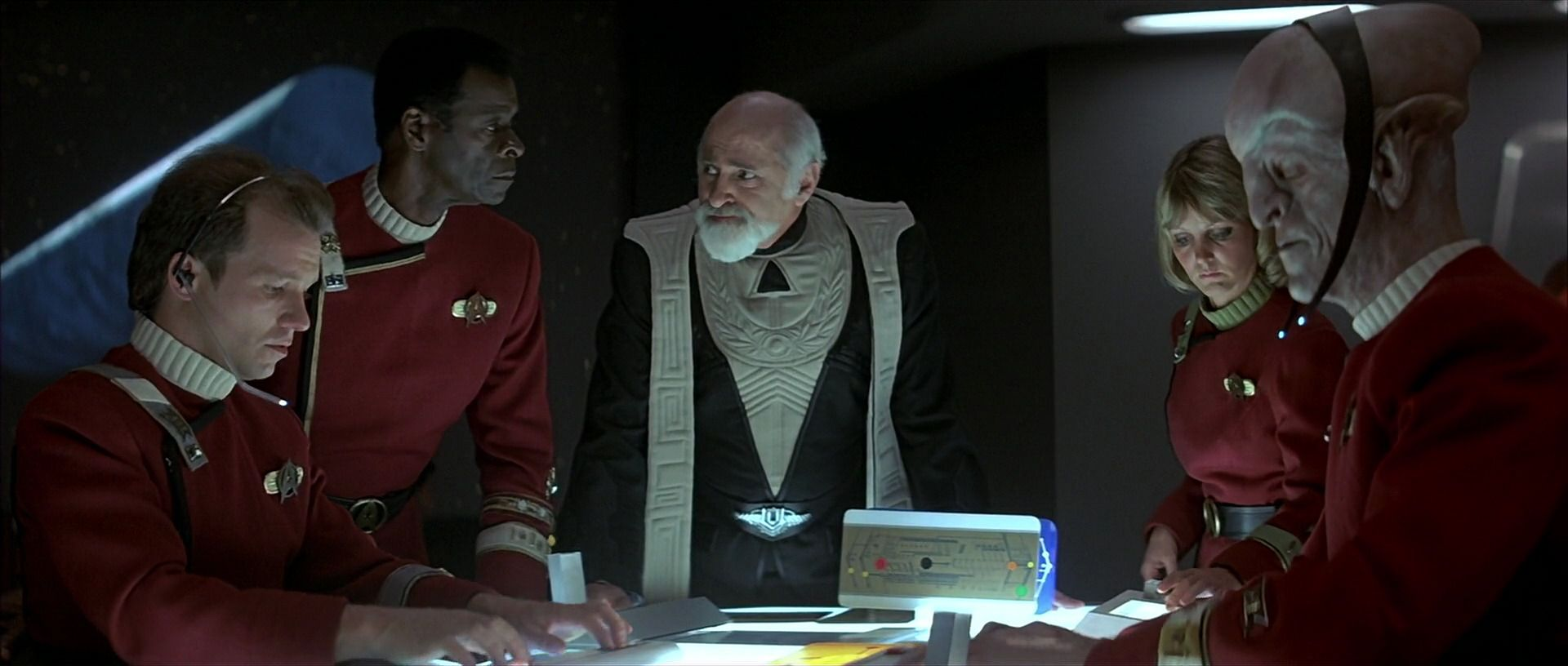
Welcome aboard: Catherine Hicks, as whale expert Gillian, is fun and flirty with Kirk. But I’m more interested in all the ancillary Starfleet characters seen at the opening of the movie. The great John Shuck hams it up as a blustery Klingon, Brock Peters is a commanding presence in his recurring role as Admiral Cartwright, plus we’ve got an unnamed Federation President, and an unnamed female starship captain years before Rachel Garrett and good ol’ Janeway. (What’s with all these unnamed characters in Trek’s supposedly rock-solid continuity?)
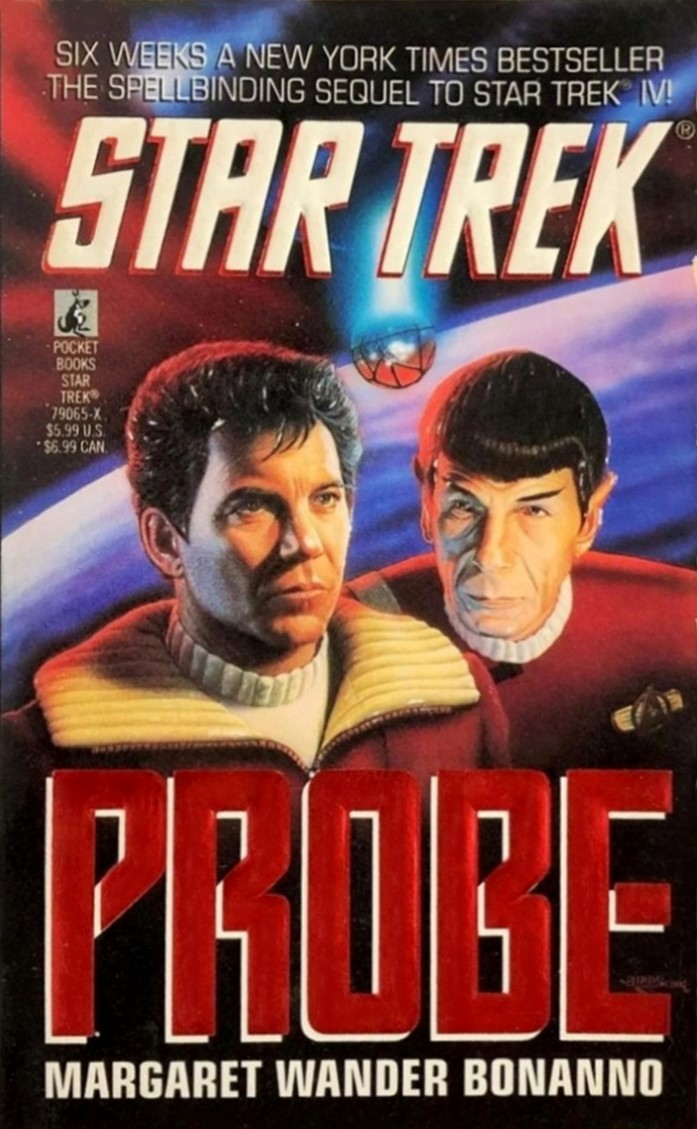
Continuity café: The movie doesn’t tell us what the probe is, where it came from. To get all that background, you had to read the follow-up novel, Star Trek: Probe (1992) by Margaret Wander Bonanno. I would go ahead and spoil it, but… I find the book unreadable. I’ve tried to get through it several times, but I never made it to the end. God Emperor of Dune was less obtuse.
What you leave behind: I like that the movie is light and funny (even if the circus music-style score is trying too hard to be wacky). But, like The Motion Picture, it makes you work to find the character arcs. This movie is beloved and considered a Trek classic, but I wonder if there could’ve been an even better version, that more successfully married its humorous side with its dramatic side.
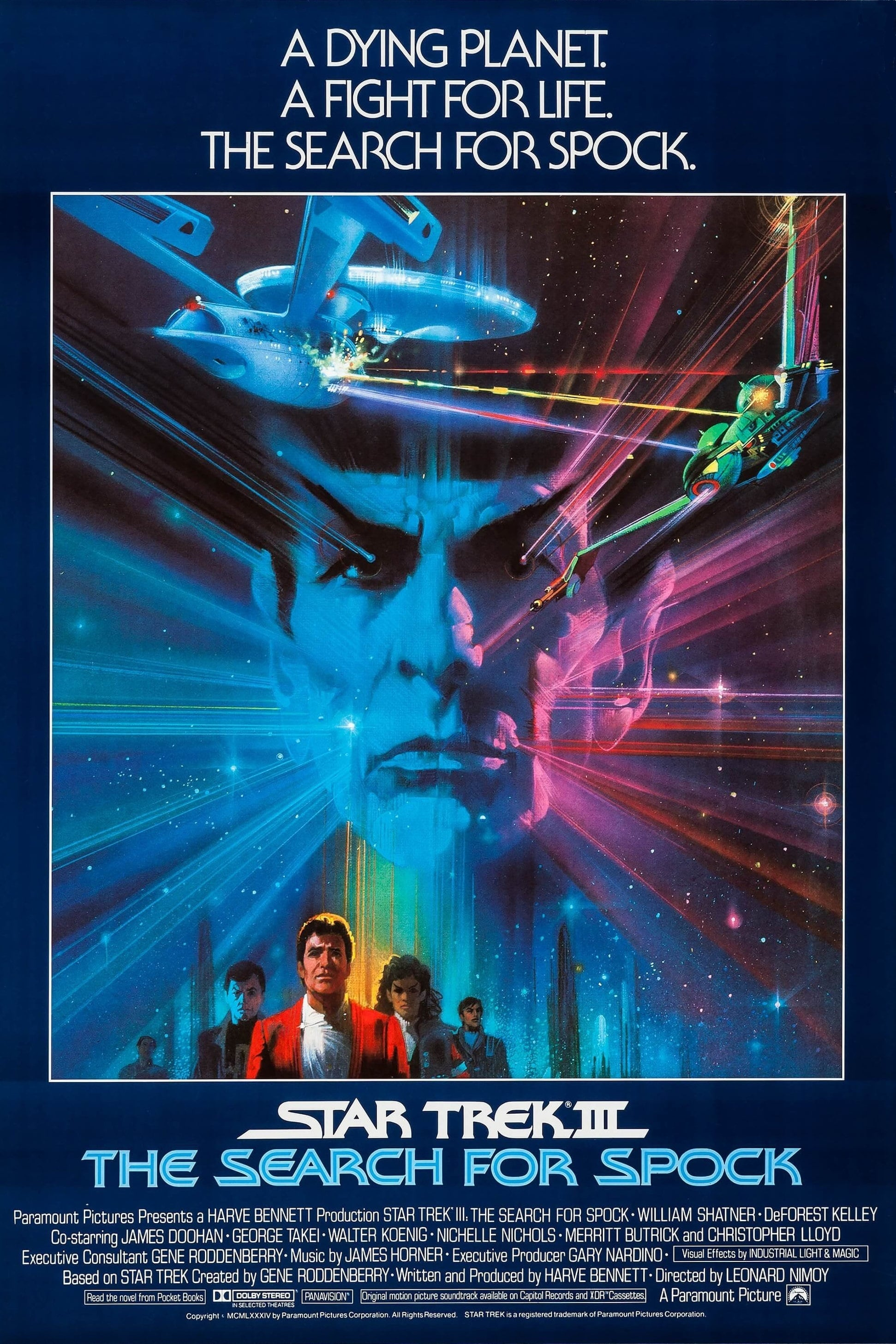
Rewatching the Star Trek movies! While Spock’s death in the previous film is moving, everyone doubted he was really dead. Hence 1984’s The Search for Spock.
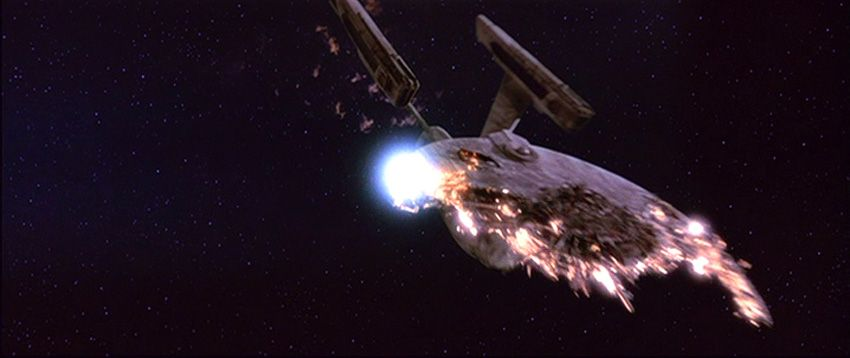
Here’s what happens: The Enterprise returns to a Federation space station following the events of the last film. But McCoy’s strange behavior and a message from Spock’s father has Kirk and the crew stealing their own ship to return to the Genesis planet to find what really became of Spock. A Klingon ship is also headed straight for Genesis, with murderous intent.
Captains courageous: There’s a great scene early on where the head of Starfleet denies permission for the Enterprise to return to Genesis, saying Kirk’s plan is based on nothing but Vulcan mysticism. Here we have the famously atheist Trek franchise going down a spiritual route. Everything Kirk does is based on faith – faith that Spock and McCoy can be saved, and faith that innate humanity can win out over the hard logic of the “needs of many vs. needs of few” thing.
Ol’ pointy ears: Does Spock have a character arc in this movie? Kinda. He spends most of the movie as a blank. He has returned as viewers predicted, so the suspense becomes in what way has he returned, and will he be the same? The movie’s final scene has Spock remembering who he is. Can we view this as a mirror to him accepting his human side in The Motion Picture, or am I reaching?
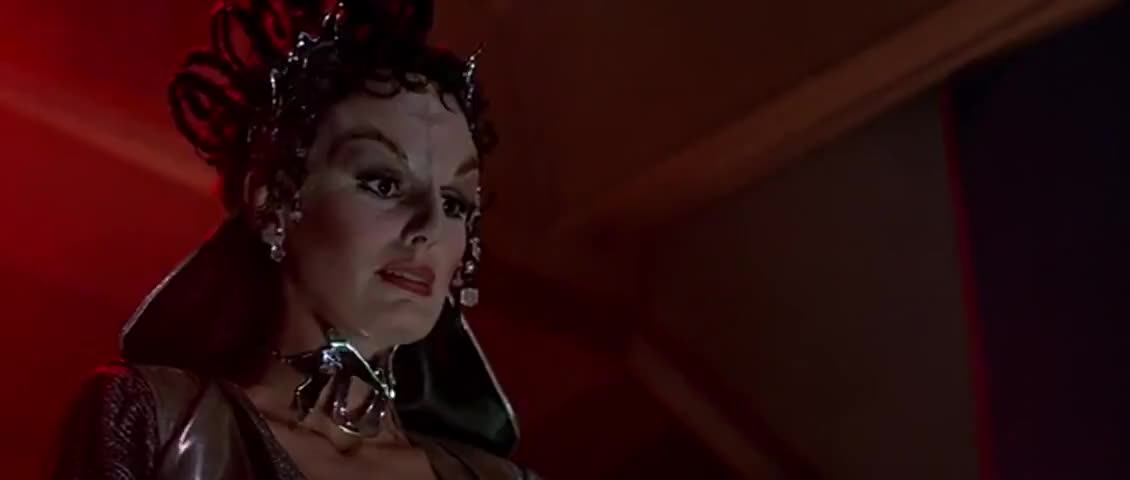
Welcome aboard: Christopher Lloyd hams it up delightfully as the evil Captain Kruge. But what is this bizarre scene at the beginning of the film where he confronts the mystery woman Valkris? She’s a Klingon agent delivering the Genesis info to him, and he kills her for looking at it without his permission. The dialogue suggests that the two may have been lovers, but the tie-in fiction disputes that, with a backstory about how they agreed to her death ahead of time, so that her dying with honor (does she?) will restore her family’s high status in the Klingon Empire.
Continuity café: McCoy goes to a bar aboard the starbase, and there’s a lot of fun alien/sci-fi gags. This includes an appearance by Tribbles. What to make of this? Does this mean Tribbles have been successfully domesticated by humans at this point, or are they about to overrun this station like they did in the classic series? Was this before or after the Klingons raided the Tribble homeworld and killed them all? Or are they not Tribbles at all, but the fake Tribbles you can buy at conventions? (Not that I’ve ever bought one…)
What you leave behind: Bringing someone back from the dead happens a lot in sci-fi/fantasy, because it’s something you can do there that you can’t do in, say, a romcom set in a small-town bookstore. I’ve been of the mind that if your story absolutely must bring a character back from the dead, it should be really hard. In this film, Kirk makes huge, life-changing sacrifices in pursuit of Spock. This speaks to the story’s theme of acting on faith. Good movie, lots to think on.
Reading the Fantastic Four comics from the start. Here’s FF #7, the second half of an extended flashback that… Oh, I just can’t.
Recap: Two issues ago, the conflict between four recently-discovered lost civilizations was complicated by four evil versions of Reed from alternate universes, and then complicated further by the appearance of the flying Inhuman city of Attilan with Black Bolt on the throne. Then we got an entire issue of a flashback how Black Bolt recently died, another flashback about the Kree Supreme Intelligence learning that an Inhuman will be his eventual demise, and yet another flashback of Black Bolt returning to life.
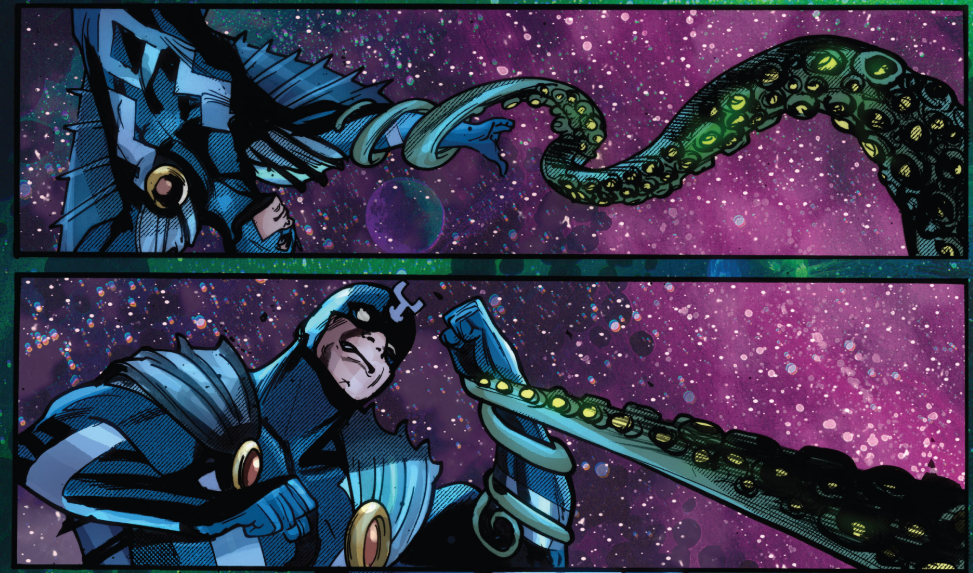
This issue begins still in flashback, located “within the fault,” in deep space, where Black Bolt is under attack by tentacles (wa-hey!). This goes on for a bit until Black Bolt is rescued by the Inhumans’ teleporting dog Lockjaw. On the Kree homeworld of Hala, we’re reminded that the Inhumans recently took that throne, with Medusa ruling in Black Bolt’s place. The Kree all kneel in awe of Black Bolt’s strength and might.
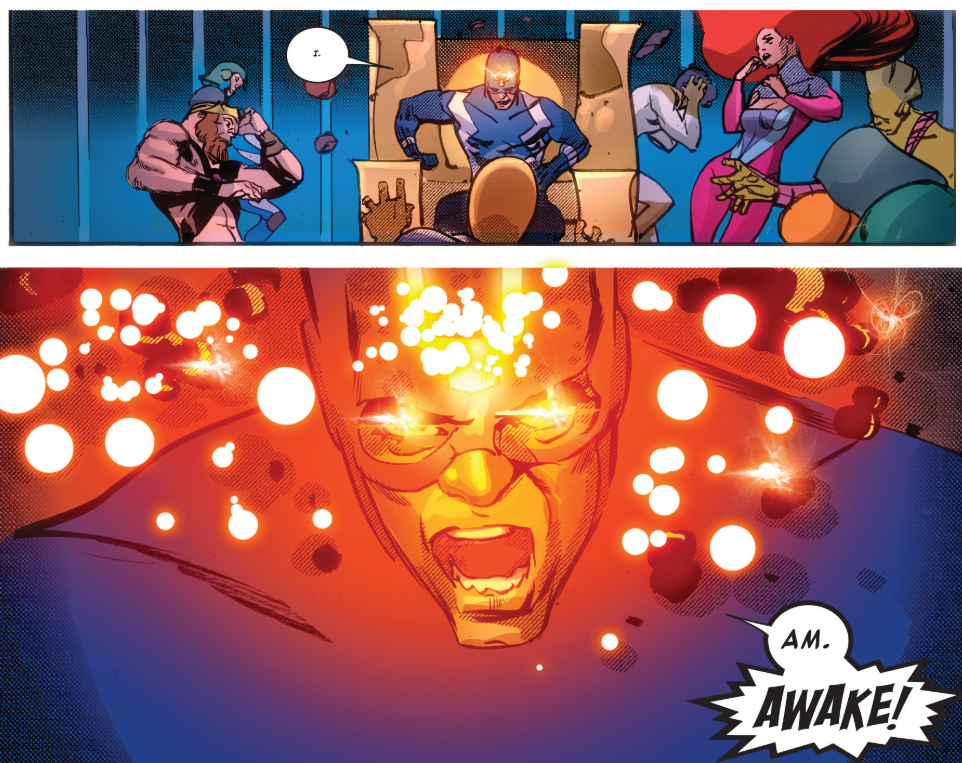
Then there’s some politicking where a Kree regent argues against sending aid from the strong core planets to the weaker and impoverished planets on the fringes of Kree space, saying that this is simply not how the Kree operate. Black Bolt leaves Ronan the Accuser in charge to deal with this matter, as the Inhumans must return to Earth immediately. The Kree all argue against this, saying they gave Black Bolt rulership over the Kree for a reason. The regent asks him what changed and he actually speaks, saying, “I am awake!” His super-powered voice wreaks destruction in the throne room and killing the regent.
Medusa further explains that the Inhumans must leave because this is a summoning. She gives Crystal the option to join them or to stay with her new husband. She chooses to stay, revealing the husband is… Ronan the Accuser?!? Okay, then.
Cut to one thousand years earlier, when the Kree Supreme Intelligence is still freaking out over his own eventual death. He says he has come up with a stratagem to change his fate, and says that it will require something unexpected, a “Supremor seed.” This seed appears in the form of a glowing spikey thing, and it’s given to that era’s (era’s) accuser for protection.
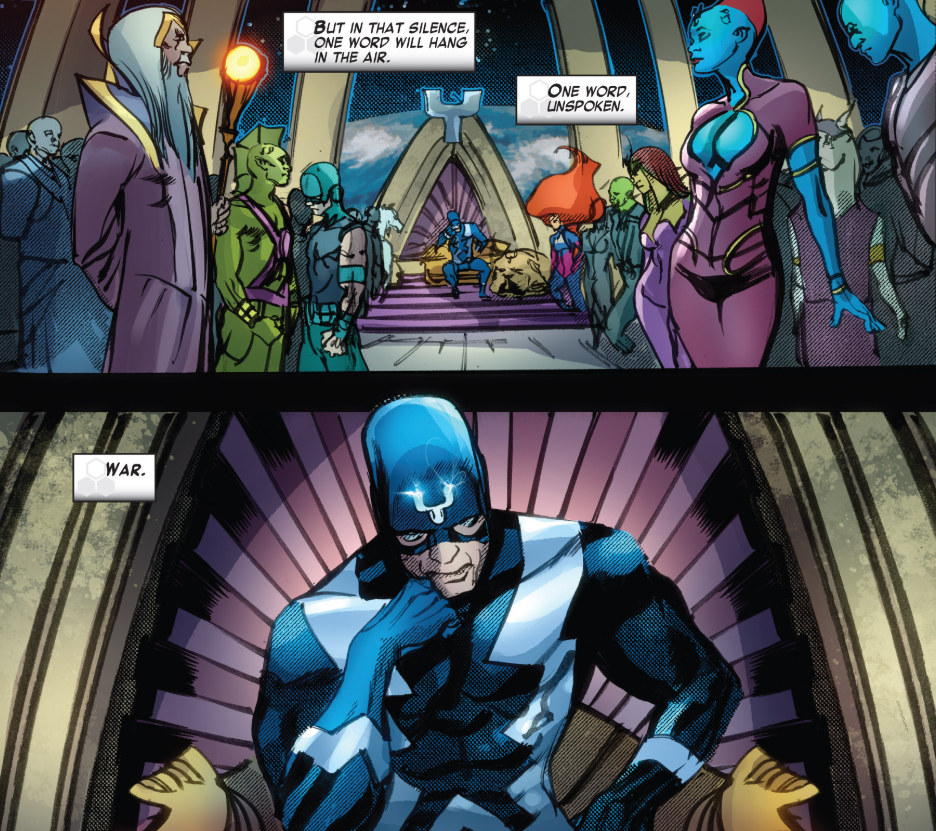
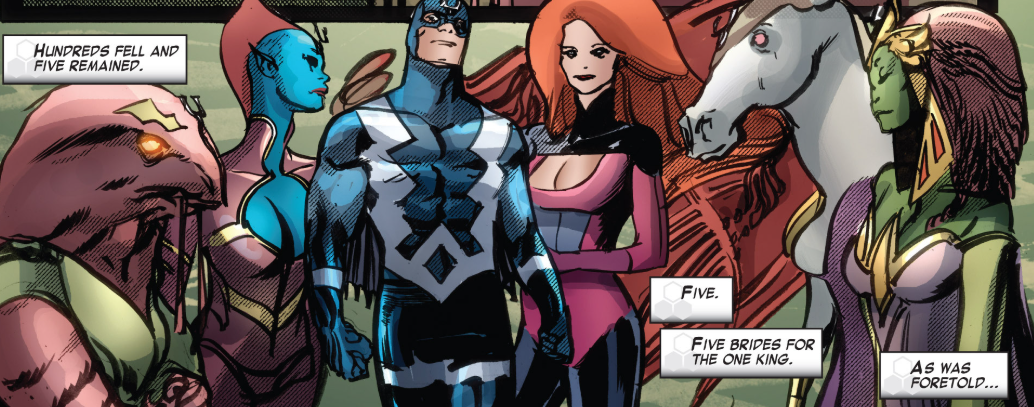
Then we flash forward/flash back to one month earlier, cutting to the moon. Black Bolt and the Inhuman royal family return to Attilan, where they meet the Universal Inhumans, made up of various aliens among these are four queens, from the Badoon, the Centaurians, the Kymellians, and even the Dire Wraiths. These four, along with Medusa, are the five brides mentioned in a prophecy in the previous issue. The captions tell us that the prophecy claims the chosen one has a voice that can shake entire worlds, and will speak one word, “War.”
To be continued?
Fantastic fifth wheel: Crystal and Ronan the Accuser are married?!? This was news to me. Turned out the blessed event happened in the Secret Invasion: Inhumans miniseries. The Inhumans allied themselves with Kree to help fight off the Skrulls. It seemed like an arranged marriage at the time, but by this issue Crystal shows some genuine affection for her new alien husband. This began Crystal’s new position as Inhuman ambassador to Earth, which the Marvel Wiki says still holds.
Medusa is able to interpret a lot of Black Bolt’s intent after seeing him just wave his hand. It’s established by now that the two of them are that in sync.
Trivia time: The names of some of Black Bolt’s new brides are familiar, or are they? The Centaurian is Oola Udonta, whom the Marvel Wiki says “may be” related to Yondu Udonta from Guardians of the Galaxy, and the Kymellian is Onomi Whitemane, with no note whatsoever whether she is related to Aelfyre Whitemane from Power Pack.
Fantastic or frightful? Everybody keeps telling me they love Jonathan Hickman’s take on this series, and that he’s one of the all-time best. But I just can’t with this guy. These last two issues have been unreadable, with the main story screeching to a halt for a two-month long info dump. A few weeks back, I praised Hickman for finally starting to tie a bunch of plot threads together, but I don’t feel that way anymore.
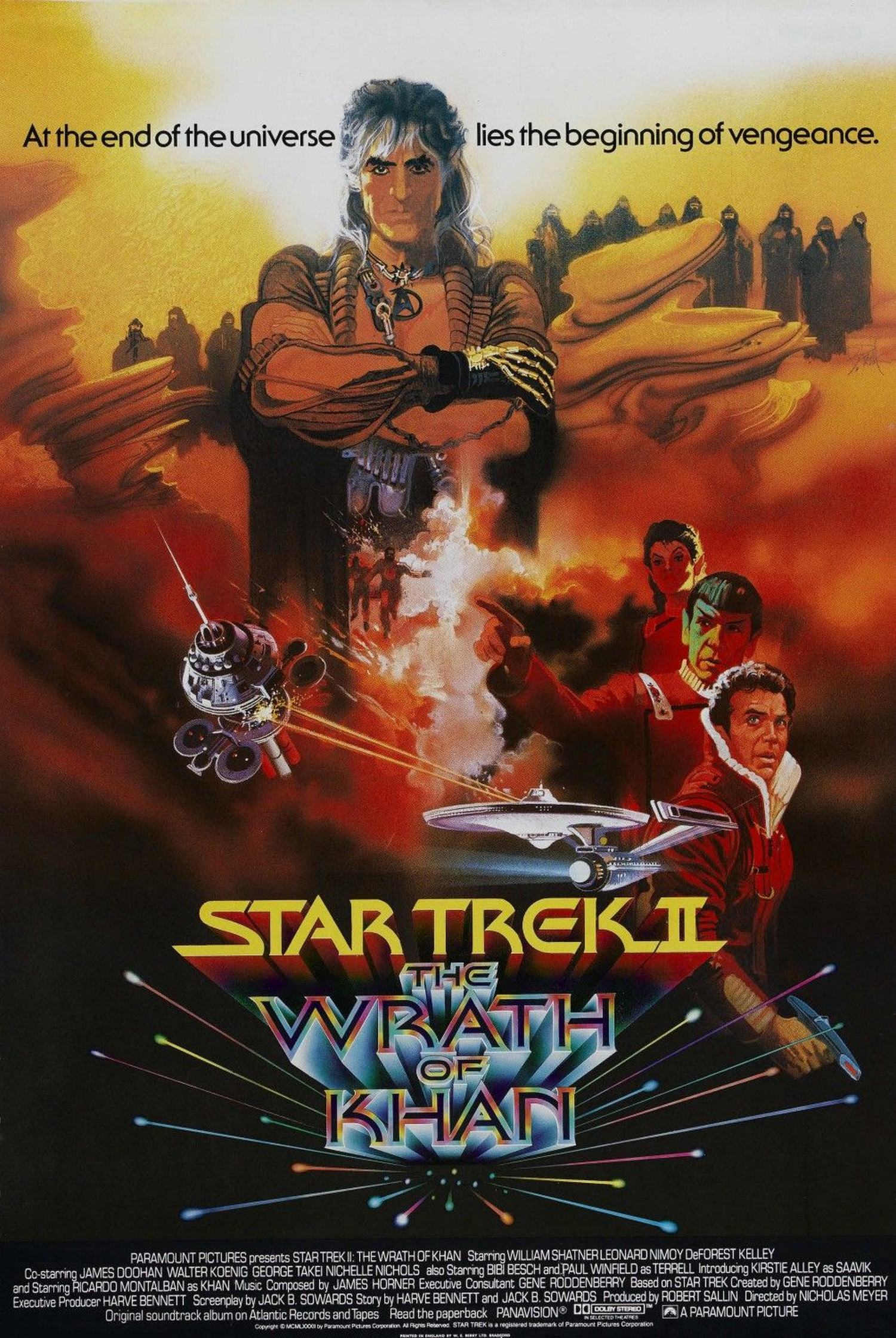
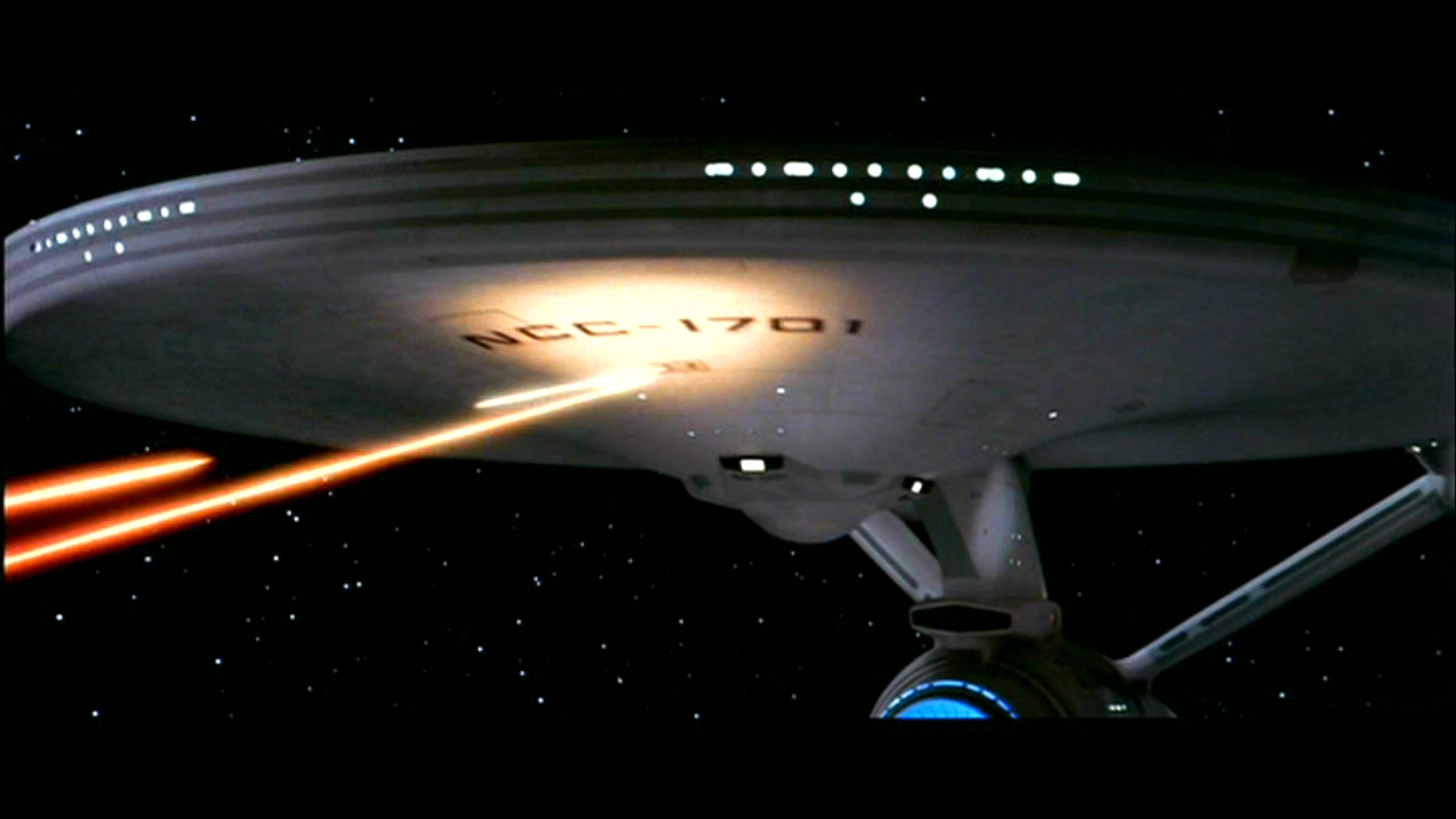
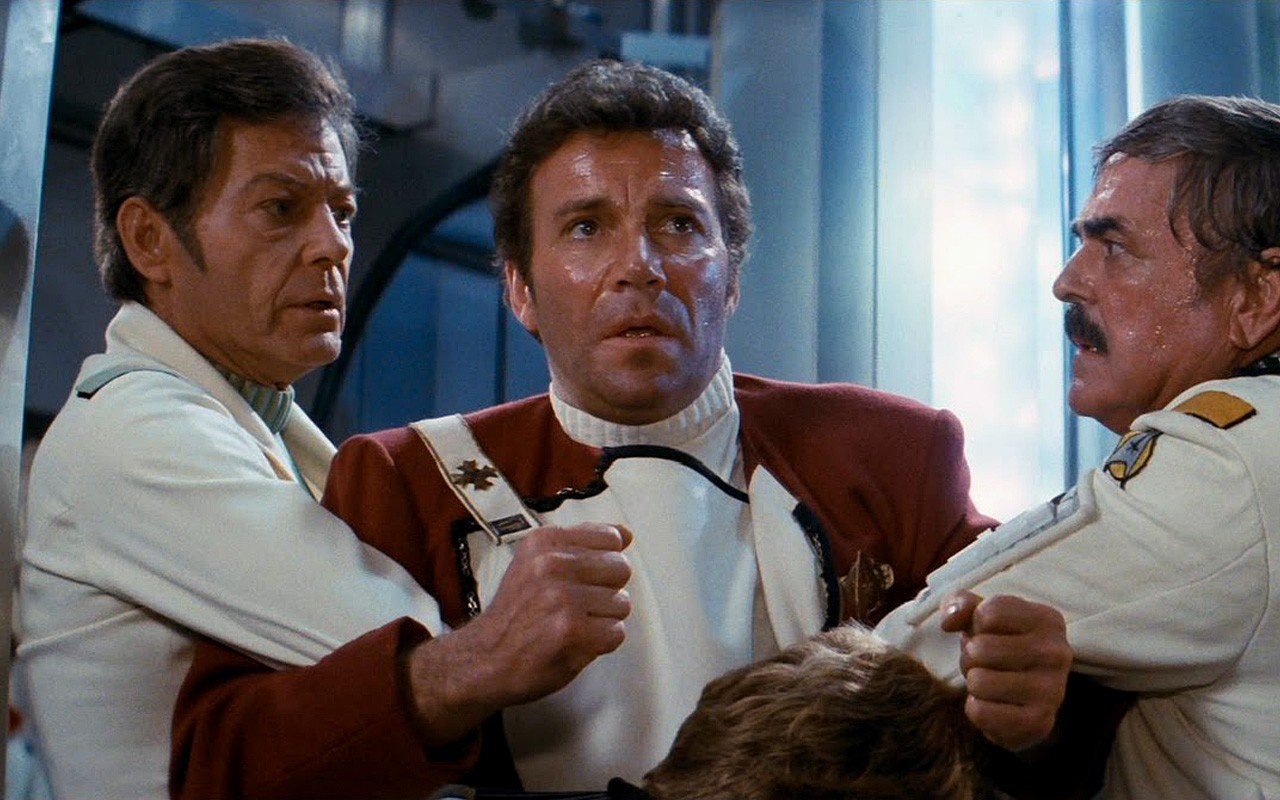
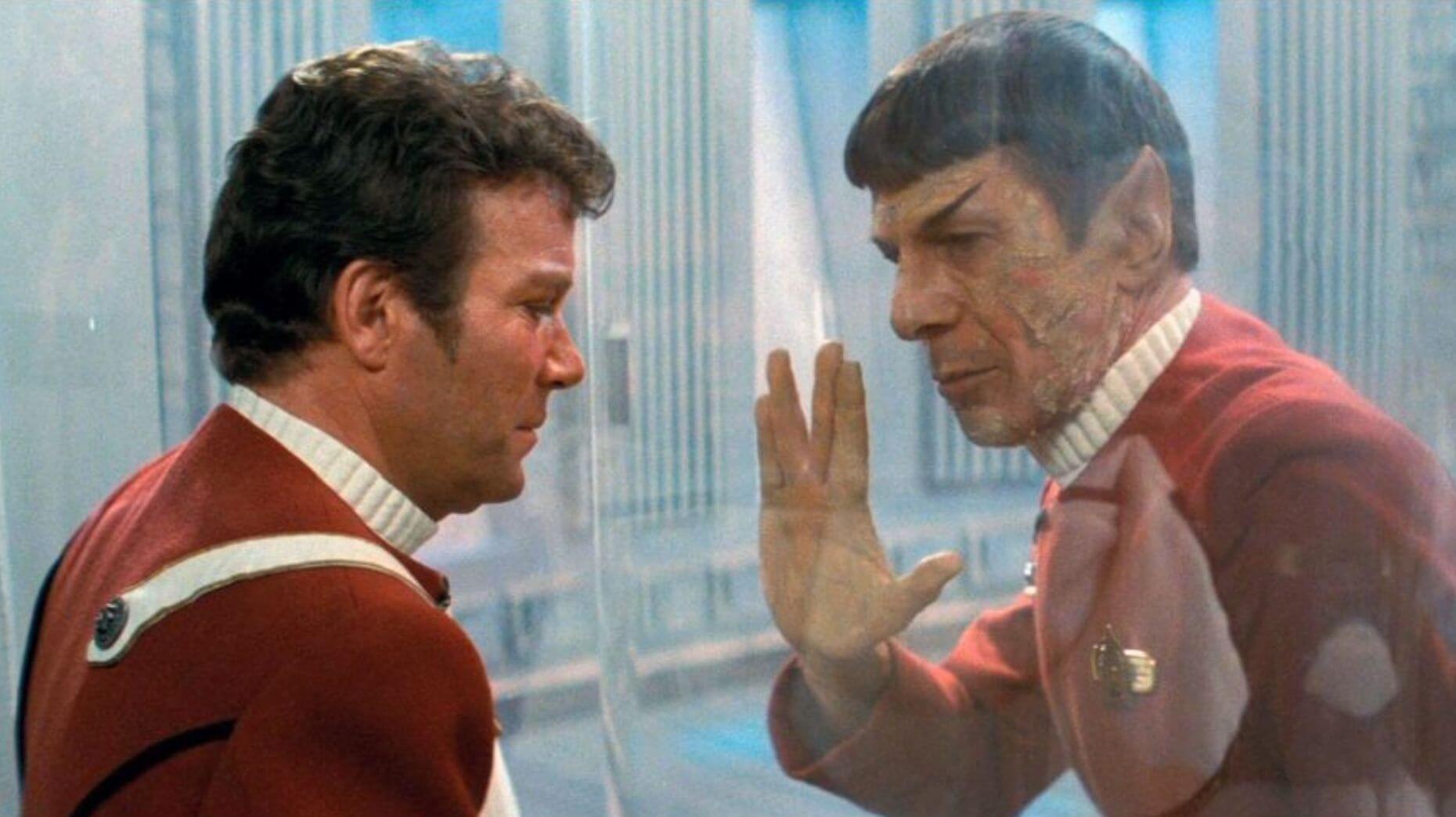
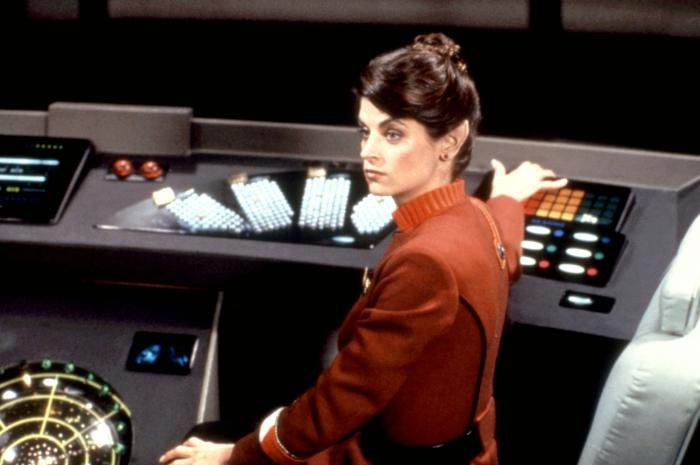
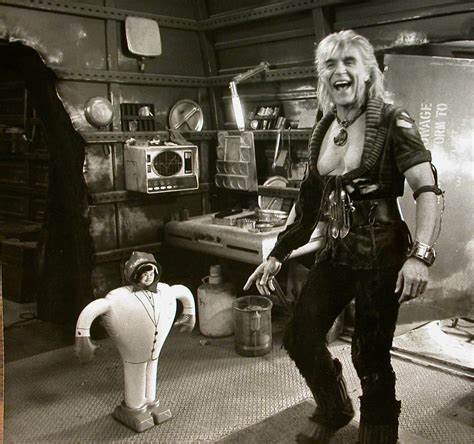
Rewatching the Star Trek movies! Star Trek II: The Wrath of Khan (1982) is considered one of the high marks – if not the high mark – of the entire franchise. But what does it say about our characters?
Here’s what happens: When a Starfleet ship accidentally discovers the villain Khan (from the original series), events are set in motion where Khan seeks vengeance against Kirk by weaponizing a miraculous new technology.
Captains courageous: Kirk is still an admiral, back on Earth, where he’s teaching a group of trainees. His crew and the trainees board the Enterprise for a three-week inspection (how does that work?) This business of training recruits has Kirk reckoning with getting older and wondering if his good days are behind him. Spock is on hand to remind him that the captain’s chair is where Kirk is meant to be.
Ol’ pointy ears: Spock spent the last movie accepting his half-human emotional side as part of himself. By now he’s circled back around to full-on logic, introducing the “needs of few vs. needs of many” theme that will carry this through the next two movies. But then, the finale of the movie is about Spock making a sacrifice that goes against the “few vs. many” logic. This makes him – dare I say it – human.
Welcome aboard: All the fan blogs love to point out that new character Lt. Saavik is not just Vulcan, but part Vulcan/part Romulan. The movie doesn’t say this, however. I did a little reading, and allegedly Saavik was created as a new version of Spock for the never-made Star Trek II TV series of the mid-70s. Her Romulan background was written out of Wrath of Khan, apparently because it was an unnecessary detail that didn’t add much to the character. Follow-up novels and comics did more with Saavik, and there’s where her Romulan-ness was made canon.
Continuity café: To get this story to work, a number of details from the original series’ Space Seed have been rewritten and/or ignored. Most fans shrug this stuff off as either the passage of time or extrapolating by filling in gaps unseen in the old episode. Imagine that – Trek fans actually suspending their disbelief for once.
WTF is this?
What you leave behind: What can I say about this movie that hasn’t been said. It’s big, bold entertainment, one that’s enjoyed by both Trek hardcores and casual viewers alike. As far as character development goes, it’s more of a reset after The Motion Picture rather than a continuation. But that’s okay, because this one establishes key themes for the characters moving forward.
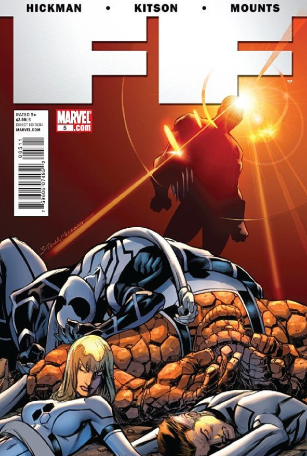
Reading the Fantastic Four comics from the start. Is Black Bolt your favorite Marvel character? He’d better be, because FF #5 all about him.
Recap: Four evil alternate universe versions of Reed, of the interdimensional Council of Reeds, are running around on Earth, plotting to bring about war between four recently-discovered lost civilizations. As the Reeds enact their plan in an underground city – one of the four – Attilan, home city of the Inhumans, appeared in the sky over Earth, with an angry Black Bolt sitting on the throne.
The issue begins with yet another recap of what the Inhumans have been up to lately, which has been a lot. In the War of Kings crossover, Black Bolt took over the Kree empire only to die in battle against Vulcan, ruler of the alien Shi’ar empire. A space-time bomb had gone off, and Black Bolt was believed dead in the explosion. Cut to “weeks ago,” where Medusa is ruling the Kree in Black Bolt’s place. Crystal spies on the proceedings from the sidelines, telling the teleporting dog Lockjaw to keep on eye on things. An unnamed Kree scholar tells Ronan the Accuser (yes, he’s here as well) that it’s time to “release the seed.”
Just as we’re starting to follow this plot, we then cut again to “thousands of years ago,” on the Kree home world of Hala. Two scientists meet with the Kree Supreme Intelligence. The scientists have experimented with “metagenesis” allowing them to create a weapon from any living being (!). The Supreme Intelligence uploads the data into itself, with a lot of talk about “cosmic awareness” and “genetic prophecy.” One of the scientists says there are thousands of minds of geniuses contained in the upload, but one lone voice speaking on behalf of religion is an outlier called the “divine chimera.” This is the individual who will eventually be the downfall of the Supreme Intelligence. He has a symbol, which looks like Black Bolt’s famous antenna.
As the upload nears completion, the Supreme Intelligence orders the scientists killed, which that era’s (era’s) accuser does. The Supreme Intelligence orders a “cleansing,” after which we see the Kree accusers travelling from planet to planet, ordering huge slaughters to prevent this “chimera” from being born. The caption states that “five and one” survived – five queens for one king. This is a reference to Black Bolts queens from alternate universes who saw him die in War of Kings.
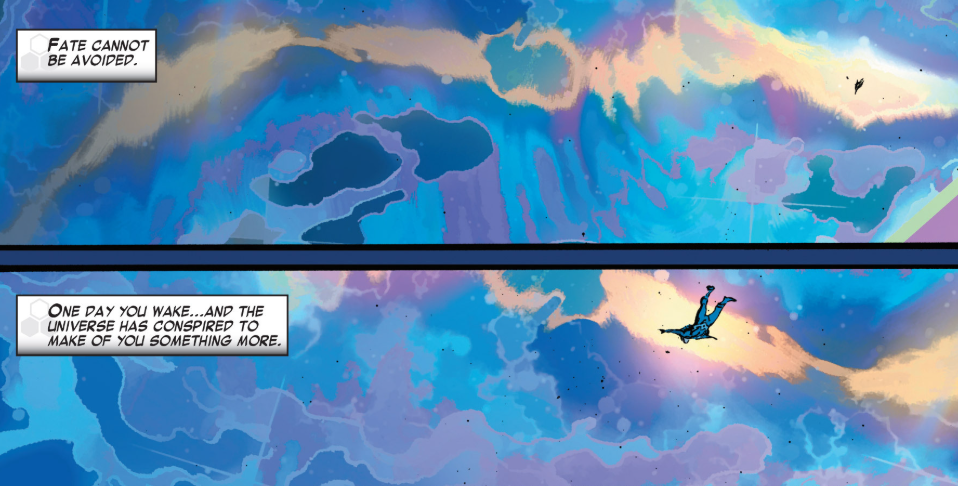
On the final page, we see Black Bolt emerge from space-time, still alive, with the caption stating that “fate cannot be avoided.”
To be continued!
Fantastic fifth wheel: Medusa is negotiating among the blue-skinned Kree and the other breeds of Kree, acknowledging (somewhat uncomfortably) all the different types of Kree there are.
It’s fun to see Crystal cast in a sneaky spy-like role, operating in the shadows.
Trivia time: This issue is setting up the big rematch between Black Bolt and the Kree Supreme Intelligence, right? Wrong! The Supreme Intelligence was killed by Wraith in the Annihilation: Conquest miniseries. Black Bolt’s return will go down a different route.
Fantastic or frightful? Heaven help any comic book fans who picked up this issue hoping for “It’s clobberin’ time” and instead getting this stuff. And yes, fans love far-out cosmic Marvel, but this issue is a far cry from the likes of Jim Starlin. Instead, it’s the first of two issues explaining how Black Bolt came back from the dead, and all in flashback with the main FF story on the backburner. Everybody loves Jonathan Hickman’s run on FF, but after reading this, all I can do is ask, “Why?”
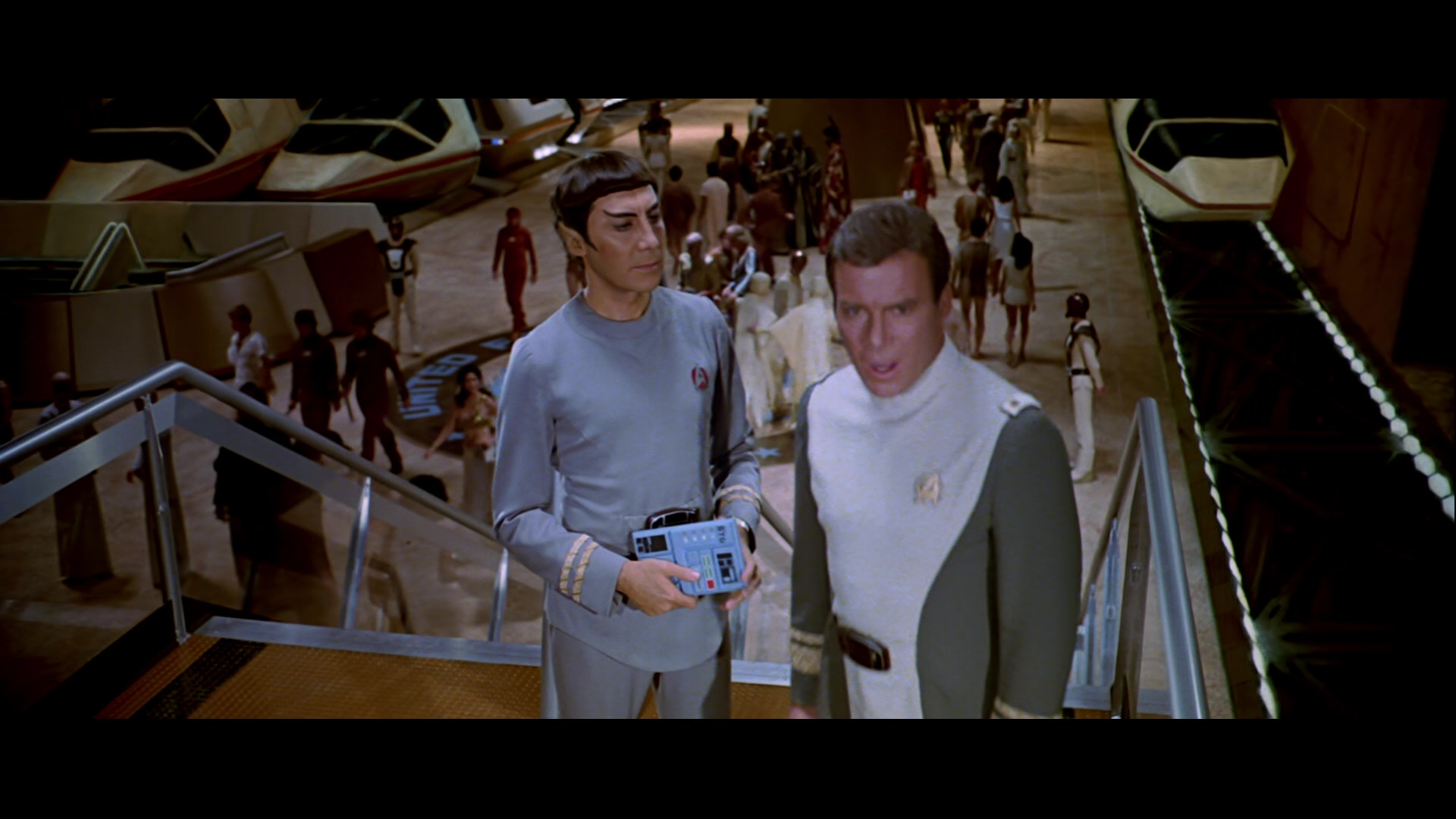
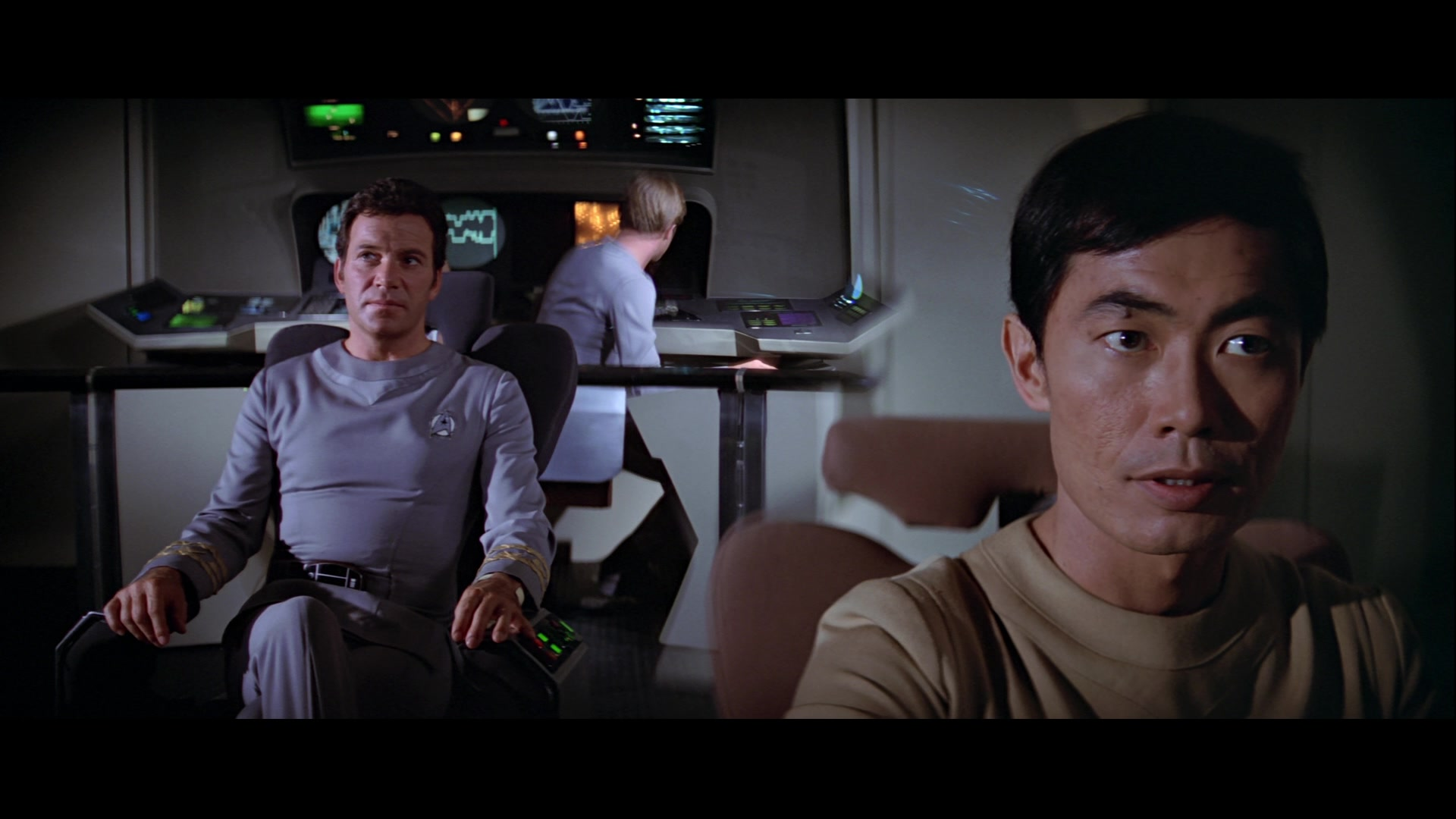
Rewatching the Star Trek movies! What’s the point of blogging about Trek when every bit of trivia minutiae has already been explored at length? I’m rewatching these in terms of characters, and hopefully sorting out the characters’ arcs over the course of these movies. Beyond that, we’ll just see what we see. Up first, Star Trek: The Motion Picture (1979).
Here’s what happens: An alien cloud of sorts approaches Earth, forcing the crew of the Enterprise to reunite and head back into action. As the Enterprise gets closer and closer to the cloud, things get stranger and stranger.
Captains courageous: Kirk is Admiral Kirk now, serving as “head of Starfleet operations,” whatever that means. His main motivation in this film is not just to solve the mystery within the cloud, but to get back in command of the Enterprise. This puts him in conflict with the current captain, Decker. While there is tension between Kirk and Decker, Decker ends up having a lot of other business to deal with.
I find it amusing that, only a minute after the story’s big finale, Kirk just sits down in the captain’s chair and sets course for unexplored space. Shouldn’t Starfleet be informed about this epic event that just occurred?
Ol’ pointy ears: This story would seem to be a big turning point for Spock. We catch up with him as he’s rejected by his fellow Vulcans for not properly purging all emotion from himself. By the end of the film, there’s the famous shot of Spock shedding a tear after everything he’s seen. This suggests that Spock has accepted his half-human, more emotional side. Spock still has some ups and downs to go through before these movies conclude, however.
Welcome aboard: Decker and hot alien babe Ilia reconcile with their romantic past. Their background is only hinted at, but it drives the emotional stakes of the plot. This is further complicated once Ilia is possessed (reprogrammed?) by the intelligence inside the cloud. Actress Persis Khambatta is a striking figure as Ilia, one of the movie’s most well-remembered visuals.
Continuity café: Who is that caveman-looking crewman who expresses concerns to Kirk at one point? He’s an unnamed Rhaandarite. According to the exhaustingly thorough Memory Alpha, the Rhaandarites are a long-lived yet childlike alien species who were regulars among the Federation. One writer described them as being Trek’s equivalent of “rednecks.” Make of that what you will. (UPDATE: The Marvel Comics adaptation of the movie gave this character a name. He’s “Mr. Amaar.”)
What you leave behind: A lot of people dislike this movie for how slow-paced and (let’s face it) dry it is. But I do enjoy the far-out spectacle of it all. As for character, I recently read through a collection of James Blish’s adaptations of the original series episodes. In those, I was struck with how Kirk is less of a gun totin’ cowboy, and more of a humanist figure. He responds to all the strangeness the Enterprise comes across by standing up for his natural humanity. That’s much the same Kirk of The Motion Picture. The gigantic world-ending threat is resolved via matters of the heart.
Re-reading Shakespeare’s The Winter’s Tale! Make that Re-re-reading it.
After finishing the final scene for my last post, I felt frustrated in that it felt like Paulina had become the main character all of a sudden, and I hadn’t followed her character as closely. So I’ve read the entire play AGAIN, this time focusing on Paulina and what her deal is.
In act 2, Antigonus has a jokey line saying that if the wonderful and amazing Hermoine is not chaste, then he cannot trust any woman to be honest, not even his wife. This wife is not mentioned by name, so the audience isn’t given anything to think that this will become an important character. Paulina doesn’t appear on stage until act 2 scene 2, where she shows up at the jail demanding to know what’s become of Hermoine. The scene’s opening exchange is between her and a jailer, where Paulina does the “Do know who you’re talking to?” game, insisting that she’s someone important that everyone knows. The servant woman Emilia informs Paulina that Hermoine has given birth to a baby girl while in jail. Paulina insists that she’s the one who must inform Leontes the king about this, because only she is “honey-mouthed” enough to deliver the bad news. She also convinces the jailer to let her take the baby away with her. This shows Paulina has a take-charge attitude. She out-talks everyone and manipulates events in her favor. This seemingly expository scene is also Paulina taking the first steps to setting up the play’s finale.
In act 2 scene 3, we get some interaction between Paulina and Antigonus, and we establish her position, where she describes herself as both physician and counselor to the king. She’s also clearly the boss in her marriage with Antigonus. When Paulina shows the baby to Leontes, he dismisses her, calling her a spy and a traitor. If she’s manipulating events behind the scenes, then could that be unintentionally true? Leontes, who has fallen deep into madness by this point, wants the baby put to death by fire (!). When Paulina argues against this, he suggests putting her to death as well. Paulina stands up to the mad king by calling him weak, and she turns the traitor insult back on him. It’s the unnamed lord, however, that convinces Leontes to change his ways, and orders the baby to be taken into the wilderness instead.
Act 3 scene 2 is Hermoine’s trial. At the height of the drama, she swoons and faints. The stage notes specify that Paulina joins the servants who carry Hermoine off stage. She has to back-to-back speeches announcing Hermoine’s death, that are loaded with insults hurled at Leontes. It’s after these two speeches that Leontes has his abrupt change of heart, and is now overwhelmed with grief over what he’s done and how he’s behaved. There’s also a detail of how Hermoine and young Prince Mamillus are to be buried in one grave. Can we interpret all this as Hermoine not dying, and Paulina secreting her away when off stage? And now the still-alive Hermoine is hiding away at Paulina’s museum-like home? I can see how you might make that case.
We don’t see Paulina again for a while, as the action shifts to Bohemia, where her husband is killed… by a bear! Then there’s the sixteen-year time jump, where we get all the romantic ups and downs with Perdita and wackiness with Antigonus (the king of thieves!). As a bunch of those characters decide to return to Sicilia, we finally return to Paullina in act 5. She’s encouraging Leontes not to remarry. She says this is because no women could be as great as Hermoine, but she also refers to Hermoine as the one Leontes “killed.” If Paulina has a living Hermoine hidden away somewhere, then this is part of her long game, hopeful to set up the big reunion someday. But she says she believes the baby died when the bear got Antigonus. So, is she hiding Hermione just keep Hermoine safe from Leontes, or does Paulina have an end game? Hard to say.
When a servant announces that Florizell has arrived in Sicilia, Paulina cries out Hermoine’s name, saying the present has become better than the sorrowful past. Remembering all that business with Oracle of Delphi earlier in the play, Paulina and the other characters see this as possible fulfilment of the prophesy considering the king’s long-lost heir. Then the big reunion happens mostly off-stage, and there’s fleeing mentions of a statue of Hermoine at Paulina’s house, with all the characters heading there to see it. That takes us to the final scene where Paulina shows everyone the statue of Hermoine. Either the statue magically transforms from stone into a still alive Hermoine, or it’s all a show and Hermoine is playing at being a statue to fake everyone out. However you read it, it appears that Hermoine manipulated things to get this statue business to happen.
I thought The Winter’s Tale was about one man’s jealousy sinking two kingdoms into darkness, and two young lovers bringing light back to it all. Now I wonder if The Winter’s Tale is about one woman seeing her kingdom fall apart, and enacting a years-long scheme to restore it all. Many scholars say Shakespeare’s plays are better seen performed rather than read, and I think that’s especially true of The Winter’s Tale. What this story is and what it’s trying to say is so ambiguous that it’s really up to each production’s director and actors to decide just what The Winter’s Tale is.
Next: I have other ideas for more Shakespeare stuff for this blog, but I’ll take a little break first. Coming up next, something with a little more… space.
Reading the Fantastic Four comics from the start. In FF #5, writer Jonathan Hickman continues tying things together and connecting all the dots with everything he’s set up.
Recap: The Fantastic Four is now the Future Foundation, with around twenty members, most of them genius kids. Spider-Man is on the team, too, taking over for Johnny after Johnny’s (not real) death. Also, the team is dealing with four ancient cities recently discovered. Also-also, Valeria let four members of the Council of Reeds out into Earth. She thought this would help, not counting on how the Reeds from alternate universes don’t have our Reed’s ethics or morals. With the help of Dr. Doom, who is also now a member of the Future Foundation thanks to Valeria, Reed has assembled a group of villains to devise a plan on how to defeat the other Reeds – defeating himself, in other words.
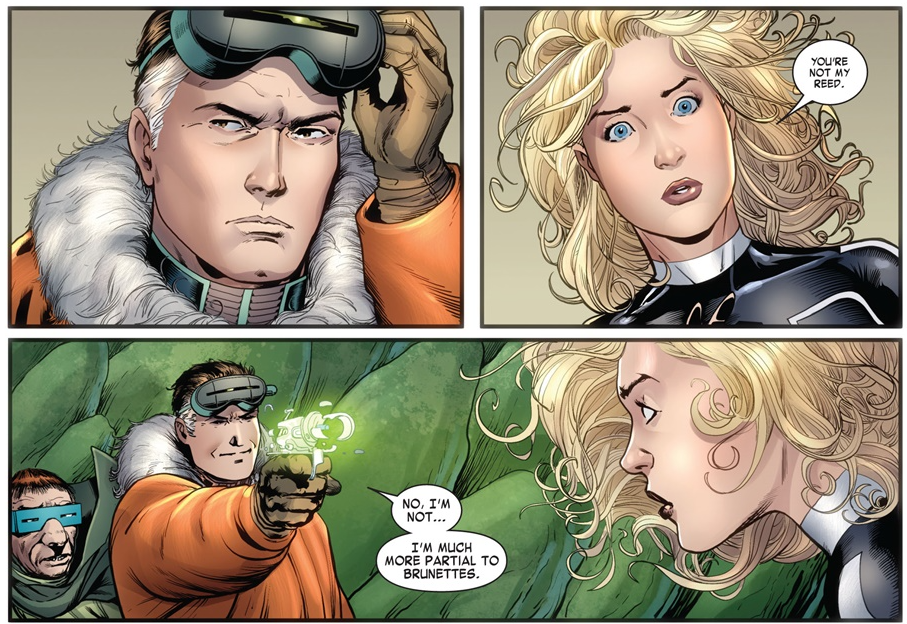
This issue begins with the Foundation and the villains working in the lab with the magic conch shell that Sue uses to communicate with and teleport to Old Atlantis, one of the four lost cities. It works, except Reed announces that the Peak, the center of Old Atlantis, has vanished. Cut to the Peak at 15 minutes earlier, Sue, Spider-Man and Alex Power are surprised to see what looks like Reed alongside the Mole Man, who is attacking the city. Sue is quick to deduce this Reed is not her husband, only for him to whip out a high-tech gun and shoot her.
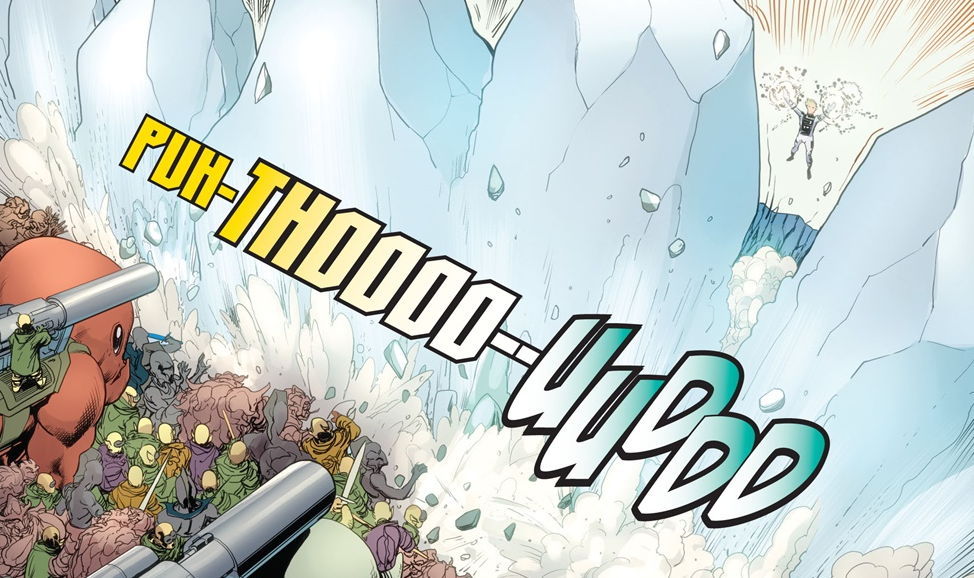
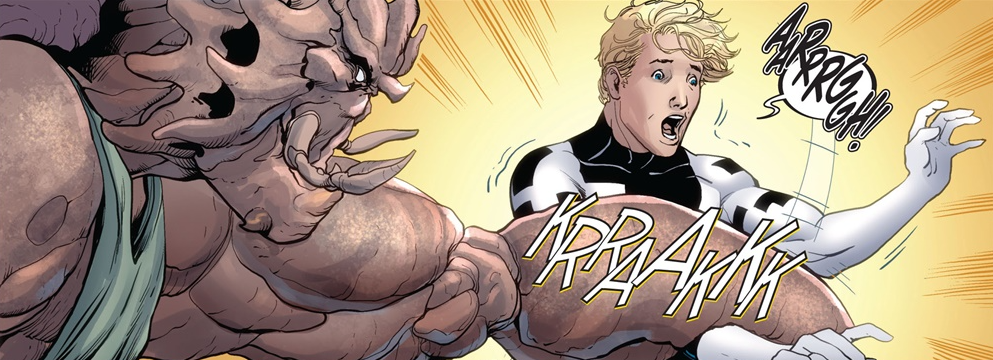
Spider-Man swings off to rescue Sue, leaving Alex Power alone against the Mole Man’s horde of monsters. He does well at first, using his gravity powers to create valleys and then walls of ice separating himself from the army. One gets through, however, inuring Alex’s arm.
After getting an injured Sue out of danger, Spidey swings back to Alex and joins the fight. But they’re too late, as the Mole Man’s weapons destroy the dome surrounding the Peak. The Mole Man and the evil Reed fire up some underground machines, and the Peak disappears into a crater. Sue manages to save the FF’s ship in a force field. She says she’ll get Namor to relocate survivors, and then she’ll head home for answers.
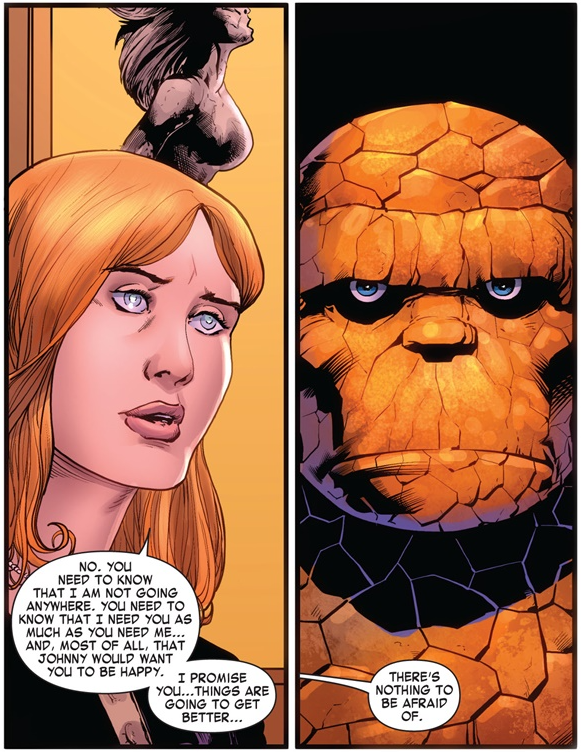
In New York, Ben has gone to Alicia’s apartment for a talk. He admits he feels guilty about Johnny’s death. She tells him he has to accept that Johnny’s gone. She tells him she loves him, and that Johnny would want him to be happy. She promises him that things will get better, and that he has nothing to be afraid of.
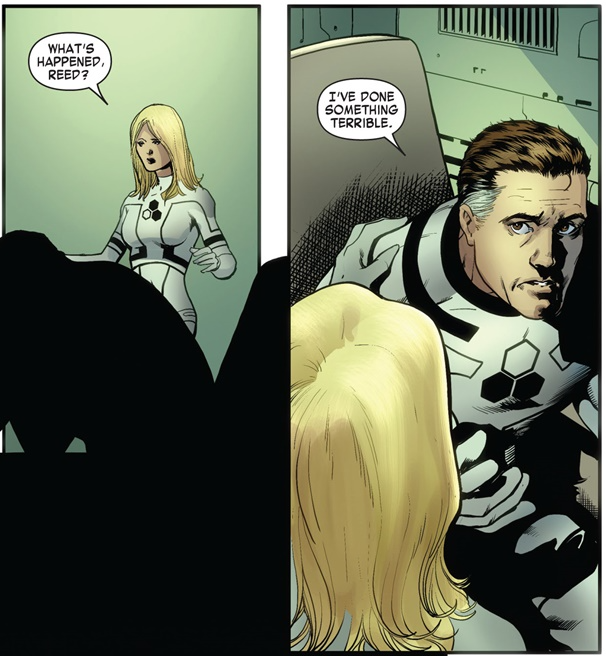
Later, Reed treats Alex’s broken arm. He encourages Alex to learn from this experience, but he also praises Alex’s effort during the battle, calling him “fantastic.” She has a minor concussion and will pull through. She says that when Reed learned about an evil Reed, he wasn’t surprised. She wants to know why, and why all the villains are in their house right now. Reed breaks down and says, “I’ve done something terrible.”
At the city of the High Evolutionary, another of the four lost cities. They’re building another giant machine, repeating “We have the solution” twice. One Reed and the Mole Man negotiate with the evolved Moloids who live there. They agree to fix things to they evolved Moloids will be able to breed on their own (wa-hey!) and to “abandon assimilation.” The evolved Moloids’ leader agrees to this in exchange for closing the doors of the city and allowing no Moloid refugees within. This pleases the Mole Man.
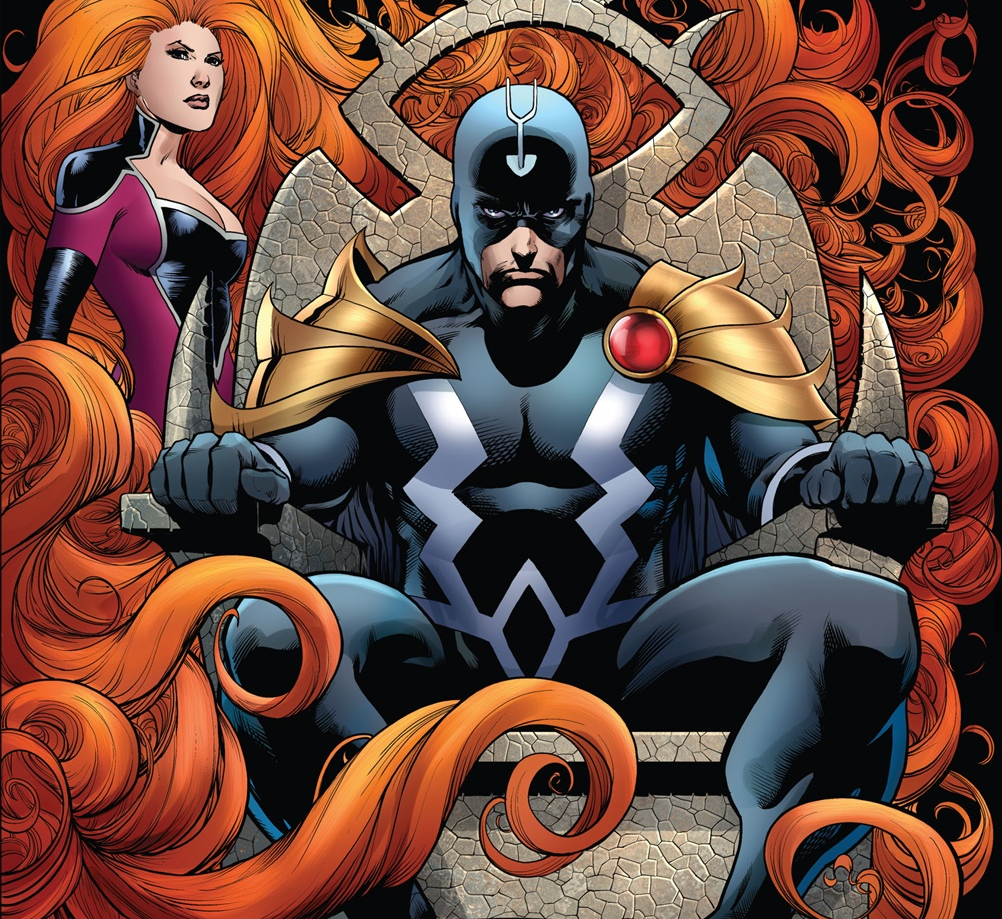
A shadow is cast overhead. It’s the city of Attilan, on the move, having flown down from the moon. (It can do that?) The issue ends with Black Bolt on his throne, looking very angry.
To be continued!
Unstable molecule: There’s mention of two other evil alternate universe Reeds we’ve met before, the Dark Raider and the Brute.
Fade out: All it takes is one look into the other Reed’s eyes. That’s enough for Sue to deduce this isn’t her version of Reed.
Clobberin’ time: Ben prefers his tea with Splenda artificial sweetener rather than real sugar. Make of that what you will.
Fantastic fifth wheel: Spider-Man uses his webs to create a cast for Alex’s arm. Later, he’s the one who reports to Reed how the mission at the Peak went.
Four and a half: There’s a funny bit where Franklin and the other kids aim their toy suction cup guns at the visiting villains.
Our gal Val: Valeria joins everyone in Reed’s lab, but she doesn’t say a word this time.
Foundational: Alex Powers has gotten considerably stronger in his gravity controlling abilities since his Power Pack days. He used to just make he and his siblings float around, or pin enemies to the ground. But in this issue, he’s causing mass destruction out in the ice.
There’s a two-panel exchange where Doom takes notice of Bentley-23. All Doom has to say about the kid is, “Hmmm.”
Trivia time: Yes, the city of Attilan can take off and fly around on its own. Fantastic Four once spent an entire issue depicting how difficult this was, but since then it’s moved locations a bunch of times, and spent some time just flying around as an aerial city.
Fantastic or frightful? I don’t know how many readers even remembered the situation at the High Evolutionary’s city, much less were invested in it. The highlight of the issue is the action with Alex Power, who gets some character development and gets to be the hero as well.



























 macmcentire