Fantastic Friday: Out with the new, in with the old

Reading the Fantastic Four comics from the start. In issues #355-356, longtime Marvel editor Tom DeFalco takes over writing duties, and he’s here to push the reset button in a big way.

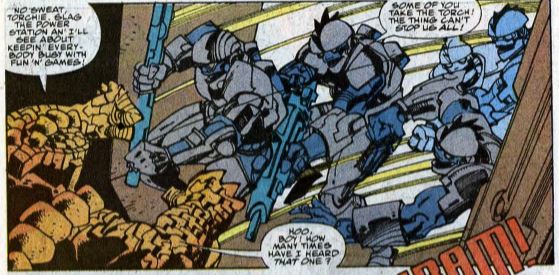
In issue #355, Ben goes back to his childhood neighborhood on Yancy Street, reuniting with his old neighbors, after which he gets into a fight with the Wrecker and a depowered Thunderball, both of the Wrecking Crew. What’s interesting here is that a footnote states that this takes place before Thor #418. But wait, that was 1987 — five years earlier! That means this issue likely takes place around Fantastic Four issues #300-303. Was this issue written with that intent, or was it created years ago, and pulled out from storage now to meet deadline? We may never know.

DeFalco’s run truly begins in issue #356. Despite (or perhaps because of) the Image Comics revolution happening all around him, DeFalco mission statement for Fantastic Four was to go back the 1960s, clearing the table of all the changes made by Byrne, Englehart, and Simonson, and restore the FF to their original, classic status. As such, the issue begins like so many of the Lee/Lirby issues, with Ben and Johnny bickering in headquarters, and Reed and Sue breaking up their fight. It’s the old excuse-for-the-characters-to-show-off-their-powers-for-a-few-pages thing.

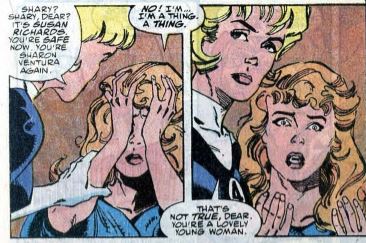
As Ben walks off to sulk, Reed explains to the others that Ben is merely upset because he’s now a monster again, after being human for a while. And in one short sentence, Reed adds that Sharon has “deserted” him. With that throwaway explanation, Sharon is off the team after we’ve spent more than 50 issues with her.

Cut to the Puppet Master, who is standing by his wife’s grave, speechifying about how he can tell something is wrong with Alicia, and how her personality has seemingly changed since she married the Human Torch. He says these are things that only a parent can notice. He swears to solve the mystery.
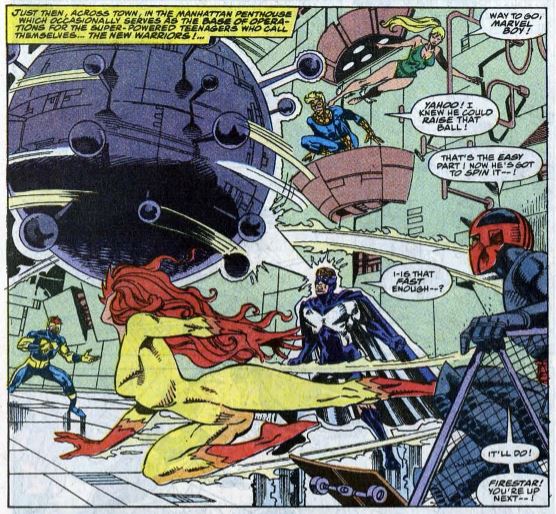
Then this ‘60s-style comic takes a left turn into the ‘90s, as we visit the New Warriors, who were Marvel’s hot property of the moment. But is the ‘60s throwback version of them. They’re in their version of the X-Men’s Danger Room, getting their own excuse-for-the-characters-to-show-off-their-powers-for-a-few-pages thing. The New Warriors consist of Firestar, Nova, Marvel Boy, Namorita, Speedball, and the super-skateboarding Night Thrasher. Marvel Boy gets a telepathic flash warning him of danger. While the others remind him that he’s not telepathic, Marvel Boy flies off. The rest of the team follows him.
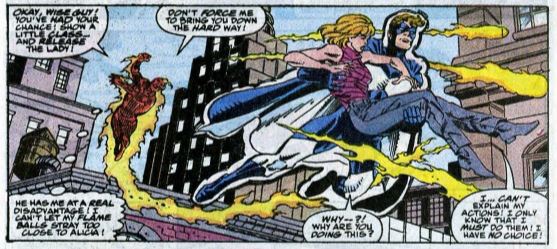
We then catch up Johnny and Alicia (who is secretly Lyja the Skrull in disguise) where they discuss her making abstract sculptures rather than the realistic ones she used to make. Marvel Boy comes flying in through the window and abducts Alicia. (The reader knows Marvel Boy is being controlled by Puppet Master because his earlier scene showed him creating a Marvel Boy puppet.) Johnny pursues Marvel Boy, but can’t attack for fear of harming Alicia.

The New Warriors see Johnny chasing Marvel Boy, so they attack Johnny. He signals the rest of the FF, who are quick to show up in a Fantasticar. Everybody fights! Firestar is no match for Johnny, but Namorita manages to punch him in the face. Nova smacks right into Sue’s force field. Reed tries to stretch himself around Speedball, but he can’t contain Speedball’s non-stop bouncing kinetic energy. Speedball escapes Reed, and that same kinetic energy sends Ben flying through the air.
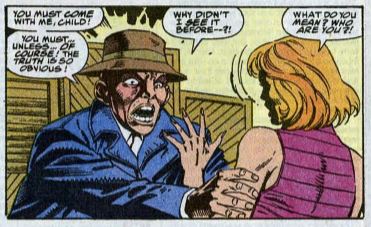
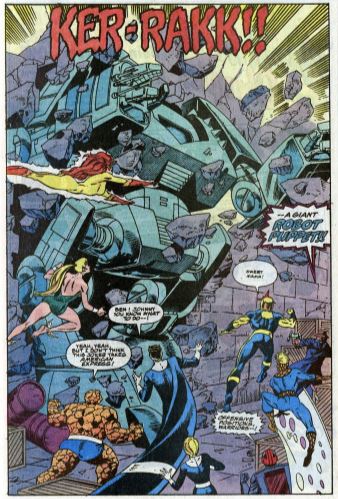
Marvel Boy delivers Alicia to the Puppet Master, just before overcoming Puppet Master’s mind control and flying off. Alicia (Lyja) doesn’t recognize Puppet Master, and he exclaims “The truth is so obvious!” The FF and the New Warriors very quickly set aside their differences and charge the Puppet Master, but he has a contingency plan. He pulls out a tiny robot puppet, which controls a gigantic robot conveniently hidden nearby. The two super-teams make short work of the robot, smashing it up real good. This, however, gives Puppet Master time to escape. (You’d think Reed and/or Night Thrasher would have scanning equipment and whatnot to search for Puppet Master, but the attitude instead is “Oh well, he got away.”)
The issue ends Reed and Sue wondering what Puppet Master wanted with Alicia. Reed ominously says he has a hunch they’re about to learn the answer about Alicia — and that they won’t like it. (Just imagine how the readers are going to feel.)

Unstable molecule: Reed knows about how Speedball’s powers work because, he says, he makes it a point to study up all new superheroes’ powers. Is that creepy? I’m thinking it’s creepy.

Fade out: When Sue has Night Thrasher trapped in a force field, he says he has weapons that can break through it, but we never see what those weapons are.

Clobberin’ time: Ben is upset at the beginning because someone crushed a statue of himself. Reed later deduces that Ben was so down in the dumps that he smashed it himself.

Flame on: Johnny demonstrates a new power while fighting with Ben. He breathes hot steam into Ben’s face.

Fantastic fifth wheel: After all that drama about Sharon’s PTSD and then her romance with Ben, it’s a huge disappointment to have her written out of the team so dismissively.

The last time the FF was just the original four members was in issues #301-302. The last time before that was way back in issue #264.

The Alicia problem: The Alicia/Lyja thing was Tom DeFalco’s idea, so this issue is the first official foreshadowing, and the hints that Alicia is not really Alicia are all over this issue. What’s odd, though, is that Lyja doesn’t recognize Puppet Master, even though she’s been immersed in Alicia’s life all this time. Maybe she was just caught off guard.

Commercial break: Okay, there’s a human, Dr. Doom, Spider-Man, the Lizard… whose hand it that supposed to be on the top right?

Trivia time: Although the FF and the New Warriors act like they’ve never met before, the crossed paths during the Atlantis Attacks and Acts of Vengeance crossovers. Not a lot of time for socializing during crossovers, I guess.

The New Warriors’ headquarters was located inside Night Thrasher’s huge Manhattan penthouse. Skateboarding might be Night Thrasher’s gimmick, but with the way he’s written, he’s basically Batman.

The New Warriors’ version of Marvel Boy is Vance Astrovik, son of Vance Astro of the original Guardians of the Galaxy. His powers are often described as “psychic,” which looks to me like basic telekinesis. Like Ben and Sharon, he too was once involved with the ridiculous Unlimited Class Wrestling Federation.

Fantastic or frightful? Although I feel that the “back-to-basics” approach isn’t what’s needed for the Fantastic Four at this time, this issue isn’t so bad. The fact that the New Warriors are able to hold their own against the FF in the fight makes it all worth it.

Next: I married a what now?

****

Want more? Check out my book, CINE HIGH, now available for the Kindle and the free Kindle app.

cine-high_v3

Posted in Fantastic Friday | Leave a comment

Willow (1988) rewatch – Part 1

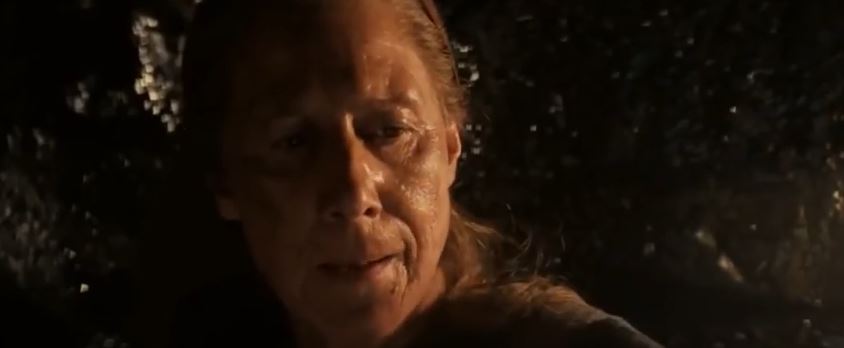
Watching the 1988 movie Willow scene-by-scene. Why? Because it’s freakin’ Willow! The movie’s first scene goes straight from birth to death in a matter of minutes, 0.00-2:34 on the Blu-ray.

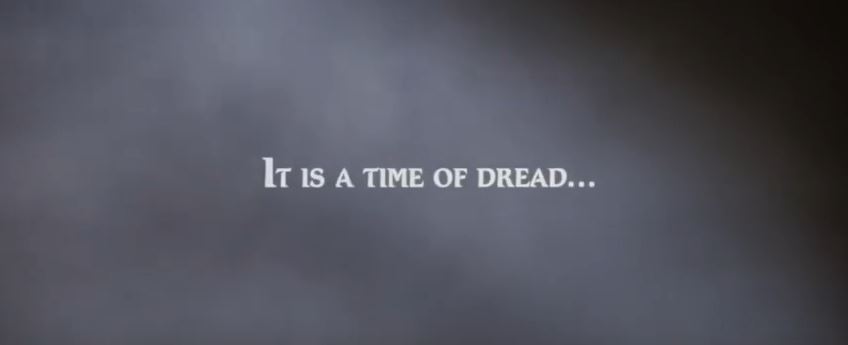
It just wouldn’t be a fantasy movie without an opening text crawl, and Willow’s is in three parts. The first part merely says “It is a time of dread…” We hold on that for a few seconds, letting it sink in. One the issues with the movie is that often speaks to a bigger world of cities and kingdoms that the viewer never gets to see. Therefore, we need a single-line “time of dread” to really hit home that life has taken a big downturn in this world.

The next part of the text states, “Seers have foretold the birth of a child who will bring about the downfall of the powerful Queen Bavmorda.” I’m not clear on who these seers are, but the canon depicts Bavmorda being raised and trained by other magic-users all her life, so it’s no stretch to assume seers are among these magic users.

The third and final part of the text crawl states, “Seizing all pregnant women in the realm, the evil queen vows to destroy the child when it is born…” Because there’s so little scope of how large or far-reaching this realm is, we can only speculate as to the logistics of this. Does the realm have some sort of rudimentary census? Did those seers help in the search? Unknown. More importantly, the crawl gives us two adjectives for Bavmorda, “powerful” and “evil,” so the audience knows who the villain is right from the start. The statement that Bavmorda vows to “destroy” the child is only partially true. We’ll get to her plans for the baby later in the movie.

Speaking of which, the first proper shot of the movie is a crying baby, apparently just having been born. This says to viewers, “better get used to lots of baby shots.” We then see four women in a cage/cell in a dungeon, each one blankly staring off to the side of the camera. A voice asks “Is it a girl?” and “Show me its arm.” A second voice says, “She bears the mark,” and a woman starts crying “No!”

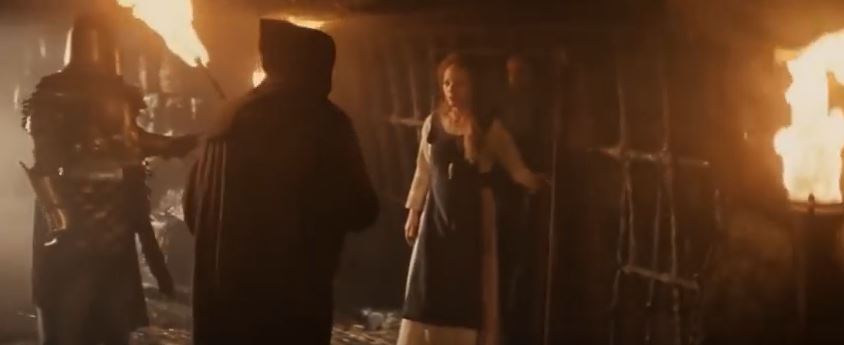
The camera pans over and we see Sorsha, though she’s not yet named. She’s wearing a plain white and blue dress rather than her usual super-cool battle armor. She speaks to two hooded men and a guard, saying “The omen is true. I must tell my mother.” Given what was just established in the opening text, the audience can easily surmise that this is Bavmorda’s daughter. The hooded men, according to canon, are the druids, a group of which are always hanging around Bavmorda’s castle as her advisors.

We then get a scene with the baby’s mother and a midwife, whom the canon names Ethna. The mother pleads for Ethna’s help, but Ethna says, “I can’t.” The mother says “They’re going to kill her,” and Ethna clearly has a change of heart. She takes the baby and places it in a basket. I guess this is supposed to be a laundry basket, but it’s conveniently baby-shaped.

We’ll soon learn that the baby is the all-important Elora Danon, and this woman is her mother. The mother, however, is never given a name or backstory. This one scene is all we know of her. Elora’s father similarly remains unknown.

Ethna not-very-sneakily sneaks down a corridor, only for a guard to shout “Stand aside for Queen Bavmorda,” just as our villain appears at the far end of the hall. Bavmorda, who appears to be walking with a slight limp, moves past the midwife, not paying her any attention. Sorsha and more druids follow her.

We next see Ethna walk by some cages filled with monstrous dogs, appropriately named Death Dogs in the canon. Instead of barking or growling, the Death Dogs make squeaky, Jawa-like sounds as they snap at each other, not knowing the baby is escaping.

Then there’s the first exterior shot of the movie, as Ethna walks outside the castle gate as black-cloaked soldiers ride horses by. To the left of the screen, we see the castle walls are made up of huge bricks, each one a couple of feet tall, held together with pale yellow clay and straw. This gives the feeling that this castle is gigantic. Even though this is a pretty dark, dreary opening scene, the score adds a heavenly chorus to this shot, adding a sense of hope and wonder to what’s happening.

Back in the dungeon, the mother says to Bavmorda, “You cannot stop the prophecy!” This raises the question of how many people know about the prophecy. In most fantasy stories, future knowledge like this is restricted to only a few. Perhaps the prisoners were informed of the prophecy after they were taken, as the few other civilians we meet in the movie don’t seem aware of it.

Bavmorda says the child will have no power over her, and she tells one of the druids to start the ritual. As we’ll see later in the movie, preparing for this ritual is quite the lengthy process. What we’re learning about Bavmorda in this moment is just how single-minded she is. It’s all about the baby and the ritual, no big speeches, no sarcastic wisecracks. She’s just getting the job done and that’s it. Bavmorda is quick to deduce that the bundle of rags in the mother’s arms is not the baby. Sorsha puts it together that the midwife took the baby, and Bavmorda orders Sorsha to find her. “Use the dogs,” Bavmorda says. “Bring her back to me alive.” That second part is an interesting detail. From what we’ll see in a few minutes, I think we can conclude that “her” means the baby in this case, not the midwife. The baby must be taken alive because of the whole ritual thing.

The baby’s mother then has a total King Lear moment, speechifying how Bavmorda’s reign of terror is at an end, and how the baby will finish her. We get a close-up of Bavmorda during this speech, and we can see the words really sting. Bavmorda says “Kill her” with maximum iciness. We don’t see the mother die, but it’s implied she does with the way the music swells. The movie never really shows us Bavmorda’s reign of terror, but I think this murder gives us some glimpse of how bad things have gotten for the kingdom. Bavmorda’s “Kill her” also shows what kind of villain we’re dealing with. There won’t be any sort of nuance or redemption arc for her — this one’s pure evil.

And on that murderous note, we’ll end for today.

Next week: It’s getting pastoral up in here.

****

Want more? Check out my book, CINE HIGH, now available for the Kindle and the free Kindle app.

cine-high_v3

Posted in Willow (1988) rewatch | Leave a comment

Fantastic Friday: It’s about time

Reading the Fantastic Four comics from the start. It’s writer-artist Walt Simonson’s last issue on the series. His run on the comic is defined by time travel stories, and his finale in issue #354 is no different.

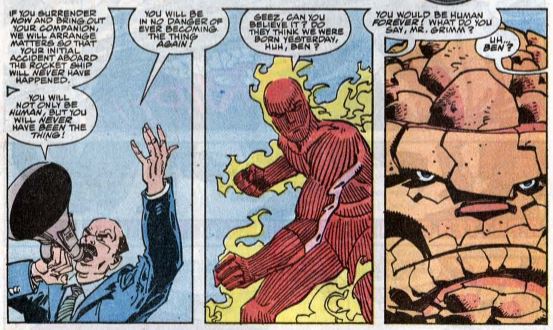
The FF have been arrested by the otherworldly bureaucrats of the Time Variance Authority, who intend to place our heroes on trial for authorized time travel. The FF isn’t having it, attempting an escape. The TVA agents offer Ben a deal — to rewrite history so the Fantastic Four never existed, allowing Ben to re-live his life an ordinary human. Ben considers the offer for a second, but then remembers that the FF stopped Galactus from devouring the entire universe in issue #341. He says that without the FF, there’s no one to stop Galactus, and he calls out the TVA officials, saying they knew Ben’s universe would be destroyed if he took the deal.

The TVA sends their Minutemen cyborgs after Johnny and Ben, for several pages of fighting. Meanwhile, Justice Peace, the TVA’s top enforcer, searches for Reed and Sue, who are hiding behind an “invisibility sphere” created by Sue. Reed says he’s reverse engineered the TVA’s tech to create a computer virus to attack them. Justice Peace spots them and uses a high-speed gun that can break through Sue’s force field faster than she can regenerate it. Then the virus starts working, splitting the TVA’s timeline into multiple parallel timelines. (This is depicted in the art by having the other timelines “splitting off” in smaller panels to the left and right of each regular-sized panel.)

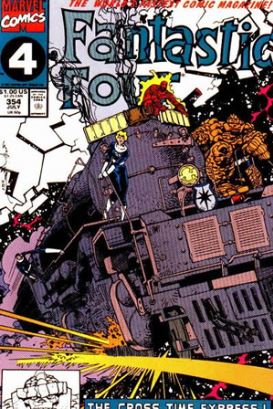
We catch up with Sharon, who reveals that she let herself be taken captive by the TVA. She uses a wrestling move to get away from her captor. She reunites with Ben and Johnny who then reunite with Reed and Sue. Then, in this crazy story, things take an even crazier turn. Our heroes end up in a railroad yard, full of old-timey trains. Reed identifies this as the Cross-Time Central Railroad. It’s run by an alien named Casey, who explains he is enamored with antique Earth trains.

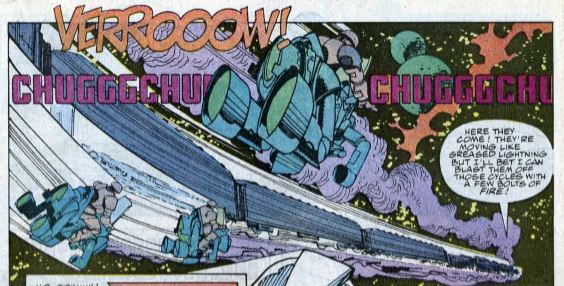
Casey offers the FF a ride in exchange for “certain goods.” The train flies off into space, with Justice Peace and the Minutemen in pursuit. There’s another big fight, and Justice Peace manages to hold his own against the FF. The train is then pursued by a “reality wave,” depicted as a large white surface covered with cracks. Reed says this is another part of his virus, which is erasing all references to the FF’s universe from the TVA’s database, so the TVA will never again bother Earth. With the rules of reality being rewritten, Justice Peace says the FF have no longer broken any laws. He leaps into the wave and vanishes.

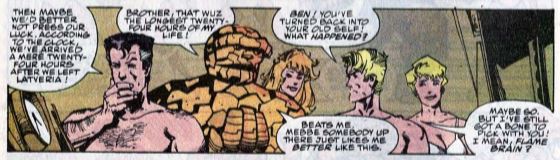
The train then reenters the FF’s universe. Casey reveals that the “goods” to pay for the trip are the FF’s uniforms, which he intends to turn into railroad worker uniforms. So the FF strip down to their undies and return to Four Freedoms Plaza. We see that Ben has mutated from his spikey form back to his classic rocky form. As he and Johnny banter, Reed comments that everything’s back to normal.

Unstable molecule: Maybe it’s too much of a stretch (heh) for Reed to create a computer virus that can alter reality, but he’s doing this with the TVA’s own tech, so I guess that explains it.

Fade out: The comic would have us believe that Sue and Reed cannot be seen inside her “sphere of invisibility,” even though that’s not how her powers work. A few pages later, Justice Peace is able to spot them, revealing that they’re not invisible after all.

Clobberin’ time: Absolutely no reason is given as to why Ben reverts from his spikey form to his more-familiar rocky form, except to say, “somebody up there just likes me better like this.” This is a not-so-subtle jab at Marvel editorial’s efforts to undo all the big changes of the last hundred issues or more and get back to Silver Age Fantastic Four.

Flame on: Johnny doesn’t like Ben calling him “Flame Brain.” Ben apologizes, saying it’s getting harder and harder to come up with good insults.

Fantastic fifth wheel: Sharon uses wrestling moves to escape a guard, remembering that she got her start in the goofy Unlimited Class Wrestling Federation.

Commercial break: This is three years after the movie came out.

Trivia time: The rumors state that Walt Simonson’s wife, writer Louise Simonson, had one too many feuds with Marvel editorial over her work on X-Factor, so she was leaving Marvel, and Walt left with her. He returned a few years later to work on Iron Man 2020 and Heroes Reborn: Avengers. Mostly, though, he became a DC Comics mainstay, working on Orion, Hawkgirl, Batman: The Judas Coin, and Michael Moorcock’s Elric, among many others.

Fantastic or frightful? What started as a Douglas Adams-style romp ends with a lot of running around, and a wacky cartoon space train. Fortunately, Simonson’s artwork is so good, it carries the lack of a real plot. It would have been nice to have Simonson on the series for more, but this is as good a sendoff as any.

Next: Out with the new, in with the old.

****

Want more? Check out my book, CINE HIGH, now available for the Kindle and the free Kindle app.
cine-high_v3

Posted in Fantastic Friday | Leave a comment

Random Warner Bros. – North by Northwest

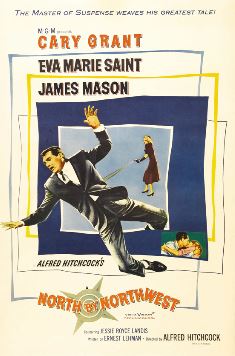
Watching all the movies on the Warner Bros. 50-movie box set that I bought for cheap. No need for the random number generator because we’ve reached movie number 50, ending this series with some Hitchcock action with North by Northwest.

 Here’s what happens: Ordinary guy Roger Thornhill is mistaken for an international spy named Kaplan. This kicks off a cross-country chase with enemies in pursuit of Kaplan’s stolen microfilm. Along the way, Thornhill gets a taste of the adventure and romance of a spy’s life.

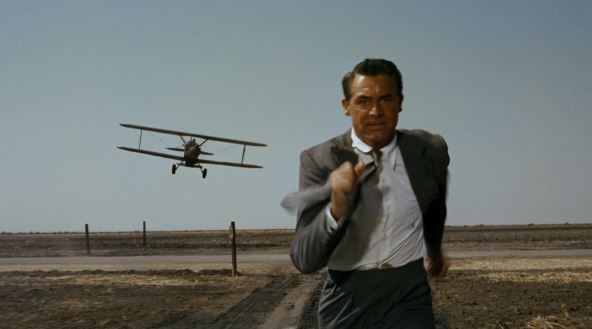
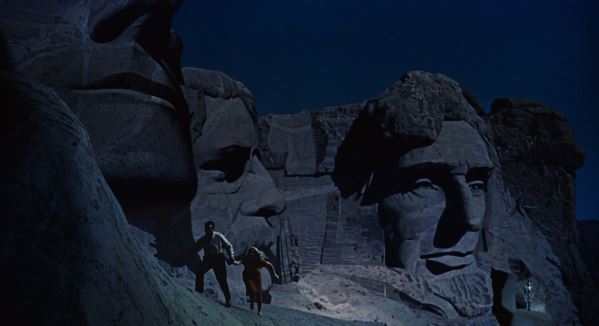
 Why it’s famous: Another example of Hollywood Hitchcock, with the classic men-in-suits-and-women-in-pretty-dresses visuals. And always, always the cropduster chase.

 Get your film degree: One of my least favorite movie tropes is the ordinary person who is recruited to become a spy. Hitchcock and screenwriter Ernest Lehman make it work, though. They instead focus on the “ordinary man in an unthinkable situation” aspect of the story, which helps the audience stay invested, even when the story gets over the top.

 Movie geekishness: Speaking of over the top, how about that cropduster scene? It begins with some long stretches of quiet, with our hero in isolation against this wide, empty backdrop. That way, when the cropduster finally makes an appearance, it feels as though Thornhill is truly helpless against it.

 Thoughts upon this viewing: It’s hard to watch North by Northwest without thinking of all the other films inspired by it. Still, it remains a hugely entertaining spy caper.

 Next on this blog: Where there’s a will…

****

Want more? Check out my book, CINE HIGH, now available for the Kindle and the free Kindle app.

cine-high_v3

Posted in Random Warner Bros. | Leave a comment

Fantastic Friday: Desk jobs

Reading the Fantastic Four comics from the start. Writer-artist Walt Simonson really had a thing for time travel stories, because our heroes are time travelling it up yet again in issue #353.

Recap: Dr. Doom retook the Latverian throne and tricked the Fantastic Four into a time travel fight with him. This caught the attention of the Time Variance Authority, an otherworldly bureaucracy that monitors time travel, who put our heroes under arrest. Meanwhile, Ben has become the Thing again just as Sharon transformed from a Thing back into a human — like Gift of the Magi but with orange rock monsters.

The issue begins when Justice Peace, the TVA’s chief enforcer, delivers the FF to the TVA board. What follows is a lot of legal mumbo-jumbo with words like “time” and “temporal” thrown into the mix. The gist of it is that the TVA is putting the FF on trial for all their unauthorized time traveling, saying that their timeline should have been destroyed already if not for their meddling. Reed asks why the TVA has never gone after the Avengers, the X-Men, or Kang for similar offenses. The TVA places the FF in custody, saying further investigations are needed.

“Custody” for the TVA is a big white space where the FF float weightlessly. Reed admits he was just stalling for time. Reed and Sharon contact their guard and ask for a tour of the gigantic TVA facility. The guard agrees, after Sharon pretends (or not?) to flirt with him. On the tour, we meet the robot-like Time Police, and the Hall of Discontinued Realities, where unaccounted-for items from destroyed universes are kept.

The next stop is the Hall of Chronometry, the location of the endless sea of desks we’ve seen in the TVA’s previous appearances. There, Ben pretends to bump into a desk. While their guide chides him, Reed and Sue sneakily swipe some chips from inside the desk. Back in “custody” Sue turns invisible to trick the guards into thinking she’s escaped. This allows the FF to break out of their cell and fight all the Time Police. Ben and Johnny run around causing a lot of destruction while Reed and Sue stealthily research the TVA’s software tech.

Ben and Johnny reach a power generator room (called a “power substation” a few pages later) where the Time Police reveal they’ve taken Sharon hostage. Ben is not going to play ball, so the Time Cops sweeten the deal. They offer to change time so that the FF’s original spaceflight never actually happened, and Ben can re-live his entire life as a human. Johnny doesn’t buy it, but Ben stays quiet, contemplating taking the deal.

To be continued!

Unstable molecule: When Reed is arguing with the TVA, he mentions the X-Men’s Days of Future Past event, calling it by that name. In that story, the X-Men fought the Brotherhood in Washington DC, so that would’ve made the news, but how does Reed know time travel was involved? This once again raises the question of whether the superhero teams ever compare notes.

Fade out: Sue uses her invisibility powers for theft in this issue, something that seems natural, but she rarely does — even when it’s in the name of stopping the bad guys.

Clobberin’ time: During the fight with the Time Cops, Ben references the 1991 Iraq war. The Marvel heroes haven’t been involved that much in Iraq. Iron Man and Wolverine have had covert missions there, and Spider-Man’s friend Flash Thompson served in Iraq. He was injured there, eventually leading to his becoming the new Venom.

Flame on: Johnny is the key to the escape plan, with the team needing him to blast through the door and take out as many Time Cops as possible so the others can have a chance to get out.

Fantastic fifth wheel: Sharon flirting with the guard and then getting taken hostage seems out of character for her, but we’ll see next issue that this is all part of the plan.

Commercial break: Shots fired at the Ninja Turtles!

Trivia time: Look closely. The Hall of Discontinued Universes contains two familiar characters. One appears to be Alex Power of Power Pack after he was transformed into an alien. The Power Pack comic was cancelled before that storyline could be resolved. (Turns out the alien Alex was actually an Alex clone.) The other figure is Supergirl, who was written out of continuity in DC’s Crisis on Infinite Earths. Supergirl later came back as the Matrix alien in the ‘90s, and then the original was finally reintroduced in the early 2000s.

Fantastic or frightful? The Time Variance Authority once again provides some amusing Douglas Adams-style comedy/satire, but other than that, the issue sets up the pieces to be knocked down next issue.

Next: It’s about time.

****

Want more? Check out my book, CINE HIGH, now available for the Kindle and the free Kindle app.
cine-high_v3

Posted in Fantastic Friday | Leave a comment

Random Warner Bros. – Harry Potter and the Sorcerer’s Stone

Watching all the movies on the Warner Bros. 50-movie box set that I bought for cheap. This week the random number is angry about the word “philosopher’s” not appearing in Harry Potter and the Sorcerer’s Stone.

Here’s what happens: Downtrodden adolescent orphan Harry Potter learns that not only is he a wizard, but a famous one. Harry is whisked off to Hogwarts, a school for magic, where he makes new friends and has magical adventures. Meanwhile, there are fears that a thought-dead evil wizard might return.

Why it’s famous: Kicking off a long-running franchise based on the blockbuster novels. Getting the casting and world-building mostly right.

Get your film degree: So why was Chris Columbus — a.k.a. the Home Alone guy — chosen to direct, when heavy hitters like Steven Spielberg, Tim Burton, and Terry Gilliam were rumored to be in consideration? For one, Columbus worked with Spielberg on Gremlins, The Goonies, and Young Sherlock Holmes, so he’s no stranger to PG-13 fantasy. Second, Columbus was chosen because, allegedly, he promised to make the movie as much like the book as was possible.

Movie geekishness: Robbie Coltrane doesn’t get enough credit for how good he is as Hagrid. Fantasy stories often live or die based on the first major fantastical element introduced. In HP’s case, that’s Hagrid, who makes for a jovial, friendly guide to all the magical weirdness and/or exposition the story needs.

Thoughts upon this viewing: While later films in the series did some more interesting stuff, this first does a good job with the heavy lifting of building the wizarding world from the ground up. The rules of Quidditch still don’t make sense to me.

Next: No need to rush (more).

****

Want more? Check out my book, CINE HIGH, now available for the Kindle and the free Kindle app.
cine-high_v3

Posted in Random Warner Bros. | Leave a comment

Fantastic Friday: Let’s all get non-linear

Reading the Fantastic Four comics from the start. Issues #351-352 offer cosmic weirdness, time travel fights, bewilderment drama, and experimental page layouts.

Issue #351 is a filler issue, in which we’re reunited with Kosmos, the godlike being who was created when the Beyonder and the Molecule Man merged into a single being. She’s on a tour of the universe hosted by fellow cosmic being Kubik. The two of them take the Fantastic Four out of the timestream, watch them escape from a maze, and then return the heroes back to where they were with no memory of what this happened. This was all to teach Kosmos about the courage and resilience of Earth’s heroes. Or something.

Issue #352 then picks up where #350 left off. Dr. Doom has retaken the Latverian throne, with his usurper now acting like his sidekick. Doom defeated the Fantastic Four, and offered Reed a challenge — a one-on-one fight between the two of them, outside of the timestream, between mere minutes. Meanwhile, Doom turned Sharon human again, and Ben transformed back into the Thing to come to her rescue.

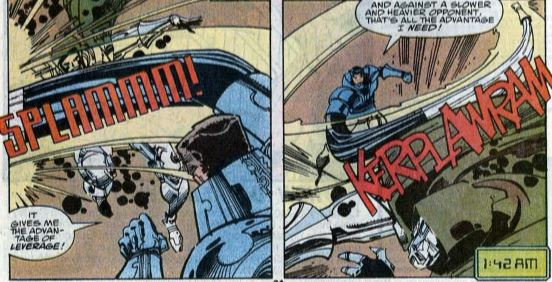
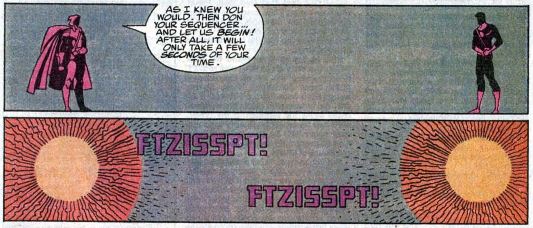
How to read this comic: Issue #352 has two stories being told simultaneously. The main FF story is read linearly, like any comic would be. The Doom vs. Reed fight, meanwhile, is non-linear. Each panel in their part of the story has a time stamp, and readers have to read them in order of the time stamps, regardless of what page they’re on.

In the main story, Ben wakes up after being knocked out by Doom. He takes Sharon, who is still unconscious. He gets Sharon to safety, and then frees Johnny from the tank of water where Doom had trapped him. After a short fight with a robot, they then revive Sue, who had been knocked out with gas. Sharon wakes up, disoriented. She’s not able to understand how she’s changed, leading to a weird bit of business where Ben wears her FF uniform to convince her that her Thing form has disappeared.

If you’re having trouble following the puzzle-like Reed and Doom story, you’re probably good, because it’s mostly the two of them throwing punches at each other. Reed at one point dons a suit of armor he finds to give him an edge in the fight. Reed finally deenergizes the time sequencer devices that allow them exist outside of time, bringing them back to the present. Somehow, this gives Reed the advantage, as he beats the crap out of Dr. Doom.

At this point, a bunch of robots appear, courtesy of the Time Variance Authority, the otherworldly bureaucracy that for some reason monitors time travel throughout the multiverse. They want to put everyone under arrest for unauthorized time travel. Doom destroys the robots, but then is blasted to death (to death!) by Justice Peace, the red-white-and-blue clad chief cop of the Time Variance Authority. Justice Peace teleports himself and the FF out of there, so they can stand trial for their time traveling.

Then, a second Dr. Doom steps out of the shadows. Turns out Kristoff was the one fighting Reed this whole time, and was killed by Justice Peace. Doom then exposits that this was his plan from the start, to trap Reed into a time-travel caper, just so the Time Variance Authority could sweep in and remove the FF from the Earth… forever.

To be continued!

Unstable molecule: Reed says he was able to out-punch Dr. Doom because Doom “overlooked” Reed’s stretching ability. Perhaps this was hint that it was really Kristoff Reed was fighting.

Fade out: When Sue discovers that Ben has mutated into his spikey Thing form, she tells him, “I don’t think I’ve ever known anybody braver than you.”

Clobberin’ time: Ben said Dr. Doom’s robot hit him harder than he’s ever been hit, and that includes his fights against the Hulk.

Flame on: After rescuing Johnny, Ben and Johnny take a few panels to exchange some jokes. It’s a fun little character moment that gives the sense that escaping from Dr. Doom’s deathtraps is just another day at the office for these two.

Fantastic fifth wheel: Sharon’s confused metal state harkens back to the PTSD storylines from when she first joined the team. She does, however, promise to love Ben no matter what he looks like.

Commercial break: Again, I dare somebody to call this number:

Trivia time: Look closely, although the time stamps begin at 1:00 a.m., one of Dr. Doom’s energy blasts gets a 12:30 a.m. The idea is that this beam went back in time to issue #350, where it freed Reed from his underground cell. This issue’s cover gets into the act, depicting Reed escaping, also with the 12:30 time stamp.

No, Kristoff isn’t really dead. He’ll return later… as one of the good guys!

Fantastic or frightful? The “puzzle-box” nature of this issue is amusing, but other than that, very little happens other than a lot of punching and Sharon being confused.

Next: Desk job.

****

Want more? Check out my book, CINE HIGH, now available for the Kindle and the free Kindle app.

cine-high_v3

Posted in Fantastic Friday | Leave a comment

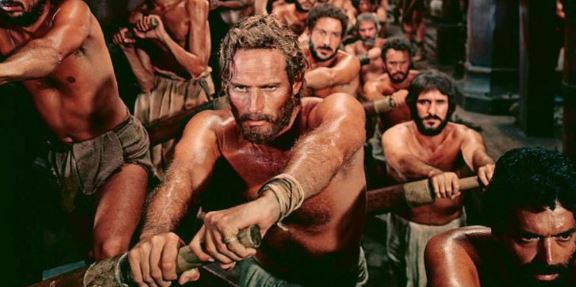
Random Warner Bros. – Ben-Hur

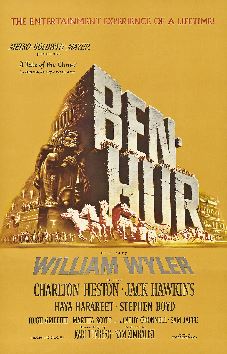
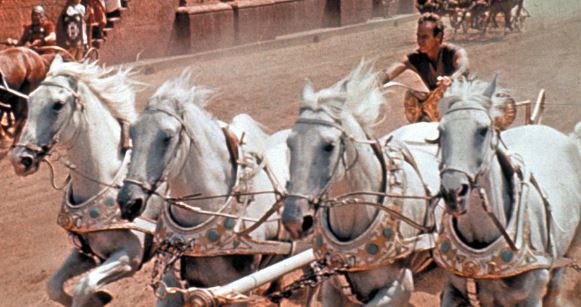
Watching all the movies on the Warner Bros. 50-movie box set that I bought for cheap. This week the random number feels bad for all those horses as it chooses Ben-Hur. This is the biggie, the movie prominently featured on the box artwork and the only one to get a second disc.

 Here’s what happens: Judah Ben-Hur is a wealthy Jew living with his family in Jerusalem. When a Roman leader a former friend of Judah’s sentences Judah to lifelong imprisonment and slavery over a minor crime, Judah begins a long quest to take revenge and find his long-lost mother and sister. Also, there’s Jesus.

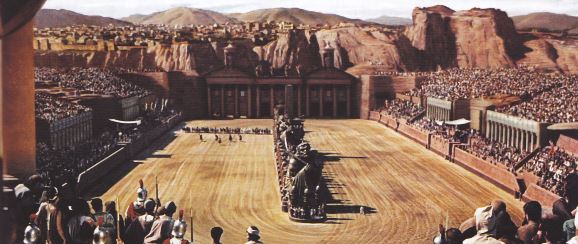
 Why it’s famous: An old-school Hollywood epic, with huge sets and vistas peopled with hundreds of extras. It culminates with a chariot race that is oft-parodied but never equaled.

 Get your film degree: It’s often been said that epic films should have simple plots and easily-explained motivations as a balance to the massive production value. That’s the case with Ben-Hur, as the movie never loses sight of Judah’s desire to reunite with his family, despite everything we’re seeing on screen.

 Movie geekishness: That chariot race, though. Despite all the times it’s been spoofed and/or ripped off, it’s still genuinely thrilling.

 Thoughts upon this viewing: Really enjoyed this one. The sense of big spectacle really works, with Charlton Heston’s big acting fitting right in. Even the religious stuff works, as it respects the importance of the Jesus story without cramming it down audience’s throats. It’s a big, hearty meal of a movie.

 Next: You’re the wizard now, dog!

****

Want more? Check out my book, CINE HIGH, now available for the Kindle and the free Kindle app.

cine-high_v3

Posted in Random Warner Bros. | Leave a comment

Fantastic Friday: The great Doombot controversy

Reading the Fantastic Four comics from the start. Issue #350 begins a four-part tale that is controversial but also wildly ambitious.

 This story arc is controversial for rewriting (or not?) Dr. Doom’s history. Also, Kristoff is prominently featured. Comic book fans often name Kristoff as one of the all-time worst Marvel characters, citing this story as one of the reasons why. It’s also been criticized for being too confusing, adding time travel and cosmic beings into the mix, while also being a major shakeup for the main FF characters. On the plus side, though, it’s writer-artist Walt Simonson pushing the limits of comic storytelling with some really experimental stuff. Just hang in there, we’ll get through this.

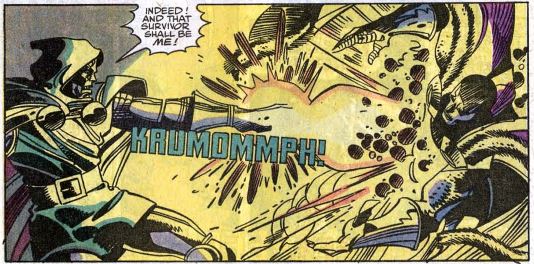
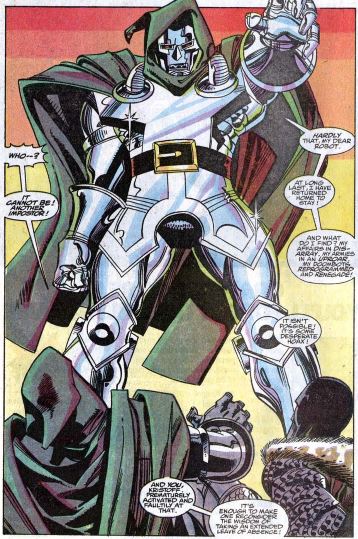
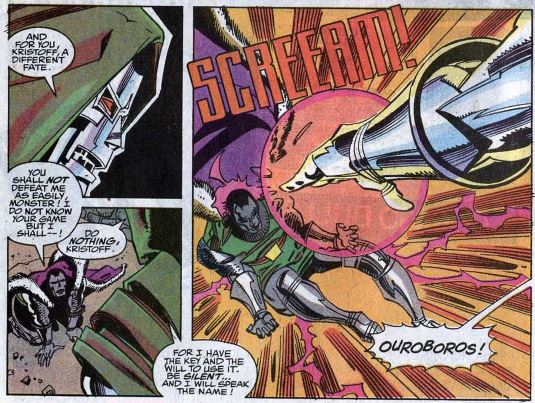
 So, Kristoff is a child brainwashed to believe he is Dr. Doom. Wearing a Dr. Doom-shaped suit of armor (!), Kristoff succeeded in taking over the Latverian throne and convincing the world he’s actually Dr. Doom. The real Doom, meanwhile, has been running around the Marvel Universe with various plots to retake his kingdom. As issue #350 begins, Doom eschews all the sneaky plots and launches a frontal attack on the Latverian castle. It’s several pages of fighting between the two of them. They’re interrupted by a third Dr. Doom, wearing a new suit of armor. This is the real Doom, the attacker is just a Doombot acting on its own. (This new armor, by the way, is made of enchanted Promethium metal, which Doom got in an issue of Excalibur just before this.)

 Doom says a code word, “Ouroboros,” which is the trigger that undoes Kristoff’s brainwashing. Doom takes off his mask and shows his scarred face to Kristoff (but not to the reader) to prove he’s the real one. Doom says he’s been far away for a long time. Now back in charge, Doom’s first action is to sit down at the computer and see what the Fantastic Four has been up to in his absence. He is surprised to learn that Johnny is married to Alicia, Ben is human again, and Sharon has joined the team as a Thing.


 You might be thinking these are continuity errors, as Doom has encountered the FF several times since the wedding, and he’s faced off Kristoff a few times without using the code word. The explanation is that Walt Simonson wrote this issue to establish that past stories of a kingdom-less Doom trying and failing to retake the throne didn’t feature the real Doom, but inferior Doombots. But Simonson leaves it up to the reader to decide which appearances were the real Dr. Doom and which were Doombots, casting doubt on every Dr. Doom appearance from at least issue #278 to the present, if not earlier. Yeesh.


 At FF headquarters, Ben has been hanging out wearing his Thing-shaped exoskeleton in the hopes of making Sharon feel more comfortable about being a Thing, now she’s developed a desire to be human again. It doesn’t work, as she feels even worse, demanding a cure from Reed. Reed says a cure might not be possible. Sharon leaves, and encounters a stranger on the street who offers her help. Intrigued, she follows him to a nearby hotel, where Dr. Doom is waiting for her. Doom offers to cure her, saying the knowledge of genetic engineering he will gain from doing so will help turn around Latveria’s economy. Sharon will not get any money, but she will be human again, so she agrees.


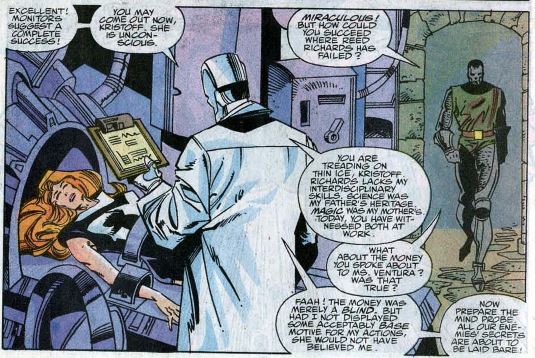
 Days pass, until Doom is ready. Using a combination of science and magic, he finally turns Sharon human again. While Sharon is unconscious, Doom explains to Kristoff (who is his sidekick now, apparently) that the money talk was false, just to ensure Sharon’s trust. At headquarters, Ben is overcome with worry about Sharon. Desperate to take action, he sneaks into Reed’s lab and steps into one of Reed’s machines in an attempt to turn himself back into the Thing. He tells the others that he did it so Sharon wouldn’t feel so alone. A robot shows up out of nowhere, inviting the FF to Castle Doom, to meet with Doom and Sharon.

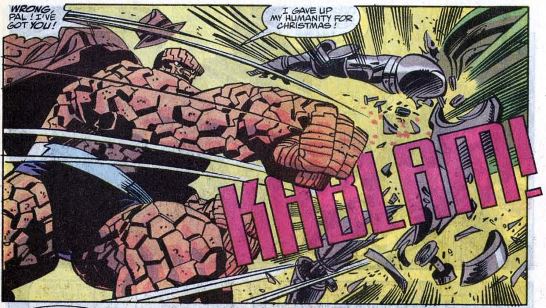
 At the castle, the FF are attacked by Doombots, and separated into four rooms, each one containing a trip designed to negate their powers. Johnny is underwater, Sue is gassed into unconsciousness, and Reed is caught a corridor with shrinking walls, giving him no room to stretch. Ben reveals that he’s the Thing again, saying “I gave up my humanity for Christmas!” which I guess establishes that this isn’t his exoskeleton.

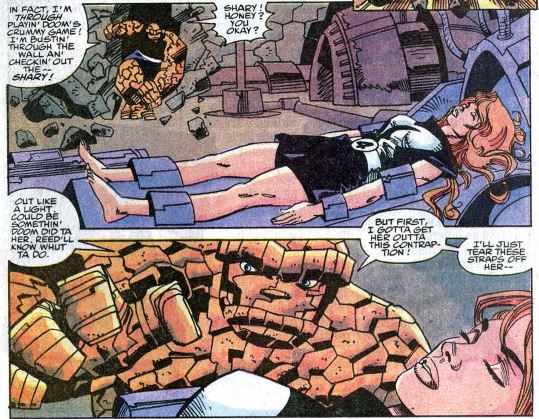
 Ben finds Sharon still asleep. He is ambushed by Dr. Doom, and there are several pages of them fighting. Ben transforms from his rocky form to his stronger spikey form, and is about to defeat Doom. Then Sharon wakes up and electrocutes Ben, so he cannot harm Doom. Doom knocks ben out. Reed shows up, having escaped his trap. Doom challenges Reed to battle, with the lives of Ben, Johnny, and Sue on the line. He produces two time machines, small enough to be worn on their belts, which will allow them to time travel “between the seconds” where they will fight. The two of them disappear outside of time, and that’s…

 To be continued!

 Unstable molecule: Reed says he escaped Doom’s sealed room thanks to “old masonry and a sharp belt buckle.” Two issues from now, we’ll learn that was a lot more to his escape than that.

 Fade out: Sue mentions that she trains “relentlessly” in the gym to be prepared for battles, which helps her against Doom’s robots.

 Clobberin’ time: Before turning back into the Thing, Ben takes a second to look at his human hands one last time, a moment of genuine sadness among all the superhero action.

 Flame on: Once again, Johnny is defeated by water, despite him having overcome that weakness several issues back. Maybe they’re drawing a difference between being wet and being fully submerged in water.

 Fantastic fifth wheel: The comic remembers that Sharon is a budding scientist, so she is able to be persuaded by Dr. Doom because she admires his science genius.

 Four and a half: In one scene, Reed performs tests on Franklin to determine what Franklin’s super-powers currently are. We’re not shown the results of those tests.

 The Alicia problem: If Dr. Doom knows that Alicia is really Lyja the Skrull in disguise, he doesn’t say so in this issue.

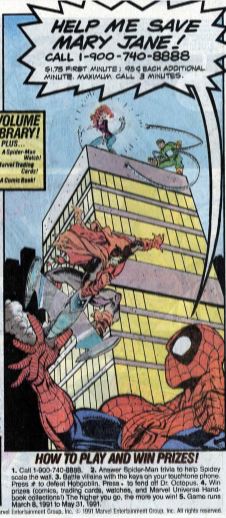
 Commercial break: I wonder who won this thing, and what it actually looked like:

 Trivia time: The “Dr. Doom was really a bunch of Doombots for the last hundred issues” thing continues to be a controversy among fans all these years later. It’ll later be addressed again as being mere propaganda on Doom’s part, but that doesn’t seem to be the intent of this issue.

 According to the Marvel Wiki, the robot who deliver’s Doom’s message to the FF is named “Message.”

 Fantastic or frightful? This issue has a lot of action and a lot of big drama, but it’s brought down by the Doombot retcon, and by how the rest of the characters other than Ben don’t seem to care at all about Sharon’s disappearance. File this one under “good, but could have been better.”

 Next: Time twisty.

****

Want more? Check out my book, CINE HIGH, now available for the Kindle and the free Kindle app.

cine-high_v3

Posted in Fantastic Friday | Leave a comment

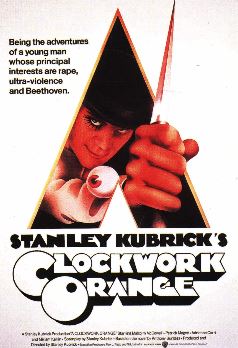
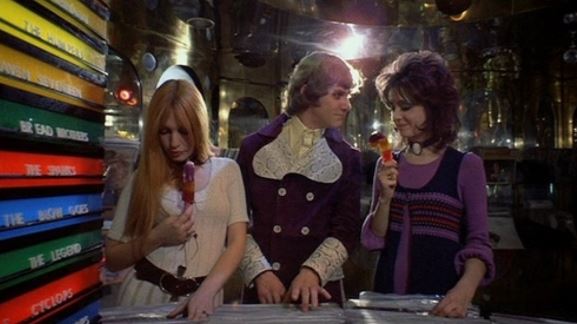
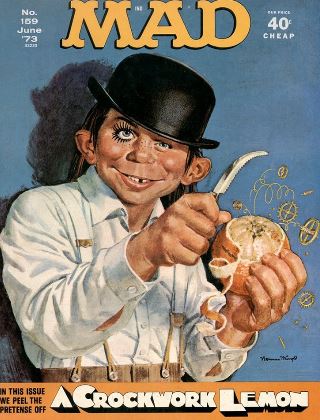
Random Warner Bros. – A Clockwork Orange

Watching all the movies on the Warner Bros. 50-movie box set that I bought for cheap. This week the random number generator can’t shut its eyes as it watches A Clockwork Orange. (Fun with math: This is the first and only time during this blog series that the random number generator chose two movies in the correct chronological order, with this one following last week’s Dirty Harry.) 

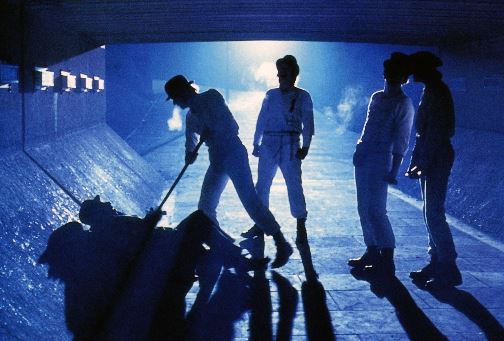
 Here’s what happens: In the future (I think?), young Alex leads a gang of “droods,” committing unthinkable acts of violence and assault every night, solely for their own amusement. When Alex is finally arrested, the government gives him a procedure meant to turn him into a perfectly non-violent citizen. But who is really controlling who?

 Why it’s famous: It’s Stanley Kubrick at his most out-there — controversial for being a sensory overload of sex and violence, while beloved for being a sensory overload of visual style and big important ideas.

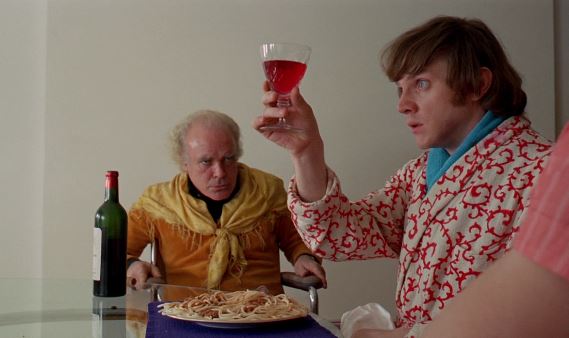
 Get your film degree: How much of the movie is science fiction and how much is pure metaphor? I cannot say. You could argue that it’s too convenient how the second half of the movie has Alex reuniting with everyone he encountered in the first half. If the movie is a metaphor, about a totalitarian state forcibly re-wiring its citizens and potentially robbing them of free will, then we need Alex to reencounter his old life to show how he has (or hasn’t?) changed.

 Movie geekishness: We all know how Kubrick likes to use classical music in place of typical film scores, but Beethoven (a.k.a. “Ludwig Van”) is practically a character in A Clockwork Orange. Alex’s love of Beethoven is a nice character detail, so that he comes off more like a real person, despite the violence he commits and the overall strangeness of the movie.

 Thoughts upon this viewing: This is a hard one to watch, but that’s by design. The intent is to provoke audiences, and leave them rattled by the time it’s over. In that sense, the movie succeeds.

 Next: All about the Benjamin.

****

Want more? Check out my book, CINE HIGH, now available for the Kindle and the free Kindle app.
cine-high_v3

Posted in Random Warner Bros. | Leave a comment